
Considering that so many people use Facebook as a means for running discussions, it's interesting to think about how when the subject of conversation is "Facebook" and what it represents, we can perhaps be led beyond concrete topics such as social networking, the internet, tagging photos and the like, and into the abstract philosophical realm of human identity in the new millennium, involving our own essential human natures and its possible plasticity, love and sex, venality and animosity, and the colossal impact of evolving technology which gradually encapsulates our human-ness. Facebook is then about much more than Facebook; Facebook is a new entity, a concept signifying something immensely important, directly related to and working in conjunction with "the cause our souls" as flesh and blood creatures of Nature. It goes far beyond its basic function, its utility.

 Much has been made about how David Fincher and Aaron Sorkin's The Social Network, a motion picture dramatizing the true-life events surrounding the inception, construction, and turmoils of the thriving online networking site Facebook, is an “era-defining” film, a true zeitgeist story about the modern age and how cyberspace has become ubiquitous. This is a film that works because it goes beyond the contours of true-life dramatization, the concrete details of the how and the what and the why, and is more intent on seeking how the post-human age it documents is weirdly alien to our own sense of the present. The Social Network is not merely a true life reflection, but is the grand fulfillment of Information Age Cinema, a genre born out of science fiction that became of increasing importance with the development of cyberpunk literature and films like Blade Runner in the 1980s, in addition to the works of philosophers like Marshall McLuhan, Jean Baudrillard, and Paul Virilio. It has accelerated to reflect the constant change of technological gadgets and media networks in the 1990s, as the world was becoming increasingly photographed, digitized, and stored on file. Human beings are becoming more like cyborgs, their brains adapting to and becoming dependent on the technologies nursing them from infancy and medicating them through life: as Fassbinder titled it in his own 1970s dystopian prediction, the world is on a wire.
 This is a literary/cinematic perspective that is fascinated with the brave new world of compressed geography and time, just as it is weary of the increasing dependence on gadgets and cyberspace, which work to reduce the development of a reflective identity and ability to think abstractly. It is a consequently Romantic genre, where Nature and raw base emotions are struggling with the unceasing rate of change that grays the world with monitors, lasers, replicated digitized codes, and mass consumption. In my own criticism it has been a primary focus, as the filmmakers who have abounded and thrived around it may be creating out of either deliberateness, or an unconscious reflection of the real world. But the motifs are recurring enough that they may warrant more than the title of Interpretive Fallacy on my part. Because Facebook has become an abstraction, so too can its story, in the hands of perceptive artists like Fincher and Sorkin, become poetic, extending far beyond docudrama.

 The world of The Social Network is a world moving too fast into the new frontier, the Internet. In the 1980s, William Gibson's Neuromancer invented the term "cyberspace" as the domain of addicted individuals in a mid-21st century where the apocalypse never got around to happening; by the 21st century, Gibson's novels had their setting shifted away from the Future and into the present, specifically the years before the books were published. "The Future is Now," Gibson has stated. It’s just not evenly distributed. As technology provokes most social and cultural change, because of things like the Internet, it could be argued that any serious work of art that seeks to deal with the present human condition is, oddly enough, science fiction. The terrain of H.G. Wells, George Orwell, or Aldous Huxley, brave new worlds or panoptical dystopias, where we have become roboticized and wired, is not unlike the Kingdom of Heaven described in the Gnostic Gospel of Thomas: it is right before us and men do not see it. The Social Network, and what more Mark Zuckerberg (Jesse Eisenberg), is as stirring and direct a meditation on the Post Human condition of a contemporary science fiction landscape as has ever been made. As played by Eisenberg, Zuckerberg is such a haunting cinematic creation because he is something other than human. With his hard stare, puckered-in lower lip, and laser-like recitations of dialogue, Zuckerberg in this film (as distinct from real life) is an odd mixture of Jay Gatsby and the HAL-9000 computer from Kubrick's 2001: A Space Odyssey, given a human body and speech upgrade, costumed with "a hoodie and fuck-you flip flops." And like Kubrick's HAL, when his steely veneer is betrayed by his insecurities – paradoxically all too human insecurities – he is driven to not only combat but to terminate his competition and expand his power. The heart of the whole film, its themes and exhortations, is contained in its opening scene.
 You do not have to be a lazy, uncritical, lethargic, unprepared, and popcorn-fisted moviegoer to feel left behind by the dazzling blink-and-you-miss-it speed of The Social Network's blurry opening scene, where the words fly so fast that the construction of the scenario on the viewer's interpretive part may be necessarily incomplete. Set in a Harvard bar, The Thirsty Scholar, with the background beats of The White Stripes' Elephant album placing us directly in the autumn of 2003, this opening would seem to be a simple enough exchange between two students on a date, trying to figure out their lives, culminating in the girl dumping the guy. But the guy talks so fast, arranging so many concepts as his words fly like bullets, that we, like the girl, fall behind him and want him to slow down and clear things up. It's even more maddening considering that the speed of his speech is an insult to the viewer's intelligence quotient, our ability to retain a plethora of information. He is, after all, discussing intelligence.
 This is masterful filmmaking, containing an excellence that will be replicated over the subsequent two hours just as it has the kernels for ideas that will be further dealt with over the course of time. It's quite extraordinary, not only how it's written as an exchange of fast, witty dialogue, but how it resonates with the viewer forced to hurry his mind to keep up. Within this opening discussion between Zuckerberg and his soon-to-be-ex-girlfriend Erica Albright (Rooney Mara), the backbeat of their stammering words reveals the heart of the entire movie. Fincher claims to have executed 99 takes of the scene, which does not only testify to his already notorious perfectionism, but also implies the scene's crucial importance in the anatomical structure of The Social Network as a whole.

 The question that opens the scene is, "How do you distinguish yourself in an environment where everyone else is a genius?" Again, the setting is Harvard, the most elite of American schools, and yet to further warp a mid-American viewer's mind, Zuckerberg has the challenging anxiety of realizing that he still does not amount to something distinct unless he is able to make his mark in the exclusive pools of an already very exclusive East Coast Ivy League environment. Even the success and money that being a smart Harvard graduate promises doesn't compare to the "Coolness" quotient. Zuckerberg voices to Erica his goal to get into the best clubs and best inner circles of Harvard, along with his afterthought of how he's going to take her, the girl he's dating, with him, introducing her to the best people. But he becomes defensive when she asks him, "What's the easiest one to get into?" This is an insult to him being that it indicates he could only possibly get into the "easiest" exclusive club. He's more strangely alert when she insinuates that she is, in general, attracted to men who "row crew," athletes who seem to easily be in such clubs. She insists that it's harmless. Such attraction is general, the same way that women find cowboys attractive.
 "You always say two things at once," she tells him, complaining that she can't decide which thing to focus on. "Dating you is like dating a stairmaster." This is a stinging piece of dialogue, being that Zuckerberg is being compared to a machine, and indeed Eisenberg's performance, again, reinforces this notion. He has a deliberate affectation to his speech and his posture that is not natural. It feels robotic. "I'm not speaking in code," she insists while he interrogates her opinions, which he is processing in his head as affronts to his self-esteem. Mark Zuckerberg, this scene establishes immediately, is a post-human individual, but he's also very class and gender conscious. The circumscriptions of his own being, as a geek with a beautiful girl, lead him to interpret the world around him at its most basic utility, very contrary to the humanistic Erica. As Zuckerberg notes, the only reason the two of them can slip into The Thirsty Scholar and drink is "because you slept with the door guy." It's not an insult to her that Zuckerberg is making, as if to say that Erica's a slut. Rather it’s the logic: it would only make sense to him that the relationship dynamics that would lead a doorman to allow a beautiful girl and her date into a bar is that sexual exchange is involved. Zuckerberg, as we will learn, is not foolish for thinking this. The Social Network has a very Freudian attitude about human beings, in how they approach other humans, and how they approach technology. The root, beneath every form of action, every piece of functionality, is sexual. "I didn't sleep with him," angrily snaps Erica. "He's a friend. His name is Bob." The counter humanistic position of nuance, that undercuts base utility, is again assumed by Erica, where true symbolic friendships can exist – and thereby an exchange of allowing an underage friend into a bar can happen – and the elements that Zuckerberg can only see as functional bits (people involved in exchanges) have names, identities, like "Bob."
 Just after Zuckerberg lays out his plans for breaking into the exclusive world of row-crews and Finals Clubs, Erica drops a bomb on him. She tells him that they are no longer dating. "Is this real?" he asks, as if there were possibly something cryptic behind her decision. But the break-up is not a simulation. It's a sharp thorn in Mark's plans and a reminder that he may not be good enough – like a "cowboy row-crew" frat guy, physically as well as mentally blessed – in bagging a girl like Erica. He insults her intelligence and her history, talking down her Boston University education (as opposed to Harvard). She leaves him alone, pathetic, sunken, defeated, adding that it's not his geekiness that staves off women, which would justify a degree of spite. Rather, "it's because you're an asshole."
 With the rejection, the story and Zuckerberg's laser-focus determination – derided by Erica as an obsession, though he insists he's just motivated – begins. Fincher cuts to Zuckerberg leaving The Thirsty Scholar, head down in the nocturnal autumn air of a busy Tuesday college town night. The electronic programming of Trent Renzor and Atticus Ross' score, a piano's emotional chords on what sounds like a sonic bed of needles, textures the credit sequence, and Fincher's amazing deep focus high-definition digital camera lens captures the immensity of a loud city of restless youth under a purple sky, contrasting with the insular presence of Zuckerberg, heading into the Kirkland House dormitory. Inside, he pops open a Beck's, goes to his Sony Vaio laptop, and blogs his grief.


 "Erica Albright's a bitch," he spills his thoughts onto the keyboard, private matters published on the internet's hyperreal ink that instantly becomes public. He denigrates her brassiere size, and proceeds to launch into every possible weak attribute, such as is often the case with the dumped. He also mentions an idea he had, of taking digital photographs of girls and placing them next to images of farm animals, so that the two groups may be compared side by side. He resists this tempting and deliberately offensive prank, and instead hacks into the house accounts of every dormitory, constructing a website from the Harvard facebooks. He sets the photographs of the girls against each other – he calls it "Facemesh" – so that people who get access to the site can choose who is more attractive, clicking to either the right or left.


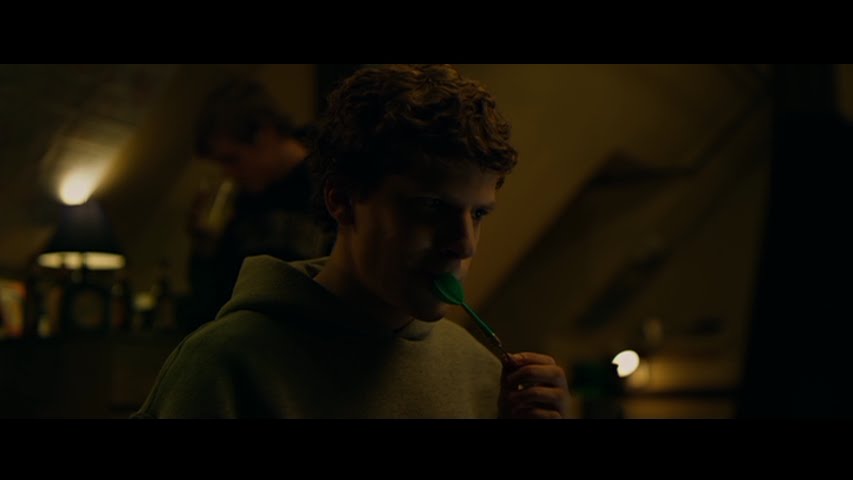 Zuckerberg's ingenuity gets ammunition from his spite, and his Geek Otherness. He's green with envy, and so his razor sharp counter offenses of contempt are symbolized by how he often seems to be holding, for no spoken reason, a green dart. This sequence, no less brilliantly executed than the opening scene, details Zuckerberg's insurgency against a world that has literally just rejected him – the world of beautiful women, who are so quick to be objectified by the successful in-groups of the Final House fraternities. Zuckerberg is so flourishing in his retaliation that he crashes Harvard's system, which lands him a six-month academic probation and instant infamy in The Harvard Crimson. He is despised as a misogynist by all the college women, rather than an ingenious and precocious troublemaker. A female classmate passes him a note – "u dick" – during a computer science class, his mindset synonymous with the worst kind of chauvinism.


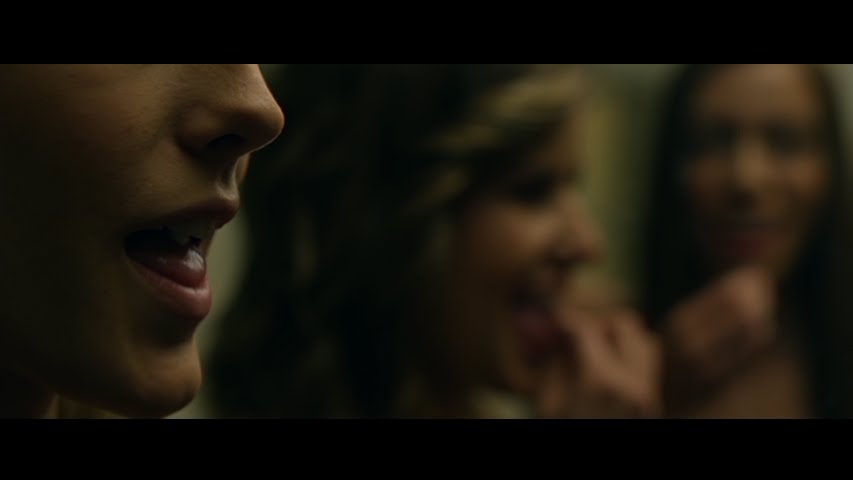
 But this sequence of events, given how Fincher constructs it, is not so simple. We pass judgment on Zuckerberg's revenge via the electronic immortality of the web, but Fincher cross-cuts Zuckerberg's hacking with the frat parties occurring at the same time. Beautiful women are bused in, lined up, and given special care as the fraternity brothers, holding positions for the oldest and most esteemed conglomerations of students at Harvard, wait eagerly to feed. The women are supplied booze, pills, and end up table-dancing in their lingerie. The surrounding men toast and salivate, like swine at a trough. These are the Beautiful People of the highly exclusive clubs, the pillars of the society from whence our leaders emerge. And because everyone seems to have a fine time at such debaucheries, though we may understand how someone may see them as decadent, we must also understand why a young man like Zuckerberg would be envious of them and eager to join with their comforts and possibilities. The film is here remarking a definite moral equivalency of the decadence in a real space, and decadence in cyberspace. One is something that happens every Friday night for all to see, and the other is covert on a computer; one has its roots in the most heralded houses at Harvard, and the other has its formula on a blog called "Zuckonit." Both are, ironically, saying the same thing as far as asserting masculinity and the objectification of women. It would seem that Mark Zuckerberg's Facemesh and his farm animals quip is perversely honest in its satire, set alongside the socially accepted behavior of the frats. Much has been made in pop cultural commentaries of The Social Network's sexism. What any careful analytical viewer realizes by examining the opening sequences is that The Social Network is hardly sexist, but is focusing on a culture that is sexist, and simultaneously blind to its sexism; just as it is classist, and not acknowledging, in the 21st century of "great progress," the immense gaps in between rich and poor. The Social Network is scathingly telling us, just as Zuckerberg is with his stunt, "You believe in progress? You think the world has changed? Think again."

 We are introduced to Mark's accomplice and best friend, Eduardo Saverin (Andrew Garfield), who interrupts Mark as he's working out Facemesh. "I heard Erica broke up with you." "How'd you know that?" "You blogged about it." Information travels fast, and not from person to person, but from screen to person. "I need you," Zuckerberg says. "I'm here for you, man," Eduardo responds with humane warmth, and whether it's a gesture of sincere friendship or simply the obligatory performance of a friend, it doesn't matter when the context is immediately undercut by Zuckerberg's response. "I need your algorithm," referring to an algorithm that will apparently allow Zuckerberg to make Facemesh work. Again, the human means nothing to Mark. Friendship is simply about utility, functionalism. That's how he processes, and he is always processing. It doesn't really make any functional sense for Eduardo to be friends with Mark. Mark uses Eduardo for money, offers no emotional warmth in return, and ultimately gets all the women on campus to hate him, and by extension, keep women away from Eduardo (what are friends for anyway?)
 Though it makes him infamous, Mark's prank does something in his favor. It gets the attention of three members of an exclusive House: Divya Narenda (Max Minghella), and the Winklevoss twins, Cameron and Tyler (both played by Armie Hammer), who are Harvard royalty, and who, we learn, row crew. The Winklevosses and Divya want to create an exclusive Harvard-only social network, and in Zuckerberg they see a programmer able to "write the code" for them, completing their idea and making it a reality. Zuckerberg asks them how this idea is different from other social networks, like Friendster and Myspace. "This is exclusive," the twins answer. And the reason for exclusivity is simple: again, it boils down to sex. Girls want to date Harvard guys. Zuckerberg says that he'll help and keep in touch. But we infer, from circumstances like Mark's possible envy of Eduardo's prospect of getting "punched" (auditioned) for the Phoenix House, or the fact that the Winklevosses can bring Mark into their house, "but not past the bike room," in addition to the legal scenes that frame the story, that Mark Zuckerberg has other plans. He puts off meeting the Winklevosses for weeks while he constructs "The Facebook" on his own, with Eduardo's financing, and thus making Eduardo Chief Financial Officer. Eduardo reflects on the brilliance of the Facebook. "In a world where social structure is everything, this was the thing."
 But Zuckerberg, green dart in hand, needs one ingredient to make it work. He is almost catatonic in his cluelessness, until one of his programmer friends, Dustin Moskovitz (Joseph Mazzello), asks if Mark knows if one of his Art History classmates is seeing anybody. Mark has his eureka moment. The Facebook, like any social network, particularly an exclusive one, is all about getting laid. The profile page is given the ingredient of "Relationship Status." The Facebook goes live, or "It's alive," so to speak in the parlance of Frankenstein and other mad scientist myths.
 And like Frankenstein, the creation brings detrimental effects with it. The Winklevosses, stunned that Zuckerberg, who had sent them cooperative emails since their first meeting, would lie to their faces (or email accounts) and steal their idea, have their lawyer send a Cease and Desist letter. Eduardo sees it ten days later, and asks why Mark never showed it to him. But Mark Zuckerberg is only capable of concrete thinking: "Because it was addressed to me." Abstractions don't matter to him, and after all, this is a wise legal defense. Ideas are ephemeral, but facts are concrete. The machine, Mark Zuckerberg, cannot believe the Winklevosses would think their idea – "Match.com for Harvard guys" – is his "The Facebook." Because the "code" is completely Mark's own. And that's all that matters to him, the concrete one-dimensional literalization of a thing. "Is any of the code in Facebook yours?" he asks them during a legal proceeding, insisting that he is the only person in the room with the intelligence to create Facebook. Zuckerberg cannot process the Winklevosses' claim: access denied, the file cannot be read or downloaded.

 Ideas and Code – the abstract versus the concrete – then becomes a pertinent issue of discussion both regarding the meaning and social presence of The Social Network. For though the movie is perhaps more metaphor than fact – like any play by Shakespeare, the Bible, or Herodotus – critics of the film dismiss it outright because of how it strays from fact (e.g., the Zuckerberg of the film is not the Zuckerberg of real life). People cannot process the movie because its ideas and metaphors – the abstract quality – are different from the code of the literal, of the Real. But the film is only too aware of this irony. For one thing, it's Kane/Rashoman-like structure, revealing conflicting viewpoints of what happened and didn't happen, implies that what we the viewer saw in the first scene was simply the sworn written testimony of Erica Albright, to which Zuckerberg says, upon being told that it was spoken by Erica under oath, "Well, I guess that's the first time in history somebody ever lied under oath." There is also a scene involving Eduardo's fraternity prospect, where the nominees must name the three lies tied to the statue of the university's founder, John Harvard: the statue says 1638, but the school was founded in 1636; Harvard didn't found the school; and the statue is not of the actual John Harvard, but of a friend of the sculptor. This is to say that the highest center of American learning acknowledges how facts intrude on the poetry of myth. Zuckerberg does have a point in his defense of how he couldn't have stolen the idea for Facebook, because the code is his; but the lumpy abstraction of the idea, in addition to the inceptory paths and lines of communication, might make it hard for an abstract thinker not to believe that Zuckerberg owes some acknowledgment to others, in addition to some money. The Social Network, like any examination of real historical personages, particularly during a televisual internet era when everything is recorded, dwells in the abstract realm of ideas more than concrete facts, as it should. This is how human consciousness, at its best, works. As shared, metaphorical, and empathetic, as opposed to the linear, sociopathic, one dimensional brilliance of a machine, which some scientists tell us the internet is molding our minds to follow, thus compromising the depth of our familiar human identity.
 The haunting science fiction quality of the significance of Facebook is revealed during his second scene with Erica. His success with the Facebook encourages a couple of fellow undergrads to approach Eduardo during a Bill Gates lecture. The girls take Mark and Eduardo into a bar restroom for sexual activity. Fincher gives the whole moment Eduardo's subjectivity, but disallows any audience identification with Mark, whom we hear, quite creepily, laugh as we see his pants fall from a floor-level angle. Eduardo too seems to be unnerved by the sexuality of his friend, because, after all, Zuckerberg is strangely sexless, just as he seems rootless (the only mention of family is in an email the Winklevosses read, where Mark says he can't see them because his parents are visiting, though this is surely a lie).
 With his Asian American groupies nearby, Mark is struck then when he sees Erica sitting in happy company with her friends at the bar. He approaches and wants to talk to her, alone, privately. But she rebuffs him, rejecting him again, saying that it would be "rude" for her to leave her friends. She calls him out on comparing women to farm animals, on denigrating her physical appearance, on the sexism of Facemesh, and adds that the Internet is not written in pencil, "but in ink." He tries to explain himself, and maybe he would if they could speak privately. Maybe his new success at Harvard, he feels, has earned him the trophy of Erica Albright. Or maybe he sincerely wants to apologize. But she refuses, and tells him dismissively, "Good luck with your video game," insulting his entire class of character, once again so as to differentiate his geekiness from the Cowboy Row-Crew crowd of physically fit men that typically capture women’s interest.
Eduardo, the humanist, believes that Mark has apologized and pats him on the back. But Zuckerberg, like so many science fiction villains of moviedom's past, determinedly looks away and says, "We need to expand!" He marches out. The Entity, the Facebook, grows, moving out of Harvard and to other East Coast schools, but also to one school on the West Coast. The reason is to get the attention of another neuromancing online genius, Sean Parker (Justin Timberlake), creator of Napster.
We first see Parker waking up after what must have been an unequivocally agreeable evening, as a girl whom he barely knows climbs off of him and heads to the bathroom in skimpy tight boy-shorts. She turns around to playfully accost him – he probably doesn't even remember her name, for instance. On the contrary, he does, as well as details about her family and education. She asks about his major and occupation, but he answers that he doesn't have one – he's not even a student. He's a "broke entrepreneur," which she interprets as "unemployed." "No, I'm an entrepreneur." "In what?" He tells her that he created a free music download website. "You mean like Napster?" "I mean exactly like Napster." "What do you mean exactly like Napster?" "I created Napster." "Sean Parker?"
 Indeed, he is Sean Parker, infamous hacker extraordinaire, creator of Napster, the free music download website that was so immensely popular at the turn of the new millennium that it changed the music business, driving it further towards digitalization in addition to, Parker adds, leading to his being sued by every artist who ever attended the Grammys, a line wryly delivered by Timberlake, being that he was exactly the kind of industry pop star that was in opposition to Napster (his then-girlfriend Britney Spears was one of the loudest opponents). Parker resigned from fighting the companies and is broke, but as evidenced by his behavior and the way those around him still hold him in veneration, he still holds large capital in Coolness. His introductory scene continues the sexist stance towards women in the film, with a slight twist. Though the attitude of the girl, Amy, is that she is the one who has been objectified by Parker, it turns out that she's the one who doesn't know his name, or anything about him, and upon learning who he is, she says, "I slept with Sean Parker?" as if she has bagged her own trophy for the evening. Such an attitude mirrors the girls eager to get into the Harvard parties, and is why Zuckerberg, automaton processor of human emotions and desires, believes that Erica would be warmed to hear that he would bring her with him to the exclusive parties once he got in them.
Parker discovers "the Facebook" on Amy's laptop, and immediately sees something of which he wants a piece. He meets with Mark and Eduardo, accompanied by their girlfriends (who seem to be already friendly with Parker), at a fancy New York City restaurant, where he charms them with drinks and wit. They discuss the future of the Facebook, namely whether Mark should allow advertisers on the site yet, which Eduardo wants because of the profit.
 But advertising, Parker tells them, isn't cool. But the Facebook is. And the Facebook is growing. "A million dollars isn't cool," Parker says. What is cool is a billion. He knows the evolution of Cool, and how it pays off in the long run, just as he manipulates his own Coolness to tap dance on top of the energy of the forecasted brave new world of the 21st century, broke but still able to buy rounds of Appletinis for underage coeds, winking at the Help while doing it. He also knows that more people will embrace the alternative digital avatars of a hyperlife and step onto the stage of the great public domain of the Facebook. "Private behavior is part of a time gone by," he soothsays to his disciples. He then adds the most important advice Zuckerberg will get. "Drop the 'the.' Just 'Facebook'."
 Mark next encounters Parker in California. Zuckerberg is spending the summer in a house rented by Eduardo, building Facebook with Dustin Moskowitz and other interns. Parker takes Zuckerberg to a loud electronic music dance club where they sit on a balcony overlooking the frenzy of an enthralled and gyrating dance floor. This is another magnificently conceived scene, as Fincher consciously chooses not to hush the volume of the electronic music that swallows most of the words uttered in the dialogue between Mark and Sean. The structure of the scene acts metaphorically, reflecting the attitude of the movie, where human connectivity and the exchange of language are mostly absorbed in the growing technological noise of the Information Age. But we can make out enough to understand what is happening: Mark asks about Parker's familiar looking date. Parker begins a story about the founding of Victoria's Secret, which began because a man wanted to buy lingerie for his wife, but was embarrassed to go into a department store. A small catalog company, Victoria's Secret, was then born, and this newly successful entrepreneur sold the company off for $4 million. The name Victoria's Secret proceeded to grow into a multi-hundred million dollar industry; the founder, meanwhile, ends up jumping off a bridge. "Is that a parable?" Mark asks. "My date's a Victoria's Secret model," answers Sean, bringing the story back down to earth. "That's where you've probably seen her." Parker then says that he was driven to create Napster out of a similar motive. He desired a girl in high school, but she was dating the captain of the football team. He vowed that he would do something that would impress her, and enable him to flip the bird to all of the erstwhile successful men who had been running the universe. He immediately created Napster and changed the world, and now has everything he ever wanted. Sean then gives Mark a kind of motivational speech on how Facebook should grow, and how $1 billion is on the horizon for him. "Do you ever think about that girl?" Mark asks, as if he had been stuck on that subject throughout the whole of Sean's spiel. Parker shrugs that off as not being the point.

 But that is the point. Through this marriage of mass technology and undulating female sex objects, like pearl before swine, whether at a dance club, a Victoria's Secret online catalog, or Facebook, the movie is stating again and again that the most earth shattering and seemingly advanced public concoctions are conceived and born out of the most private longings of our nature as procreating social organisms. As romance itself is a metaphor for sex, so associatively are the sentiments of art and then ultimately the development of organizations, which seize upon and exploit these same basic longings, be it in the construction of a brassiere, or a friend request on Facebook. But what gets increasingly lost in the noise, like words in the booming fuzz of techno beats, is the poetry, the humanistic Romantic core that would make it worthwhile, the artful construction of the Lie. We also see Mark's feelings become transparent here, revelatory of how deeply affected this automaton of a character was by Erica's rejections.
 The disintegrating relationship between Eduardo and Mark is the key conflict of the film's last act, and the most pronounced irony, being that Facebook's social network is all about friendship. But they are virtual friendships, digital friendships, electronically coded instead of interpersonal. Eduardo, the human face in Facebook's hierarchy, suffers the most because Mark essentially lies to his face, as opposed to lying to an email account, like he does with the Winklevosses. As Sean and Mark build Facebook, Eduardo is neglected and kept out of the loop; he's abandoned at the airport, and his 30+% of stock shares are dwindled down to .03%, allowing new stockholders to buy in. Mark's excuse early on, as Eduardo berates him for not picking him up at the airport, is that the corporation, this Entity, Facebook, is growing. "It's moving fast, faster than we ever thought it would." Mark had just spent 36 hours coding non-stop, further reinforcing the design of his character as something more machine than human. It's the cold focus of Mark and Sean, completely without reflection yet fermented with cunning and strategy, that perhaps earns them the share of Facebook that is negated from the cautious Eduardo, whose heart, to be honest, does not seem to be as invested in the organization (though it's been fully funded thus far by his money). The employees of Facebook are all about functionalism, just as Eduardo's friendship to Mark is simply, as we remember from the beginning, about utility. Facebook's programmers are indeed forbidden to be human: "He can't hear you," Mark says of an intern. "He's coding." When Moskovitz hears the doorbell ring as he's programming, Parker tells him that he can't answer the door, "because you're coding." Eduardo is the moral human link in the apparatus, and thus must be squeezed out. He's not digital enough, mechanical enough. Even his marker of sexuality eschews the Information Age's digital binaries. His girlfriend yells at him, "Your relationship status says 'single'! Is it so you can fool around with the Silicon Valley sluts?!" He honestly never thought about changing his "Relationship Status" on his profile, because his profile isn't him, he's him, and he doesn't have to remind himself with technology that he's in a relationship. After all, in the real world, "those Silicon Valley sluts don't care what your relationship status is." He understands human behavior is more nuanced.
Y et in a digital landscape of computing, nothing is nuanced. Indeed, to print something in media means to make it fact – something understood by Zuckerberg, a misogynist "dick" because of Facemesh and The Harvard Crimson’s reporting. Similarly, the Crimson publishes a story on Eduardo, because as part of his Phoenix training he had to watch a chicken for a week, and ended up feeding the chicken cafeteria food that turned out to be chicken. He's guilty of animal cruelty in the eyes of society. "This is not good for us," Zuckerberg says. Parker too becomes a liability, and perhaps voluntarily parts company because of it (we don't know for sure, but he nevertheless still has 7% of Facebook's stock), after being busted at a celebration party with underage interns and cocaine.
 To live on the internet then means to be on public display for scrutiny. There are no private moments in the brave new world where Big Brother is not a panopticon to be feared, as in Orwell, but a television show people clamor to see and be a part of. It's the efficiencies and feel-good gadgets that perhaps then do us real harm, insinuating that Huxley and Brave New World was perhaps more on the mark than Orwell and 1984. This is where Zuckerberg's Facebook, a visual informative drug, is taking us, and it's where he has offered us "the best you that you can be," to quote the deliberately cheesy remark of Erica to Mark at the film's beginning. "The true digitalization of Real Life," as Parker calls it, is to make time a hospitable prisoner to constantly recorded occurrence – which is to say a plethora of recurrences without an original occurrence. Experiences are not to be experienced as genuine moments unto themselves, but are recorded, posted, tagged, and then ceaselessly replicated forever on the web, the very definition of hyperreality, wherein an object is a clone without an origin, like a hotel room. There will be no more actual life in Facebook Land, in the frontier of the Internet. "We lived on farms, then cities. Now we'll live on the Internet," Parker says, while readying his interns for drugs, indicating that this is indeed a narcotic, a kind of chemical escape, and possibly unhealthy, however revolutionary.
 This is the Geek's revenge on the Physical, on the Actual, akin to the Christian's revenge on Grecian or Roman culture. The physical body, of the row crew frat cowboy football captains with brawn and athletic talent, is futile. We see this during the Winklevosses' rowing competition in England, where their exertions in a too-close loss to the Dutch rowing team, seems akin to parody, the exploits of physical training amounting to, possibly, nothing. The music is appropriately a Reznor/Ross adaptation of Grieg's "In the Hall of the Mountain King" from the opera of Ibsen's Peer Gynt, where the Troll King says, "Ice to your blood."
*
 "I don't hate them. I don't hate anybody," Zuckerberg says of the Winklevosses during one of his lawsuit proceedings. "Things just didn't work out for them this once, for the first time in their lives." There's a lot of envy in that remark, regarding the Winklevoss twins as physical specimens out of Mark's league, just as they belong to a class or race out of his league (one may possibly, though it may not be worthwhile, read his offense to them as a Jew's revenge on a very Aryan-looking pair of boys). But I also believe that Zuckerberg doesn't hate them, because he does not seem capable of hate, though he may be capable of grudges, jealousy, spite, and romantic longing. He doesn't hate the Winklevosses, because he really doesn't acknowledge them as equals. He regards no one as an equal. He is, to reiterate the point, an impersonal machine. And this returns me to my introductory point that The Social Network is an important part of the Information Age Cinema genre.


 To know Information Age Cinema, we must acknowledge that like any genre, such as film noir, from which it derives many of its motifs, the movement wasn't conscious of itself necessarily while it was beginning, though the circumstances of culture have appropriately reflected on it to this point that it is perhaps now conscious of itself. The most significant literary works that anticipate the genre are the novels of William Gibson, whose Neuromancer was published in 1984. By looking at the variety of concepts in that book, repeated in subsequent Gibson books and elaborated on by other philosophers, writers, and filmmakers, we can see what we're looking for in "Information Age Cinema" as calling card motifs, and why The Social Network is perhaps the most appropriate fulfillment of a genre that was looking forward to an uncanny future when it began, and now, is reflecting into the past, telling us how the Future has already occurred. In Information Age Cinema, some of the main topics are the dichotomy between "Cyberpsace" – a term coined by Gibson in Neuromancer, representing the computer generated world of the web – and "Meatspace," or the concrete actual world comprised of atoms. Gibson describes cyberspace as "a consensual hallucination experienced daily by billions of legitimate operations, in every nation, by children being taught mathematical concepts…A graphic representation of data abstracted from banks of every computer in the human system. Unthinkable complexity." Gibson's "neuromancers" are renegade hackers able to get into the cybernetic grid and in doing so, are akin to terrorists disrupting the corrupting manipulations of huge corporations. Immediately, we can recognize people like Sean Parker and Mark Zuckerberg (or Julian Assange) as being almost precisely the kinds of characters Gibson was writing about in the 1980s, the men he forecasted. They are addicted to this brave new world, less than human and more than human, but are yet not human, and seek to disrupt the order that outcasts them.
 Another concept is the compression of Identity into the binary code, the hyperreal wavelength of cyberspace. Corporations rule in Information Age Cinema, and workers, like the interns constantly "wired in" in The Social Network, are not allowed basic human relationships and processes. Again, functionality is what determines usefulness, like Eduardo's algorithm to Mark, versus Eduardo offering warmth to a friend that's just been dumped. Facebook avatars are of course a compression of Self into the frontier of the Internet, where the best Self is molded, constructed of photos, videos, likes and dislikes.


 We are in the terrain of the cyborg, where human beings are dependent on technology in order to thrive, as opposed to simply getting their hands dirty. We are not living an analog existence, but a digital one. Cell phones are a huge motif in Information Age Cinema, as are laptops and screens (examples being The Departed, Miami Vice, and the Bourne films). The cyborg's relationship to technology allows for greater plasticity of Identity; his function is to adapt accordingly with his technology, which readjusts identity, a trait the genre appropriated from espionage stories. If someone does not function any more, they are gotten rid of. Zuckerberg does not seem to have any biological root; he exists in a kind of vacuum, as opposed to Eduardo, who is concerned of how his father will feel about him. There is a conflict between the link to the past vs. the immediate digital replication and reformation of the present, ever occuring Now. For example, one of the things preventing the Winklevosses from fighting back is that one of the twins holds an antiquated belief that being "men of Harvard" means something. But in this hollow age, it doesn't. Zuckerberg has no naval, and so no attachments. He wins in the Post-Human world.
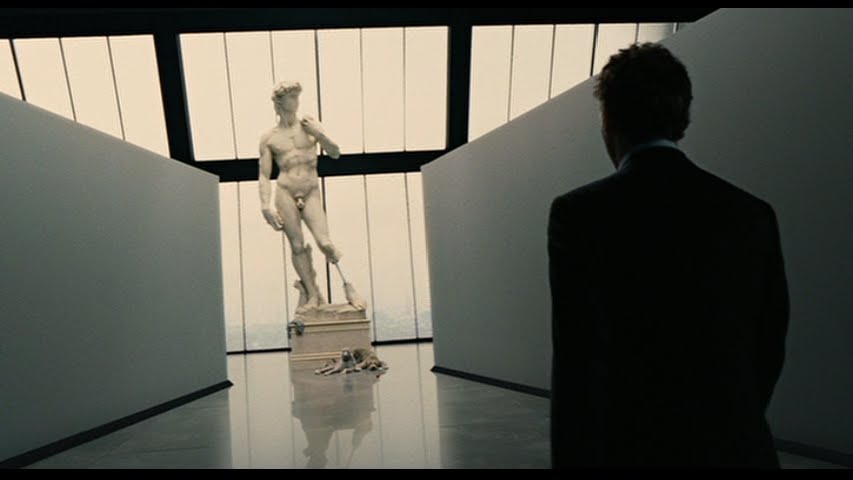
 Information Age art has the motif of Zero History (actually the title of the newest Gibson novel). In a digital era, the present is not related to the past, as the Present is always the Present, and nothing has a historical context. The legacy of Harvard, like a "336 year old doorknob to the president’s office,” means nothing. History is rewritten, re-recorded, and re-blogged every second of the day. Nothing has any depth because Time has no depth. A good example of this is in Alfonso Cuaron’s 2006 film Children of Men, where the statue of Michelangelo's David stands apart from any sense of its historical origin, and has thus lost any kind of meaning, which is the tragedy of an age when everything is cloned on a massive scale. Nothing possesses an aura. There's just the present moving into the present, into infinity at the speed of light. As the real world and real people are recorded and do not actually live anymore in meatspace, all history is futile. Nothing can be learned from this shallow history, which is the theme of this year's other great Information Age Cinema film, Roman Polanski's The Ghost Writer.

 Finally, The Social Network is conscious of itself as it is a David Fincher film, and Fincher works with digital filmmaking and is himself a gadget geek. But here one should briefly note Fincher's own ideas about the internet, which are not necessarily positive. His previous film, The Curious Case of Benjamin Button, qualified as Information Age Cinema, and anticipates The Social Network. In Benjamin Button, he begins with a blind clockmaker constructing a rail station clock that moves backwards, so that all of the parents who lost their children during the Great War can hope that time will return the dead. The film then follows Benjamin Button (Brad Pitt), born an old man who ages backwards, experiencing the whole 20th century. But with the plethora of changes, Benjamin doesn't grow and become more sophisticated. Rather, he is entropied by the experience, becoming a child who doesn't want to be touched (much like Zuckerberg, who is "not a hugger," as Parker notes), losing his memory and getting rid of family photographs in lieu of generic pictures. By 2003, the Blind Clockmaker's analog clock that reaches back in time, its hands mindful of the past and history, has been replaced by a digital clock. The rail station has been decorated with "Citizen Soldier" posters, as the Iraq War, an event that evidences a certain lack of memory among a great populace, is beginning. In filming Benjamin Button, Fincher used the best state-of-the-art technology there was, but he also deliberately sought to create sequences – such as the Blind Clockmaker prologue, or the short snippets where an old man remembers each time he was hit by lightning – in antique filmmaking styles, as if to note that he, David Fincher, will use this technology mindful of cinema's past and its development as an artistic language, something that distinguishes Benjamin Button from the scallywag CGI fast-food junk mass-produced every week by studios.

 The digital trickery of The Social Network also seems self aware; it is a digital landscape with too-perfect computer-generated breath, too-perfect computer generated snow, and even Armie Hammer's Winklevoss twins just seem too perfect to be twins; they're more like, well, sci-fi clones – which may indeed be the point. The Social Network also plays nicely against Fincher's 2007 Zodiac, his first film shot digitally (and with this picture, his other masterpiece). Zodiac is similarly about communication and we are meant to reflect, as we watch the opening credits with a mail courier going through the hallways of The San Francisco Chronicle, how much communication has changed in under 40 years.

 Benjamin Button also has roots in F. Scott Fitzgerald, its concept taken loosely from a short story, but its themes of memory, time, to say nothing of the heroine named "Daisy," indicating a certain indebtedness to The Great Gatsby (the final image of the Clockmaker, rowing out to sea, vibrantly recalls the last sentence of Fitzgerald's book). The Social Network also seems indebted, in part, to Fitzgerald and Gatsby, as Zuckerberg is kind of a warped Jay Gatsby for the Information Age, his eyes on the prize of a lost lady love that he could not earn at one time, and yet with his (possibly ill-gotten) riches he remains alone. As the Beatles song indicates at the end, he is now one of the beautiful people, and yet there is something that still keeps him apart. He's even, it could be said, rejected again, as a woman on his defense team (Rashida Jones) chooses not to take up his offer on joining him for something to eat, though she bookends Erica Albright's insult at the beginning by saying, "You're not an asshole, Mark. You're just trying so hard to be one."

 Mark Zuckerberg, Post-Human entrepreneur, one of the prime neuromancers of the New Frontier, is alone with his billions of dollars. He looks at Erica Albright's Facebook profile; she is part of his kingdom, willingly parading herself in his own Finals House, Facebook. He friend-requests her and clicks the refresh button, his eyes fixed on the object of his obsession like Kane reflecting on Rosebud, or like Michael Corleone in his isolation at the conclusion of Godfather II, each click of the refresh icon like Howard Hughes repeating "the way of the future" to himself as the blackness swallows him completely in The Aviator. In The Social Network, David Fincher and Aaron Sorkin have constructed a masterstroke fictional character from the outline of a real-life person, pushing beyond the boundaries of fact and capturing the unnerving anxieties of an age seeking to disappear from the weight of the past, rootless and yet unconsciously refreshing, caught in the looping of Now, hoping for the solace of a primal warmth.

