Search This Blog

Friday, July 2, 2010

Health Care Reform Then and Now: Francis Ford Coppola’s “The Rainmaker” (1997)


The first time I heard about "health care reform" as regards to the impossible cost of basic care – ranging from a random doctor's visit to complex treatment for a chronic condition -- was during the first part of the Clinton Administration, when Hillary Clinton's plan became infamous, having been shot down by the an ingenious media counter-offensive ("Harry and Louise") and a Democrat-controlled congress. The avalanche culminated in the "Republican Revolution" of 1994, and the ascension of Newt Gingrich's "contract with America," whatever that was. The fact of the matter was health care reform – which was code for universal health coverage – was socialism, and was ultimately putting the citizens' health in the hands of bureaucrats, and not in the hand of the "individual." Clinton softened up, became a great corporatist-centrist, the pissed-off folks voted for Nader in 2000, and George W. Bush became president. So go the days of our lives.

When I first heard that "socialized medicine" (which is really socialized insurance) didn't work, I was a Young Republican, which is another way of being a Young Contrarian uncomfortable with any status quo alignment. It was before I ever had to deal with the cost of illness and the ramifications that follow. Actually, long before, considering that my father's insurance plan handled most of it for a time – though, being a kid who didn't make a lot of money, the cost for prescription medication was still something of a burden when I had to pick it up myself.

Getting older, or really, just getting old, puts a different spin on how important health maintenance is for a person's well being, beyond physicality and into the psychological realm, and then economical, sexual, even intellectual well-being. So now in 2009 with health care reform becoming an urgent Hail Mary pass as Barack Obama hopes to get into the end-zone before congress goes on vacation in August, I do not know of anything more perplexing and nerve-jangling. The question stands: how can a developed and wealthy nation not offer health coverage to its citizens, being the walking anachronism of health – while still paying twice as much per citizen in health care while those same citizens live on-average shorter lives than the people in other countries? What in the hell is going on here? The main beneficiaries of universal health coverage are sickos with chronic conditions beyond their control, walking the jagged and shaky line where you are privy to the secret knowledge of how the body actually is the soul and soul the body, something the healthy do not understand any more than the wealthy understand what it means to be poor. These "sickos" cannot afford to be healthy; even with insurance plans offered through employment (themselves now on shaky ground), the costs are burdensome and take a thick bite out of a person's ability to preserve any firm capital base. In the end, there is a rather murky and unfortunate avalanche of after-effects. If you need constant care and maintenance on the engine of your body, lax control of that engine (which is all you can afford – kind of like getting an oil change every 12,000 miles instead of every 3,000) leads to worse problems down the road; you have discovered that time's run out in the form of your expired flesh, which has extended to an exhausted and depressed mind, and a withered will that one realizes is not exactly free, despite what the theologians say. The decay of the body that most people take for granted is visceral with the diseased individual, whose weathered self-esteem leads to less maintenance and care (e.g. you're more likely to eat like shit if you can only afford to treat your body moderately shitty), and kind of a profound sense of alienation. Everyone has a clock on them in terms of final destinations; the diseased individual, however, sees that clock, like a Cassandra. It requires an awful lot of self-delusion to keep that clock's reality at bay, but the second hand ticks loudly, constantly, unbearably.

And so looking out, he wonders, "Oh what I may have done were I only healthy." The sick seem to be burdens on the financial system, but were they healthy or had access to good health care, I believe whole heartedly that many of them would be quite successful, contributing more to the system in terms of money, activities, and ideas. Granted, they may be a less interesting group as well (as Nietzsche pointed out, the diseased man sees the whole picture; he has the key to understanding human nature – perhaps Dostoyevsky wouldn't be as interesting a writer had he not been epileptic), but bollocks to that. Prosperity in economics and health in the body are quite perpendicular, each side helping the other out.

So in this crisis of health and the unbearable cost of being healthy (if not incredible insurance premiums, then it is contracting oneself to a soulless occupation that steals away one's time for reflection and living in good faith, and binding yourself to your work as anxiety always creeps up in regards to keeping it), is it not astounding that really nothing has happened in these past 16 years? Aside from health care costs going up (I paid $254 for a doctor's visit five years ago; now it's $350), and the prices of meds going up ($85…$93…$113!...or how's about $983 for an order of "happy pills"…only $178 WITH insurance), has there been any progress?

How can we be proud of our country here, continuing to say that we live in the greatest nation on the planet? I say this because, as I pointed out, our entire well-being extends from our physical health, and that extends, I would imagine, beyond individuals and into families, communities, and social structures and functions. Goddamn, I can't tell you how much more motivated I am to exercise and eat healthy when I am healthy while simultaneously feeling stress-free. And this, my country, wouldn't even pass legislation giving federal funding for stem-cell research. Strangely enough, acting as an oblivious metaphor for the populace of the country, members of my own family voted for the figurehead responsible for this – even though the results could have been beneficial to people suffering from diabetes and Parkinson's – twice! Why? Because the said idiot figurehead was someone they wanted to "have a beer with."

The brutal truth here is that this is not the land of the free and the home of the brave; were it brave, the Democrats would grow some balls – actually, all of us would grow some balls and march on Washington, doing hunger-strikes, etc. And free? From whom are we free? Free from political power? Free from the British? Ah, but not free from economic structures, which ultimately control the political powers, and so we are after all under some hierarchal thumb. The Republicans protest having government bureaucrats running our health system, but they're peculiarly happy with wealthy businessmen running it as they do now. Insurance companies should be corporate cultures of science, but they are just corporate cultures of profit. This, as applied to disease and health, is only irrationally rational, and is capable of being the fodder for a fantastic movie satire of Strangelove caliber deadpan juiciness.

The most melancholy factor is that even if there is health care reform this summer/fall, I can't help but feel that it's too little and too late. It is a little over-the-top to feel sorry for oneself in this instance, in a country with a silent history of injustices. But the plight of the uninsured in this current system can only be called "unjust." When you look at our health care system, here in "the greatest nation on earth" that young men and women are dying for overseas, and then when compared to those other developed nations it can't help but make one a little sick, and amazed at how – again – America seems to always be late in dealing with crises (slavery and Civil Rights; the two World Wars; the absurdity of Vietnam; AIDS; and coming soon, climate change) – while simultaneously being able to fine a corporation $300,000 for using profanity or flashing a boob on the airwaves. As Colonel Kurtz said, "We rain fire on people, but soldiers aren't allowed to write FUCK on their airplanes because…it's obscene!"

Which brings me to the point of interest that holds this rant together. Namely, Francis Ford Coppola's 1997 adaptation of John Grisham's The Rainmaker, which oddly may be the definitive film about the health care/insurance crisis plaguing the United States from the Clinton years to the present – odd because this is no zeitgeist movie or incredible work of art worthy of Coppola's great 1970s achievements, or even the magisterial dazzle of his eccentric work in the subsequent decade (One from the Heart; Rumble Fish; Tucker; Godfather III; Dracula). It's simply a well-made, extremely well-acted ensemble adaptation of a conventional legal fiction bestseller by a celebrity author who is hardly literary. One could say that Mario Puzo is not a great artist either, but at least The Godfather had a kind of baroque weight that was pumped into healthy circulation with the film adaptation. The Godfather films consequently said something about the times in which they were made. Strangely, The Rainmaker re-watched in 2008 and 2009 (remember, everyone had given up on health care by November 1997), seems just as political as it is entertaining. And it stands solitary as one of the only Hollywood films during the Clinton Era that I can think of directly addressing the problems of health insurance companies in conflict with working class and undereducated families; the only other ones I can think of are Warren Beatty's very good and unfortunately little-seen satire Bulworth (1998), probably a little different because of its overt politics ("Come on everybody, let me hear that dirty word: SOCIALISM!") and its target was the tired and sold-out politicians (like the Clintons) who'd given up on their ideals and the will to change things in lieu of a perpetuation of keeping the populace decidedly not roused (how else can one describe the 1996 election between Clinton and Dole?); and Michael Mann's The Insider (1999), which addresses the anxieties of maintaining health benefits, and how that may conflict with one's integrity. But The Rainmaker, being that it is conventionally populist – even very old-fashioned – loudly calls out the System and directly asks the question: How can our nation let the uninsured just die?

I was motivated to put The Rainmaker in the DVD player again recently for a variety of reasons, most pertinently because I was preparing to see the new Coppola picture, Tetro. Watching it, I cannot help but be surprised by how good it is, particularly in the company of other John Grisham adaptations. The Rainmaker was the last of the Hollywood John Grisham adaptations that began sprouting rampantly after Grisham became a publishing phenomenon in the early 1990s, beginning with The Firm, which became ubiquitous on the bookshelves of insurance salesmen, business travelers, retired schoolteachers, and slacking phone operators. Each Grisham publication was greeted quickly with the optioning of screen rights, sometimes so quickly that, in the case of The Chamber, Grisham hadn't even come close to finishing a draft of the book before Ron Howard began pre-production. The films were met with much anticipation, though each subsequent adaptation carried less box office steam than the previous effort: Sydney Pollack's competent The Firm (1993), Alan J. Pakula's all-right The Pelican Brief (1993), Joel Schumacher's (shrugs) The Client (1994), and James Foley's widely panned The Chamber (1996; the book apparently wasn't as good as Ron Howard thought it would be), which signaled the beginning of Hollywood's disinterest. The sequence ended with Schumacher's much anticipated adaptation of Grisham's first book, A Time to Kill in the summer of 1996, which, though mildly successful at the box office, is probably one of the worst movies I have ever paid to see; it is, to me, no better or different from the subsequent collaboration of Schumacher and screenwriter Akiva Goldsman, the infamous Batman and Robin (1997).

Too bad, considering that the book following The Chamber was The Rainmaker, easily Grisham's best written book (though I confess I haven't read any novel of his since), executed in humorous first-person by the protagonist Rudy Baylor. It would also be the best – and last – of the movie adaptations, preferred by Grisham himself, and perhaps the only Grisham movie to bear any kind of emotional care by its Hollywood handlers. Everyone else (Schumacher, Pollack, Pakula, Foley) seemed to be working on autopilot with their delegated jobs (as a side note, it is interesting to compare these films to Robert Altman's 1998 irony-laden film of Grisham's original screenplay, The Gingerbread Man, which actively critiques the simplistic and flawed morality of Grisham's characters, something taken for granted by his good American readers – but that's an entirely separate, albeit fascinating, discussion). It is also funny to think of a New York/San Francisco-based director of operatic event-films like Coppola to be tangling with Grisham's book, all too evidential of the filmmaker's fall from grace, particularly after his previous throwaway effort, the wretchedly embarrassing Jack (1996). At a time when film aficionados were waiting for Coppola to make his Napoleonic return with either the long-gestating Megalopolis project or a black and white 16mm adaptation of Kerouac's On the Road, a Grisham movie, particularly after A Time to Kill and Grisham's own populist simplicity exhibited in the author's loud denouncement of Oliver Stone's Natural Born Killers, was troubling and a further hindrance to the long-awaited "re-emergence" of a great artist in hiding. Unlike the other Grisham films, there were no big-name actors headlining (Matt Damon's Good Will Hunting was still a month away from release), and in a narrative without guns or sexual tension, audiences simply had a courtroom drama about insurance companies. The Rainmaker had a too-modest box office run, fizzling out quickly. Ironically, the least profitable - and final - Grisham endeavor was the only memorable one.

The handsome organ music that opens the picture instantly addresses its uniqueness as a legal drama, and as we are led into the quirky opening we see how Coppola hasn't at all lost his touch as a screenwriter (though credit must be given to frequent Coppola and Kubrick collaborator Michael Herr, who wrote the narration). Rudy Baylor (Matt Damon) will spend much of the movie ruminating on the double bind that lawyers find themselves in: they are despised, they are a nuisance, and they are deceitful, while simultaneously they are able to enact positive social change (e.g. the civil rights lawyers from the 1960s). As Rudy becomes employed by the firm of a shadowy lawyer named "Bruiser" (an excellent Mickey Rourke) and taken under the tutelage of Deck Shiffler (Danny DeVito), who has failed the bar exam six times, he learns that ambulance chasing is the most consistently lucrative way for lawyers to make money, and also the easiest byway for young lawyers to lose their ethics. When Rudy tells Deck that he didn't get out of law school to chase ambulances, Deck tells him, "Well, you better learn or you're gonna starve." Indeed, what Coppola seems to find so fascinating in The Rainmaker is the process of the "law business", and how that "business" aspect of layering becomes much more important than any kind of genuflection on the upholding of "Law."

The Rainmaker is concerned with this question: what do we think about institutions that were implemented to protect us, when these same institutions in a free-market system of profit can all too easily be corrupted and harmful? Going back to my hypothetical health care satire, we can speculate about doctors becoming doctors simply to make money, as opposed to helping and healing the sick, but what about lawyers? Bruiser's firm is not interested in the suffering victims whom they are representing in ambulance-chasing lawsuits; only the profits (one third of the final settlement) that they will reap. The Law in this story operates as a machine dictated by either very precise rules or a mastery of lawyer-speak; due process is a drawn-out and seemingly absurd process unrelated to real human dialogue and exchange. The person usually controlling the language of the dialogue is the party that can afford the best – or most distinguished – lawyers. The most fascinating thing I see in Law is how a lawyer can be identical to a post-modernist philosophy student in terms of creating or deconstructing truth simply by controlling language and contexts.

Rudy gets his feet wet by taking on a case involving the Blacks, a lower-middle class family struggling with the insurance company Great Benefit. The insurance company is denying a claim of the Blacks' dying son, whose chances of survival would be greatly increased if he had a bone marrow transplant. The motives for taking on the case are revealed from two perspectives: the humanitarian viewpoint of Rudy, and then the financial motive of Deck ("There's nothing more thrilling than nailing an insurance company.") Representing Great Benefit is an expensive team of lawyers headed by Leo Drummond (Jon Voight), eager to make a settlement with the Black family because, after all, their fees amount to more than any reasonable settlement. Drummond makes Rudy an offer of $75,000 while in chambers with a corrupt judge (Dean Stockwell) who is also in the pocket of the big corporation (his staccato cough leads Deck to whisper into Rudy's ear, "Big supporter of the tobacco lobby.")
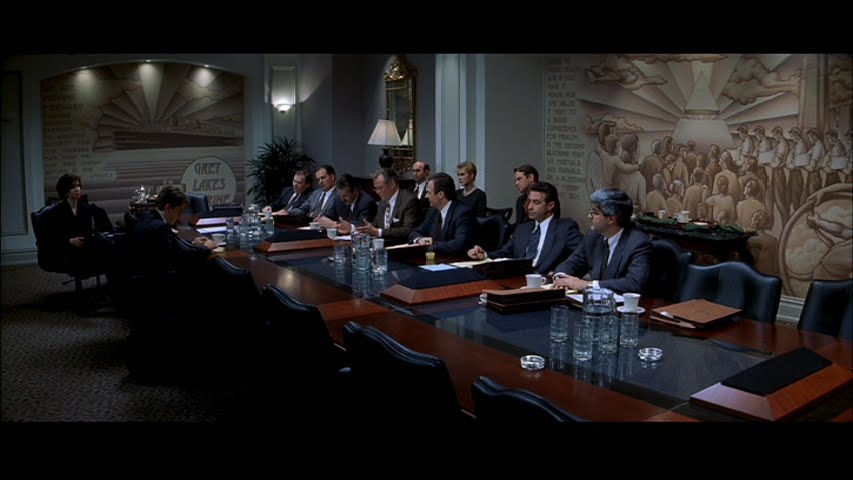
However, the mother, Dot Black (Mary Kay Place), is not going to be bought, being that any money she receives from the lawsuit will go towards cancer research. Her determination is fortuitously complemented by the corrupt judge suddenly dying, who is replaced by a black liberal, Tyrone Kipler (Danny Glover), who clearly sides with the underdog Rudy, and is not impressed by the arrogance or pretensions of Drummond and Great Benefit's estimable team. Nevertheless, Drummond and Great Benefit exercise their power by controlling witnesses. The key witness, Jackie Lemanczyck (Virginia Madsen), has been missing since her resignation from Great Benefit, and other key witnesses have been "downsized." Their absence at a preliminary meeting leads Rudy to break any social niceties and directly ask Drummond, "Do you remember the first time it was when you sold out?" Rudy's position here is indicative of an idealist populism that permeates much of the film, but it's a good question for Drummond, who seems like countless other politicians and lawyers who are happy to represent any body of persons or corporations at the cost of a link with a larger human base. Drummond calls Rudy an "arrogant puissant" in response; after all, he has generated a sense of hospitality and warmth towards Rudy up to this point, but we realize, as does Rudy, that this pleasant demeanor is precisely the "even keel" position that keeps individuals and corporations corruptible.

The victim with cancer, Donny Ray Black, dies before the trial can be finished, prompting Rudy to ask how we can allow the uninsured to die in a wealthy country with great technology and doctors. We learn that it is actually the modus operandi of Great Benefit to deny claims within its twisted yarn-ball of offices and representatives, continuously making money off of paying customers while offering no coverage in return, the executives growing wealthy while the sick perish. This is revealed by Jackie Lemanczyck, who has been found by Deck and Rudy, when she testifies and admits that she signed a letter of resignation in order to keep payoffs and benefits for herself and her own children, which like Mann's The Insider points out the twisted paradox of our private selves and our working selves: we undergo acts of bad faith to protect those dear to us. Jackie, it is revealed (to the detriment of her testimony), had been bribed by the Great Benefit executives, who would give her raises and promotions in exchange for sexual favors, a fact that the philandering executives are willing to disclose because the individual is always secondary to the protection of the capital machine.

There is little mystery to the conclusion of the film, though it remains very satisfying, as Great Benefit is ordered to pay off $50 million to the Black family after it is revealed that the company's CEO (Roy Scheider) cannot list off a single moment when his company has actually paid off on a claim. Rudy and Deck are triumphant, though Great Benefit files for bankruptcy before they can deliver a single penny of their debt to the Blacks. "Great Benefit's like a bad slot machine - it never pays off!" Deck jokes in frustration, then adds, "We should have taken the $75,000," indicating that he's learned nothing about the difference of a capital statement versus a symbolic one. "It's all gotten twisted - this whole law profession," he admits, descending the stairs and leaving Rudy, who cannot help but agree. The Rainmaker concludes on an ambiguous note, again distinct from other Grisham films, as Rudy admits that he probably will not be able to go on practicing law and will instead teach it. The law in practice will never be as commendable as law in theory, which is a melancholy realization. Were Rudy to continue practicing, he admits that it may only be a matter of time before he is like Leo Drummond or Bruiser Stone, "another shark in the dirty water."

These rather murky final moments help elevate the picture above formulaic popular legal drama, though it remains nothing too extraordinary. The film's sentimentality is at times too distracting to seem genuine, and a romantic subplot involving Rudy's budding relationship with a battered wife (Claire Danes) is hackneyed and tired. But The Rainmaker is a fine portrait of corporate corruption and the absurdity of law in a for-profit late capitalist economy. Coppola is going beyond the implicit corruption of the law profession and speaking about all professions of protection and safety. What does it mean if the Chief Executive Officer of a health insurance company does not care anything for the health of citizens? These same companies and executive personages, who would stop at nothing to kill the wide ranging changes made to a health care system put in effect to protect citizens in the only developed country on earth that doesn't see health care as a protective right (the same way law enforcement and fire-fighting are protective and essential institutions open to everyone)? It would be silly of me to say that The Rainmaker is one of the greatest political films ever made, better though it may be than many other high profile prestige pictures, but what strikes me as being vastly more silly is that a pop film like this was made more than ten years ago, and virtually nothing has changed regarding the problems it directly addresses.

One from the Heart: Francis Ford Coppola’s “Tetro”


To empathetically engage in Francis Ford Coppola's Tetro is to become almost uncomfortable in wake of the sheer nakedness with which the artist is giving himself to the audience. Coppola is creating with a reckless self-abandon, unsealing his true-life insecurities that have plagued him from childhood. It is the artist/creator ripping apart the safety of the façade that makes him appear "distinguished" to us, and then revealing the unbridled psychology that exists within every being but is hidden so that others may tolerate us. The traumas displayed in Tetro, a modern family story about a teenager who goes to Argentina to find his bohemian writer/brother, have been topical throughout Coppola's career, but previously they were always buffered by genre or the wider fictional canvas onto which he was creating a vision. The autobiographical sense in Tetro is unmistakable, as the patriarch of what is perhaps the most prominent and far-reaching family in American cinema comes clean at long last.

Not that the melodrama of this film is completely fact. But the story certainly correlates to emotional truisms deeply felt by Francis Ford Coppola, perhaps budded during those long lonely hours as a sickly polio-afflicted youth, dreaming of fame while envying and blindly loving his older brother August, the intellectual ladies' man, both boys living under the eye of a very proud and egotistical father, the composer/conductor Carmine Coppola – who may have been resentful of the eventual notoriety his children achieved. No character in Tetro is necessarily a concrete stand-in for a real-life Coppola; rather they are more possibly amalgamations of a few of them, all of the Coppolas finding multiple faces in the myriad of characters. For example, Tetro (Vincent Gallo), has changed his name, not wanting anything to do with his biological family, something that makes one think of Francis’s nephew, the movie megastar Nicolas Cage. But Tetro is also certainly August, the admired artist held in awe by his younger brother, and is also Francis. Tetro has put his talent on hold, fearful to express what he has written, while in the meantime he works in theatre as a talented lighting-man – a professional hack. Tetro’s insecurity is like Coppola's, who is admitting his frustration with his critics. His victory is to finally come forward with his creation, not caring what anyone thinks and not looking for awards. It is easy to nitpick and criticize Coppola's recent independent work for their flaws, whether here in Tetro and in 2007's Youth Without Youth, about an old man who becomes young again, much like the director’s new method. But the flaws in these two films are different from the flaws in his previous features. He just doesn't seem to care, and if he falters it is because he is playing with the reckless passion of a man who understands that he is running out of time.

Artists are very selfish, egotistical people, sublimating their overactive psychology onto a world full of people who cannot ever fully understand them. And so the artist continues again and again, the true meaning of his words hidden between the lines and layers. He wants to reveal the bile of his existence, but must mask it poetically, in effect keeping everyone – including himself – safe. They are jealous of their thoughts which they desire to have seen and touched, but must refrain at the last moment, pulling them away, hiding again in the lukewarm safety of artifice. The boundaries and costumes of civilization are there for a purpose, and what an uninhabitable world it would be if we all took off our well-groomed visages and openly expressed ourselves. Poetry slams tell us this (I guess blogs do too…), and some Friday night "beat" coffeehouses make sessions of artistic expression full-bodied red-faced cringe exhibitions.

Yet what the hypothetical artist / neurotic displays is not unique to his own nature. The mind is mysterious, and our dark places are more universal than we’d care to acknowledge. With Blue Velvet in 1986, many therapists who viewed the picture believed that David Lynch had to have been sexually traumatized as a child – which he wasn't, at least in the sense that we commonly define sexual trauma; he hadn't even read anything dealing explicitly with psychoanalysis. The brutal truth of Blue Velvet is that it's a vision that encompasses universal psychosexual problems that plague us unconsciously. All men and women have a Frank Booth and Dorothy Vallens in them somewhere, just as they have a Jeffrey Beaumont and Sandy Williams (or even the enigmatic Dean Stockwell character, Ben). Lynch simply dug these images and feelings up within himself and had the bravery to put them on display.

I wonder if I would admire Tetro so much if I was not as aware of the director's own past and relationships. Coppola was the subject of the first film biography I ever read (Peter Cowie's Coppola, first published in 1990, then revised for paperback in 1994), in addition to being the main focus of the first film documentaries I watched in the early 1990s (The Godfather Family and the excellent Hearts of Darkness: A Filmmaker's Apocalypse), and finally he would be the first director that I would analytically study. He was the topic of an eighth grade biography presentation for my English class, and the following summer I would be introduced to serious film criticism by reading about Coppola in Robert Kolker's first edition of A Cinema of Loneliness (the subsequent editions of Kolker's book, published in 1988 and 2000, dropped Coppola from the study, claiming that he'd lost his creativity in the late 1970s; Kolker’s book is my bible of sorts, but he’s wrong). Coppola wears his family life on his sleeve, and to watch his films is to become involved in his personal life, something never more – either genuinely or ironically – felt than in the casting of his daughter Sofia as Michael Corleone's doomed daughter Mary in The Godfather Part III. Given the abusive treatment that the press gave Sofia in the film's aftermath, whether merited or not, it is hard not to hear Mary's dying words – "Dad?" – with a grave significance, directed beyond Michael Corleone and to the real-life director/father, Francis Ford Coppola. As the filmmaker puts it, "They shot at Sofia, when they really wanted to get me." Coppola, like Michael, felt responsible for this assassination. It's the robust emotionalism that Coppola puts in a public statement like that – as found on Godfather III's invaluable DVD commentary – that is the whole sentiment, issued poetically, of Tetro. And that is uncomfortable to watch. From a smug cocktail party perspective, Tetro is pretentious family melodrama. From another, it is an incredibly moving and beautifully rendered confession showcasing the artist's naked soul.

Because Coppola's career has been so erratic, with periods of for-hire work while he tried to build a financial base for constructing his personal films, it is easy to agree with Robert Kolker and see little interpretive value in Coppola as we may find in Scorsese, Altman, or Kubrick. But given the abundance of biographical data available, we can see the personal concerns of the director throughout his body of work. The dynamics of Family, particularly conflicts between brothers, have always been pertinent to Coppola's films, beginning with his first feature Dementia 13 (1963), a Roger Corman-produced horror film set in Ireland involving brothers vying for the inheritance of a family estate (with the imagery of an axe, which ties it neatly to Tetro’s climax). The subsequent films of his early career feature characters who are trapped by the bonds of family and seek to escape from it: You're a Big Boy Now (1966), where the young virgin protagonist is trying to thrive independently and "grow up" apart from his father and doting mother; the light-hearted studio job Finian’s Rainbow (1967) has a daughter moving on from her father; The Rain People (1969), follows a young married woman who inexplicably flees from the responsibilities of a stable marriage; and of course The Godfather, where Michael Corleone insists that he is separate from the illegal and immoral business dealings of his father and the rest of his family. Though an acquired for-hire project, The Godfather documents the key tragic paradox in many Coppola films: one must retain a link to family in order to be "a real man," while at the same time, to be nothing but loyal to family is self-destructive, as Michael's vow to "be with" his father results in the imperilment of his soul. At the conclusion of The Godfather, by ordering the death of his brother-in-law Carlo, and more dramatically in The Godfather Part II, when he orders the death of his biological brother Fredo, Michael is destroying his family by acting to protect it.

It is in Godfather II where Coppola's most personal traumas emerge, though he is safely hidden by the period and source material. The relationship between the two surviving Corleone brothers, Michael (Al Pacino) and Fredo (John Cazale), is very poignant. One is powerful, the other is weak. One is feared, the other is vulnerable. One is malevolently silent, while the other speaks too much and is too loud. One seems content, while the other lusts for the power denied him. Overlooking their painful conflict is the memory and insurmountable power of their absent father, Vito (Marlon Brando in the first film; Robert De Niro in Godfather II), a haunting ghost for both sons unable to grasp his calm and grace. These concerns follow Coppola through the 1980s, particularly with both S.E. Hinton adaptations, The Outsiders (1983) and Rumble Fish (1983), The Cotton Club (1985), and of course in the ever-present echoes of Godfather III (1990).

Coppola's biography has similarities to the family men in his fiction. He adored his older brother August, who excelled in school, was extremely well-read, and was successful with girls. Young Francis was dopey and suffered from polio which kept him bed-ridden for a long time. He would keep himself company by creating puppet shows. Francis was a mediocre student, had bad skin, and did not read an entire novel until he was fourteen. And yet he wanted to be famous; he wrote his mother, Italia, a letter when he was nine: "Dear Mom – I want to be rich and famous one day. I'm scared that it will not happen." Both brothers were nomadically living in a restless household, the patriarch Carmine moving across the country in search of conducting gigs, obsessed with achieving fame and notoriety. And this father figure too had a brother, also a conductor (Anton Coppola), with whom he was destructively competitive to the point that they became estranged and refused to speak.

The Coppola family drama continued to unfurl as young Francis became the famous celebrity director of the 1970s, while August taught literature and philosophy as a university professor; the sister, Talia, achieved her own notoriety as an actress, first by acting for her brother as Connie Corleone in The Godfather, then becoming Rocky Balboa's wife Adrian in the Rocky films. Francis himself married a WASP (like Michael Corleone with Kay Adams), Eleanor, and had three children – Gian-Carlo, Roman, and Sofia – and established an estate in Napa Valley with a vineyard, seeking to become a new kind of film mogul working out of San Francisco with his company, American Zoetrope. In the late 1970s while working in the jungle on Apocalypse Now, Francis's marriage to Eleanor became strained and it almost ended as he began a relationship with an assistant (these feelings of fidelity he would explore in his next film, the infamous One from the Heart, which was to be connected to his planned four-film adaptation of Goethe's 1809 novel Elective Affinities). The problems of the marriage were documented in Eleanor's memoirs of the period, Notes, published in the early 1980s, while Francis' creative and administrative insecurities were captured by her documentary footage that would serve as a major tool in George Hickenlooper's Hearts of Darkness documentary – much to the apparent disdain of Francis (who has dubbed the film, "Watch Francis Suffer"). The decade saw Francis' financial collapse, losing his studio and latitude while becoming heavily in debt as he had to take on impersonal projects like The Cotton Club (1985). Working as a journeyman, he groomed all three of his children to follow in his footsteps, particularly Gian-Carlo, who directed full musical set-pieces in Cotton Club. This came to a dramatic halt when Gian-Carlo, himself a new father, died in a boating accident in 1987. Meanwhile, August's son Nicolas changed his last name to "Cage" before getting his own career started in his uncle's films Rumble Fish, Cotton Club, and Peggy Sue Got Married. Though he looks a Coppola in every respect, there was a schism that came between father August and son Nicolas when August's wife, the dancer Joy Vogelsang, revealed that she had an affair early in the marriage and that Nicolas may not be August's biological son. Peaks and valleys continued in the 1990s, as The Godfather Part III disappointed many and made Sofia infamous; nominated for the Academy Award of Best Song, Carmine Coppola would have a stroke and die on the very night of the Oscars because he was so agitated that he lost the award to a song performed by Madonna. Dracula's surprising box office success in 1992 saved Francis Coppola and the dreams of Zoetrope, while his winery and tourism businesses in South America became highly profitable. Nicolas Cage won an Academy Award for Leaving Las Vegas, and divided his time between popular Hollywood projects and more eccentric films. Finally, Sofia Coppola would culturally redeem herself by directing three brilliant films (The Virgin Suicides, the masterpiece Lost in Translation, and the under-appreciated Marie Antoinette), herself winning an Academy Award for screenwriting. Perhaps inspired by his daughter, Francis quit trying to become a mogul who would finance thoughtful films on a grand scale (which was to be paid for by a controversial $80 million lawsuit Coppola brought against Warner Bros after the studio derailed his heartfelt production of Pinocchio, which was to be dedicated to his dead son), and returned to his pre-Godfather roots, financing modest and personal works with funds from his wine business. The results are mixed (Youth Without Youth, a beautiful experiment, was widely panned) and triumphant (Tetro). Francis Coppola the director is like Tetro the character. They are prodigies of a movement who have estranged themselves from their origins, finally returning to where they had for so long been running; youth without youth indeed.

*

Tetro begins with images of a moth's entrancement with light, trying to assimilate with that bulb and lose itself. The image is intercut with a theatrical spotlight and the face of Tetro, whose actual name is Angelo Tetrocinni. The name is a weird portent for this personality, "tetro" being the Italian word for "gloomy," and as we observe this character early on – alone in his dark room, not wanting to be bothered, locking the whole world out just as he tries to lock himself out of the grips of his past and family – it becomes kind of a humorous tongue-in-cheek commentary (and is why Vincent Gallo is perfect).

We follow the younger brother of Tetro, Bennie (Adam Ehrenrich), who appears to be a naval officer but is really just a waiter for a docked cruise ship. He walks the lonely streets of Buenos Aires at night, searching for his brother's apartment, passing by a wavering sign that reads "Wind Sweeps the Road: You Can Not Go Back." Reaching his destination, he is greeted warmly and enthusiastically by Tetro's live-in girlfriend, clueless of his distinguished origins, Miranda (Mirabel Verdu), who admits that Tetro is not really interested in anything from the past. As Bennie prepares to sleep on the apartment couch, he takes out a letter that Tetro (or Angelo, as the letter is signed) wrote just when he left New York, which ends with the promise that Angie will come back to get Bennie so that they can have adventures together. Of course, this never came to be. Bennie weeps over the letter. His dreams were lost over the course of Angelo's absence as a brother and role model.

We meet Tetro the next morning. Though warm to Bennie, he is not at all fraternal. He wants to control the conversation and the questions that can be asked, so that the dialogue is not natural and real, but amiably complacent and safely distant ("Who wants a conversation?" he says dismissively). He avoids the realities of his absence, the fact that he has given up the family name, the truth of the imposing father (a famed composer, Carlo Tetroccini, played by Klaus Maria Brandauer), and the thing that Bennie finds most troubling, that Angelo left New York to begin a sabbatical on which he would try to develop as a writer, while then not continuing to write or publish anything, instead being content to lay around and work for the local theatre run by his friend Jose (Rodrigo De la Sirna) as a lighting technician, his own words, thoughts, emotions, etc – all of which are based on an actual historical existence – being bypassed in lieu of safely playing a professional who works for other peoples' creative fantasies, particularly the homosexual performer/playwright Abelardo (Mike Amigorena).

Bennie is introduced to Tetro's hip artist friends, but not as a brother – he's just a friend. This makes Bennie, who has adoring memories of his brother, angry. Without a family context in this relationship with Tetro, he is nothing but a bit player, an unnecessary add-on in the still-life drama of a mysterious man's existence that is heading nowhere. "Why don't you introduce me as your brother?" he asks Tetro, who responds by reminding Bennie that the younger brother is not allowed to ask such intrusive questions. Tetro has completely closed himself off from links to history. His passion is closing off his outlet for expressing passion, and that passion is rooted in the trauma of the early domestic experiences involving his relationship to his father, Carlo. Curious to learn about his enigmatic brother, Bennie snoops throughout the apartment and discovers Tetro's unfinished play. It is essentially a document detailing his relationship to the father, the dramatic loss of his soprano mother (killed in a car crash while Tetro/Angelo was driving), and his ambition to be a great artist.

In contrast to the static black and white compositions of the present story, Tetro's scripting of the past is filmed in hand-held saturated vibrant color. Carlo Tetroccini learns that his son Angelo wants to be a great writer – and a genius, no less. "There can only be one genius in a family," the father tells the son, as if the pearls of great artistry will not be shared. Earlier, we saw Carlo suggest to his own brother Alfie (also played by Klaus Maria Brandauer) that he change his last name, even though Alfie is older. What we see of the father is a something of a compassionate man, nevertheless too egocentric to share his family's legacy with anyone else. This is cruelly evident when young Tetro brings home a dancer girlfriend, whom Carlo amuses with his piano playing, and then ultimately will seduce (a blatant parallel to the question of the fidelity of August’s wife, who was a dancer).

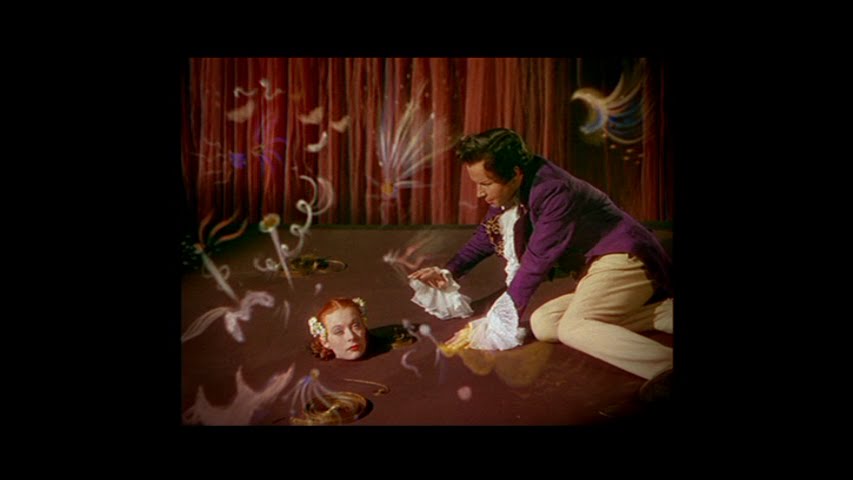
What are the father's motivations? Is it revenge, as Angelo was responsible for the mother's death? Or, even more troubling, is it because the powerful individual is seducing his son's girlfriend simply because he can? Tetro seems to believe that it's this latter reason. The sordid love triangle is expressed by Coppola in a third form of presenting his film: beautifully colorized ballet sequences that evoke the Powell and Pressburger films of the 1940s, in particular Tales of Hoffman and The Red Shoes. The girlfriend herself is presented as a manifestation of Angelo's own fears of women and love, being that the organically conventional love relationship she shares with him is replaced by her becoming a clock-work machine prone to manipulation, easily controlled by power of the wand-waving conductor-father who monopolizes his power and genius.

This kind of sacrilegious attitude towards family, where the whole group is personified in the shape of a single figurehead instead of a community of members, extends to the mystery of Tetro's relationship to Bennie. It becomes evident to us that Angelo's former girlfriend is in fact Bennie's mother, and Carlo's next wife. This is why Bennie becomes obsessed with Tetro's unfinished and cryptic play. It is not just Tetro/Angie's story, but Bennie's. The family's tumultuous past belongs to both of them. Bennie copies and finishes Tetro's play, which was written in "military school code," requiring a mirror to be read and copied and continuing Coppola's motif of reflection.

Bennie discovers more about his brother while watching a theatrical production of Fausta, a female version of the Faust story. Midway through the performance, Tetro begins taunting the writer/star Abelardo for how ludicrous the story is, obviously sublimating his own lack of creative output on a mediocre, though successful, artist who is able to do precisely what Tetro doesn't allow himself to do. Tetro's humorous interruption is broken by the arrival of a dark and distinguished looking middle-aged woman whom the artists all venerate: a great critic and writer, known by the pseudonym "Alone." Alone was Tetro's mentor until the two had a falling-out, resulting in Tetro abandonment of writing altogether. She asks the performers to continue with Fausta, which has become a highly sexual peep-show as the aged Fausta has been made young and begins to strip. The insinuation here is that the performer or artist is an exhibitionist, baring herself for the amusement and stimulation of others; this stands in contrast to the disposition of in-the-dark Tetro, who has killed his real identity: "Angelo is dead," he says to Bennie, adding that no one in Buenos Aires knows that he is the son of the famous conductor Carlo Tetroccini; much like with Stephen Dedalus in Joyce's Ulysses, history is a nightmare for Tetro.

News comes from New York that Carlo has had a stroke and is dying; he wants both of his sons by his bedside in his final hours. This is a confrontation that is unbearable for Tetro. To confront the past while making peace with it is just as troubling as facing the future, where one resides in non-being. It is very comfortable for Tetro to abide in his static existence of simply being a hack technician, rather than expose himself in front of his peers and be made vulnerable.

Tetro has warmed up to Bennie – slightly. After Bennie is injured in a motorcycle collision, Tetro visits Bennie in the hospital, bearing flowers. However, Tetro discovers what Bennie is doing with the unfinished play, which makes the older brother ferociously angry. The play is Tetro's "life," and belongs solely to him, and being that the life that it portrays is of someone who is no more ("Angelo") it is not meant to be seen by anyone. Bennie retorts that it's "his life too," and therefore it belongs to both of them. Strangely, Tetro doesn't take the manuscript back as he leaves the hospital room in a fiery rush. Deep down, he wants to story to be finished. The outcome is apparently successful, being that Alone has read the finished manuscript and has selected it to be presented as one of the finalists in a theatrical competition where the brothers and performers will be surrounded by the press and famed dignitaries of the arts.

The journey to the competition becomes a ritual of maturity for Bennie, who finds himself deflowered in a threesome with one of the play's actresses and her niece. Tetro understands what is happening to Bennie, and mysteriously disappears, bothered. Just earlier, as the group was driving past the icy mountains, Tetro found himself disappearing in the sparkling light of the sun reflecting off of the ice, much like the moth entering the flame at the film's beginning. This period, added with the weight of understanding his father's mortality, is bidding him to undergo a change and unveiling of his own new maturity. But is he suicidal? When Tetro disappears from the resort where the group is staying, Miranda and Bennie are alarmed by a car crashing. They (and the audience) are convinced that Tetro (whom has walked in front of buses before) has volitionally collided with traffic. But it is only a deer. Tetro is gone.

Bennie and the actors arrive at the theatrical competition, bathed in media light and publicity, the cameras and theatrical pundits toasting all the guests of honor with pleasantries and compliments. It is a fashionable and glitzy world, while at the same time repugnant and artificial, suggesting that this lensed and lit palace of rewards could not be more opposite from the emotions of art that are being produced and performed. In this sequence, the black and white photography added to the paparazzi-textured mise-en-scene evokes the film festival-laden worlds Fellini created in La Dolce Vita and then with a more surreal and psychological bent in 8 ½. It calls into question something that surely must have been on Coppola's mind throughout the moments of honor he received throughout the 1970s, just as surely as it must have struck Fellini: how is it that art, which is so personal, naked, and expressive, becomes aligned with the superficialities of fashion and pop punditry? I've been to a few social soirees where art is exhibited by scene elites dressed in their best as they munch off of expensive catering and champagne. Yet I find such events bizarre in how the topics of discussion are shallow, when maybe there should be deep discourse. It feels mechanical and wafer thin. It's an ironic display of an artificial aristocracy as performed by artists who are anything but starving, serving as a secure blanket that hushes any kind of profound observations or ugly truisms embedded within the art on display.

There is an impression of unpredictability during this climactic part of Tetro, as the ugly truth of an artist's reality must by necessity stand in a kind of opposing posture to the niceties of the gala event. Outside of the building where a sample of the Tetrocinni play is being performed, Tetro confronts Bennie about the truth. "How does the play end?" Tetro asks Bennie, who took it upon himself to finish the work. "The father dies," is Bennie's response. The son kills the father who betrayed and stole the girlfriend. Tetro reveals an axe and offers it to Bennie.

The catharsis that Tetro desires for his own life, and that any dramatic work demands, must here be enacted, as it is revealed that Angie is in fact Bennie's father, not Carlo. "You have to kill me," Tetro says, wanting his sibling/son to take the axe and finish it. The proposition of death is much more shocking and frightening than the revelation of the Tetrocinni family secret, given the corporeal nature of such a death and its possibility – the over-the-top exhibitions of artifice inside the festival hall, in fact, demand such a contrasting act of violence. But Bennie, shocked, flees and leaves Tetro, who is soon swarmed by cameras and microphones congratulating him on his creative accomplishment. Alone, the critic, materializes to bestow on Tetro the coveted award for the evening – but he strangely turns her down. "I don't need your approval anymore," he says, walking away. She, in retaliation, slashes her finger along her throat, signaling an end to the cameras, microphones, and electricity. Tetro, like Coppola with Tetro, is abandoning his hindering self-consciousness and safeguards, devoting himself to the truths of his life and expressions of his mind at the cost of relying on any kind of approval, which haunted him throughout his childhood with his mother and father, and throughout his career as an artist surrounded by critics. Alone's name bespeaks an artist's attitude towards the safe world of critics, being that critics are able to hermetically seal themselves off from the rest of the world and thus from any kind of outside vulnerabilities; they are fashionista insiders. The critic and the artist are thus breeds apart. Tetro must break through his own isolating wall, where he safely criticizes other artists while simultaneously creates nothing but light, the same light that he saw in headlights stealing away his mother’s life, and which have entranced him ever since.

Carlo Tetrocinni is buried, his legacy sealed in a mask and the passing on of his conductor's wand to the new patriarch, the exiled brother Alfie, who accepts it generously but with mixed feelings being that he never made peace with his brother in life (so was also the case between Carmine and Anton, the dueling Coppola musicians). The funeral is interrupted by Bennie's drunken behavior. To the entire family he exposes his roots and the dangerously megalomaniacal power of Carlo. The dead man, so honored, was never his father after all, and was in fact a traitor to the sanctity of Family.

Bennie leaves the funeral and walks into the dense oncoming traffic, where a flurry of endless lights head towards him. It is Tetro, reborn as Angelo, who comes to his rescue, following his brother/son into the traffic and grabbing him, embracing him and withholding nothing in affection. This steely rock of a gloomy individual, Tetro, then tells Bennie, "Don't look into the light. You have to close your eyes. Just don't look into the light." He affirms his position in the family, as a real individual in the chain of history, saying "You're my son. We're family," and guides Bennie back to safety.

It's this moment of final embrace, so beautifully photographed by Mihai Malaimare Jr., which for me sealed Tetro as a powerful experience. As I wrote earlier, Tetro's melodrama and lack of inhibition may easily lead some to deride it as overly self-indulgent and pretentious. Interpreting it is heady work, given that Coppola has layered the picture with such density: motifs of mirrors and light, colors, allusions, and metaphors. Very much rides on the final crescendo where the emotional melody is tightly compacted with an explosive outburst in the final image. Like The Godfather trilogy or Apocalypse Now, Coppola is not interested in realism so much as operatic expressionism where real emotions are poeticized in mythic brush-strokes. The ballets of Tetro are a metaphor for how Coppola works. All of Tetro's melancholy, density of plot and meaning, and unrestrained emotion is here at the finale when Angelo and Bennie are reunited and born again together in the inexplicable closeness of filial blood. The sheer nakedness of the moment mirrors Coppola's frankness as storyteller and confessor. Given the flaws and highly outspoken moments that have warranted this 70-year-old master filmmaker so much criticism and infamy to match and overshadow his evident genius, his sins are forgiven and entire career is affirmed. It seems that the conclusion of Tetro brings Francis Ford Coppola back to his long-abandoned origins and dreams, where for so long we have impatiently waited for his return.