
"'PhD' is a mark of academic attainment, bestowed in my case in recognition of my mastery of the antique languages of Latin and Greek. I also hold a number of other advanced degrees, including the baccalaureate from a school in Paris, France called the Sorbonne."
"'Sore bone.' Hmm. Well that fits."
– Conversation between Professor C.H. Dorr (Tom Hanks) and Marva Munson (Irma P. Hall) in the Coen brothers' 2004 remake of The Ladykillers.
 It may be something of a stretch to say that one of the deciding factors for the Coen brothers adapting Charles Portis' 1968 novel True Grit into a film in 2010 was that the antagonist in the book is named "Chaney," pronounced like the more familiar "Cheney" of the last decade, and yet I cannot help but think that the connotations to war criminality in the Bush Administration, headlined by the Vice President's amoral and unrepentant "Dark Side" mentality documented in books like Jane Mayer's The Dark Side or Barton Gellman's Cheney biography Angler: The Cheney Vice Presidency, was in some way a conscious cause in remaking a revenge fantasy. The allegory, if my interpretive fallacy is by some off-chance correct, is not central to True Grit's appreciation, but it relates to what is the central theme of the picture, namely the uneasy conflict between the actual and the abstract.
  It is not too far-fetched to think that the Coens and their actors must have had Dick Cheney in mind, reflecting on lines detailing how "Chaney shot a man" and "found himself scot-free." something that when spoken aloud in a contemporary context cannot help but allude to the infamous Dick Cheney hunting accident in 2006, when the “Vice” shot hunting companion Harry Whittington in the face. Subsequent to the incident, somehow Dick Cheney got his victim to apologize to him. The story has the kind of Strangelove-like logic connected to the larger social problem of Dick Cheney, a man probably responsible for an illegal war, and thus thousands of people that consequently died, war crimes involving torture, the outing of dissident CIA agents (the Valerie Plame affair), and the deliberate manipulation of an entire nation. Confronted after his influence had lost the public's faith and support, his responses amounted to "So?" and "Go fuck yourself."
  There were no regrets. Justification was found in the masterful handling of legalese by lawyers David Addington and John Yoo. The refuge for the Bush Administration was in the law’s language, worthy of the displacement from the reality of war as found in the musings of Jonathan Swift's Laputans. Many on the Left believed that with a Democratic administration taking over, Cheney and his ilk would get a proper judgment: the tag line of True Grit, “retribution.” Rather, the new administration’s strategy was to not rock a partisan nation's boat. The due process for a prosecution of Bush Administration war criminals was something too complicated and disruptive to get started.
 Isn't this the same problem young Mattie Ross (Hailee Steinfeld) has after finding her father has been shot by Tom Chaney (Josh Brolin), who's fled the county into Indian territory, as meanwhile officials representing the law cannot be bothered to give chase? "He might as well have walked with his horse," Mattie reflects on Chaney's flight. The Sheriff cannot be bothered to deal with it, and the U.S. Marshals have bigger fish to fry. The satisfaction of retribution cannot be fulfilled by the mechanics of due processes. "The wicked flee when none pursueth," is the opening placard of True Grit, taken from Proverbs 28:1, plugging us into the Protestant spirit of young Mattie, while also seeming to, at present, call to mind the white collar criminals off "scot free" whether in present day war politics or shady Wall Street economics.
 The correlations denoting political/history allegory probably end there, at least with references to concrete issues. The world of True Grit, set in the post-Civil War American Southwest, has the implicit divide of a shattered nation or uneasy boundaries regarding loyalties in the last great military conflict. The richness of the film, though, consistently addresses legal absurdities and specifications that seem inhumane, contrary to "grit," to the ephemeral mental nature of being human. It’s a conflict of mathematical facts versus truth. The mechanical sense of language extends beyond Law and into our social lives nowadays, as a robust physical laugh is rendered in language as LOL or ROFL. Absurdities inherent in our communication, such a wonderful recurring theme for the Coens, are then equated to the perennial theme of the Western and the Frontier, the eternal notion of the entire genre: the past and the future in conflict as Civilization tames – by defining – the wild unknown chaos of Nature.
 In the Western, this dichotomy between Civilization and Nature is displayed often as being elegiac, capturing the best of both worlds, our human ingenuity in a dependent relationship with the budding and ageless world beyond the fences. There's glory in the music of Westerns, as Manifest Destiny moves steadfastly with its flexing burliness. There's also sadness, a theme embedded in the Westerns following John Ford's morally confused The Searchers, becoming more central in the radical genre reinventions of Arthur Penn's The Left-Handed Gun and Little Big Man, Robert Altman's McCabe and Mrs. Miller, and most importantly in Sam Peckinpah's The Wild Bunch. Here you have a world passing on in a fit of melancholia, dying and despoiled as native peoples are obliterated and chivalric ideals are destroyed by more ubiquitous technologies and impersonal treaties, the Heroic Men being filtered out of time.
 Bodies and Language are two things that Joel and Ethan Coen have been splendid at playing with throughout their work, and those are the two main combatants in their Western as Civilization (Words) confronts and conquers Nature (Bodies). "What separates us from the animals, from the beasts of prey – Ethics," says Johnny Caspar (Jon Polito) in the opening scene of Miller's Crossing, however ironically given Caspar's own inability to control his temper. The scripting of "the wrestling picture," where characters utter the rather primitive notions like "I will destroy you!" is something treated weightily by the title character in Barton Fink (John Turturro), in addition to many other lofty geniuses of Faulkeresque ambition. Violence, something the Coens are known for doing so well, is often countered ironically by the way language surrounds the gruesomeness, demonstrative in the negotiations between Minnesotans like Jerry Lundegaard (William H. Macy) and seasoned kidnappers (Steve Buscemi, Peter Storemare) in Fargo, or the flowery elegance of Professor G.H. Dorr (Tom Hanks) as he plots the murder of Marva Munson (Irma P. Hall) in The Ladykillers.
 This also relates to the primitively amorous, as in Intolerable Cruelty where romance – or finding "an ass to mount" – is reducible to a piece of paper understandable only to lawyers, or the "parlance of our times" in reference to how we label the promiscuity of the trophy slut Bunny in The Big Lebowski, and finally the legal and orthodox religious discussions in A Serious Man, where Larry Gopnik (Michael Stuhlbarg) flees from the gross physical truth of his troubles (best represented by his brother’s cyst), seeking the help of rabbis. The friendly terms and stable social relationships of St. Louis Park Jews cannot save his unconscious from the truth: Sy Ableman is seriously fucking his wife.
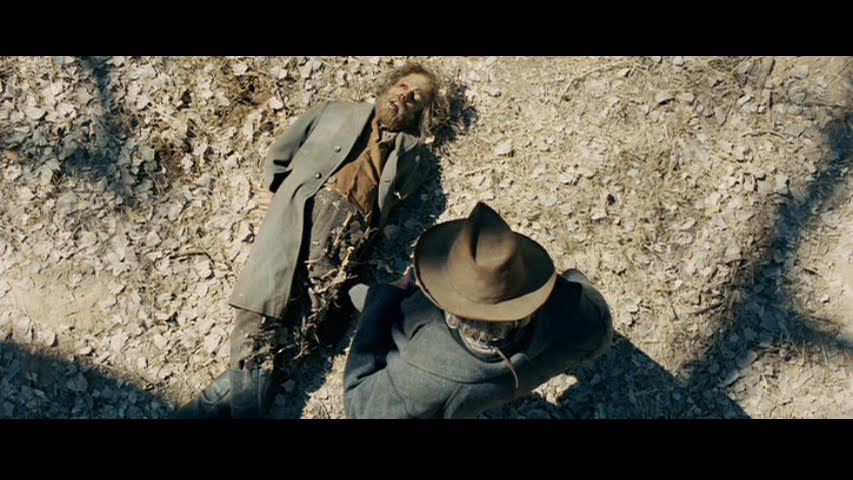 Meanwhile, the gross bodies are things to be interpreted and disposed: the discarded corpses in the woods at Miller's Crossing; Barton Fink's head in the box ("I'll show you the life of the mind!" as John Goodman's serial killer guns down his prey); the mysterious toe, the Dude's imperiled "Johnson," and the cremation and scattering of poor Donny in The Big Lebowski; the hair that "never stops growing" in The Man Who Wasn't There; the mysterious and decaying left-over remains leading to a greater story in No Country for Old Men; the plethora of physical references (anaphylactic shock, exercise, "hard bodies") versus digital communication (the "raw shit" of a computer CD, online dating, "the organs of government") in Burn After Reading; and the gurgling sounds, medical examinations, draining cysts, pulsing sci-fi brains, and most remarkably the "Goy's Teeth" with which Hashem/God speaks to us in A Serious Man. The ironic juxtaposition reaps ceaseless meaningful rewards between the primitive and the civilized in the Coen brothers' cinema, where Ulysses Everett McGill justifies his ability to lead in O Brother, Where Art Thou? by his "capability of abstract thought," while John Turturro is "turned into a toad" by sirens. The language in each case – and sometimes the silence (No Country for Old Men) – is musical in its rhythms, repetitions, and alliterations, bespeaking the absurdity of our communication in addition to the way it may often be poetic. For example, the dialogue in O Brother is ridiculous – in a delightful way – but the songs selected by T. Bone Burnett are sincere in their emotional transcendence.
The accent on communication would then be expected in True Grit, and yes, it is more central to the movie than to any kind of post-modern loving nostalgia of "the Western." But the beauty in True Grit is, well, true, just as its focus on the ridiculous quirks of how we handle language and most particularly the language of the law is also quite hilarious. And again, seeing how the Western is the genre capturing that conflict of rugged bodies and terrain versus the burgeoning Iron Horse train as Civilization heads westward, this is a fine garden for Coen themes, which they reap to maximum riches. The theme is perennial and urgent to our own legally confused present.
 My sense of seeing True Grit led me to afterwards interpret it as a kind of symphony, comprised of movements where the harmony is dictated by the haggling and negotiations between characters, much more so than the concrete "revenge story" folk melody to which we are, as viewers of the Western, so accustomed. Because it is the practice of critics in our over-televisioned age to focus on plot" many have stated that this is the most mainstream of Coen endeavors, seeing how the story covers a conventional trajectory of murder, pursuit, capture, and catharsis – this coming from the guys who took a James M. Cain scenario of 1950s infidelity, murder, and imprisonment in The Man Who Wasn't There, then somehow inserted a subplot involving UFO abduction. I'm not sure if this is not necessarily the most mainstream film the Coens have made (it's not exactly difficult to make a movie unconventional by most standards and yet still have it be "normal" when compared to other Coen scenarios), but I would argue the formal structure of True Grit is eccentric and off-the-wall in the sophisticated way that it magnificently relates to the content and bare-bones plot – the harmony in the symphonic movements capturing the "negotiations," the particulars, while the grit, the earthiness, the flesh, is secondary, even an afterthought, until the emotionally shattering conclusion. The public performance of grittiness is what we like in a Western revenge story. But while True Grit is consciously deconstructive, the Coens are smart enough to know that the revisionist Westerns of Penn and Altman are of a different tune. The song beneath the symphony, the grit, is finally real with the Coens.
The accent on the "particulars" of language, the faux elegance of civilization and its absurd idioms for communication, gives the whole affair a kind of finesse that is distinct for a Western. Entertainment Weekly critic Lisa Schwarzbaum writes, "What keeps us at arm's length, however, is the almost reflexive Coen instinct to favor controlled surface style over emotional mess and to dote on weird slapshots of violence that don't leave room to feel real horror." Schwarzbaum is completely correct, though she may be fishing for minnows while sitting on the whale, in how her one major criticism of True Grit (she otherwise likes it very much) is actually the central theme of the picture.
 The first extensive dialogue scene in True Grit lays everything out. A confrontation evocative of the Dude and Walter haggling over poor Donny's remains in The Big Lebowski, we listen to Mattie talk to the town undertaker over her father's corpse. "Why is it so much?" she asks, regarding the price for handling a body. “The quality of the casket, and of the embalming, the lifelike appearance requires time, and art. And the chemicals come dear. The particulars are in your bill.” He adds, "If you would like to kiss him, it would be all right." "Thank you, the spirit has flown," Mattie responds quickly, still focused on the business side of this transaction and not the sentimental side. The spirit is gone, leaving only the grit, the bones, the empty flesh, and docile body prettified by "art." In this primitive mortuary, we're dealing with the gross physical stuff, the excreted left-overs of civilization, coupled with those "particulars" in the bill, the abstractions translated into numbers and capital. The particulars denote something, but honestly, in and of themselves when set alongside the permanence of death, amount to nothing at all. Mattie will spend a night in the mortuary with the bodies of three hanged men as her father is taken by a black man accompanying her on behalf of her family ("Slavery" is now illegal, but in word only), and it's very significant to note how she relates the experience: "I felt like Ezekiel in the Valley of the Dry Bones." This reinforces how damned literate Mattie is when compared to everybody else; her mother, she says, has trouble spelling "cat" and so cannot be left to the business of handling her father's remains or enlisting help to capture the fugitive Chaney. In addition Mattie’s biblical knowledge shows how deeply a Protestant sentiment runs in her blood. But the allusion to Ezekiel is significant to the interpretation of the whole picture.
 The source is Ezekiel, 37: 1-14, where God (or the LORD, as he is identified at this stage in Bible) takes the prophet Ezekiel to a valley strewn with human remains – decayed to the dry bone. God tells Ezekiel, "Prophesy to these bones and say to them, 'Dry bones, hear the word of the LORD! This is what the Sovereign LORD says to these bones: I will make breath enter you, and you will come to life. I will attach tendons to you and make flesh come upon you and cover you with skin; I will put breath in you, and you will come to life. Then you will know that I am the LORD."
 The idea here is that the WORD of the LORD is the breath of life, animating dead flesh and able to make corpses live. Words give Life to flesh, which otherwise is indistinct from the earthy grit into which they decompose. By consciously inserting this observation of Mattie into their version of True Grit, the Coens build a subtext into the architecture of the work that far transcends the given contrivances of the 1969 John Wayne adaptation of Portis' book, and so elevates the whole sense of how we should approach this film as viewers of a Western. Words, the breath and wind of life, make dead bodies conscious and give them a voice. And yet the contradictions that are imbued in the debates and bargaining comprising True Grit deal with how lifeless those words may be – Storytelling vs. Facts, in legalese the latter being just as dry as the bones among which Ezekiel and Mattie sleep. We will see that any meaningful scene in the context of this Western is contingent on how a character may handle words – and then connected with words, the performance or act of words and roles.


 We see the performance of grave matters in the very next scene, where Mattie goes to a public execution to see three men hanged. The scaffold is a stage just as it is a tool of final justice. The first man repentantly cries, lamenting and dictating to his children not to fall into low company as he had. The second man keeps his poise, unapologetic, sneering as he says he killed the wrong man, and had he killed the right man, he wouldn't be in this pickle. But notice the dark hilarity of what the Coens do with the third man, an Indian (significantly named His Tongue in the Rain) who says, "Before I am hanged, I would like to say—" and is instantly silenced by the hangman who puts the obligatory bag over the native's head. This is a wry commentary on the way laws and the performance of those laws are enacted throughout the Coens' Old West, where everyone seems to be filled with "keen talk" – and yet the Native Americans are denied any dignity as individuals, precisely because they are disallowed language. We later will see Reuben 'Rooster' Cogburn (Jeff Bridges) go to a prairie oasis for information, where two young Native children sit on a porch. As he enters the store, he inexplicably abuses the children, kicking them both off the porch before he enters, like they are piles of bones to be senselessly thrown around. There are no words spoken. We also notice a young black boy who talks with Mattie as she takes her pony, which she names "Blackie." "That's a good name," the boy says. As she rides away, she tells him to thank the storekeeper on her behalf. "No, ma'am. I'm not even allowed to utter your name." African Americans, as in the case of Mattie's family chaperon at the mortuary or the young boy, are still slaves and unequal, regardless of any emancipation, because they are denied access to words. The only minority that has any clout is the one who has access to goods for bargaining and weapons of defense. We see this character, an Indian, approach Rooster and Mattie on their journey, holding a gun and apparently bearing trading goods for a dead body.
 The rhythm of business negotiation is accelerated in a fascinating scene where Mattie bargains with the horse salesman, Colonel Stonehill, who was in business with her father. Since Frank Ross' horses were stolen by Chaney when they were in the care of the Stonehill, Mattie insists that she's owed the money that her father paid for them. In addition, she demands money for returned ponies, ultimately amounting to, according her calculations, $325. The haggle hilariously moves from Stonehill refusing to give a dime to playing into Mattie's demands, as she defeats him in the art of "hypotheticals" and legal abstractions. "I do not entertain hypotheticals, the world as it is is vexing enough," Stonehill says angrily, but being that Mattie has the ammunition of a powerful lawyer back home in Dardanelle, Arkansas, he is forced to entertain the math of hypotheticals and play by the rules of legalese.
 Language in official quarters plays out next in the courtroom, when Mattie seeks out U.S. Marshall Cockburn, who comes recommended as a man with "grit" and will successfully help her find Chaney (she earlier approached him while he was in an outhouse, but with irritation he told her that he was had “prior business,” a humorous alignment of the grittiest form of dirt – pooping – and official work). The context of the hearing at hand is the prosecution of a man captured by Cockburn, whose allegedly murderous accomplices – family members – were killed by the marshal. As Rooster drawls out his words on the witness stand in response to the prosecuting attorney's questions, we notice how he seems to relay the experience like any number of old men who love to tell stories. The defense attorney is not as helpful. Being that he must defend an alleged criminal against the "hearsay" of a lawman, he undercuts the yarn-telling of Rooster with the mathematical precision of facts, particularly regarding the position of the dead bodies and how the "particulars" of forensic evidence (in this primitive pre-CSI age) contradict Rooster. The story told of how Rooster caught his quarry is very good, simply in the fashion of how Rooster tells the story, with the rhythms of his speech, sometimes unintelligible, with a hard-edged focus of a true law man. It's the stuff of, well, good movie Westerns.
But the particulars, damn it, ruin it! The defense attorney asks for a specific number of people Rooster has killed. "Twelve…fifteen," he answers. The choice is not 12 or 13, but the far more random and imprecise choice of 12 or 15. When the attorney mentions the two recent victims of Rooster, the number is revised to 23.
 The "factual" inconsistency in Rooster's handling of such bare specifics is evidentiary of how unreliable a storyteller Rooster is. The body of Rooster's victim could not possibly be where Rooster said it was, according to the back-stepping of the attorney – therefore the gritty heroism of the marshal is derided in court as "a cold blooded bushwhack." "I do not remember," Rooster says regarding the specific questions of the attorney, a line he repeats, and it's an important line. Anyone in the business of telling stories, most particularly those that are rooted in true-life memory, understands how the process of memory recall is one of artful revision, however unconscious on the part of the subject. It is simply impossible for any storyteller to relay every fact, while the motive of the teller is to convey truth. Facts and stories are two different things in True Grit. Words are words without the soul of storytelling, which necessitate a departure from facts. Rooster is conscious of this, and lets us know when Mattie introduces herself to him outside the courtroom, making her $50 proposal for Chaney's bounty. Rooster's reaction is skepticism, and he dismisses her talk as the stuff of "fairy tales and sermons," and will later deride her as the girl "with stories of El Dorado." Not until he sees the money – of which there is no better communicative tool in civilization – does he agree to her proposal.
 But even after the opening recurrences of negotiations, our Western Revenge tale is not necessarily on its way. The Coens wisely persist with the harmonic conceit of business-speak throughout the journey towards Chaney, consciously downplaying – and parodying – the notion of "grit" in these Old West characters. One stipulation of Mattie's hiring of Rooster – which might as well be contractual – is that she be allowed to go along with him on this "Coon Hunt." The next day, when she discovers that he's already gone and left her with a train ticket back to Dardanelle, she with incomparable muster pursues him on Blackie the Pony, perilously riding across a river to catch up. One of the "particulars" of this agreement is that she be allowed to come with, and if this specific element is not fulfilled, then the contract is nullified. Complicating matters is the appearance of a Texas Ranger, LeBoeuf (pronounced "LeBeef"), played by Matt Damon, and modeled by the Coens in his speech patterns on Bill Clinton, a politician's politician in terms of his aggressive mastery of language – perhaps with little "grit" to back it up.
 LeBoeuf is also set to find Chaney, because he shot a state senator – and the senator's dog – in Texas. This has led to an alliance between Rooster and LeBoeuf where they will find Chaney together, and then Rooster will allow the Ranger to take Chaney to Texas for prosecution and hanging. Mattie is, of course, apoplectic. Very fitting to the current Age of Obama, where politicians struggle to maintain poise while making deals, the conflict between the three is nearly insoluble. The problem is adhering to the particulars of a contract where money finally changes hands – the capital exchange – and also keeping a hold of one's integrity, or rather the performative frame of one's sense of self. The heavily costumed LeBoeuf with his spurs and accoutrement is identified by Mattie as a "rodeo clown," and we sense a character that is hilariously showy. Asked by Mattie why he has failed to find Chaney as of yet, Leboeuf defensively replies, "He is a crafty one" (a perfect description of our modern day Cheney). She responds, "That's his act," noting how she found Chaney to be something of a half-wit. Acting becomes an important element in True Grit, as well as a commentary on the Western genre and how we may react to the uneasy position this film finds itself in, being that it's a remake of a film that won "The Duke" his Oscar, and as such will be seen by fans of the genre as blasphemy against John Wayne.
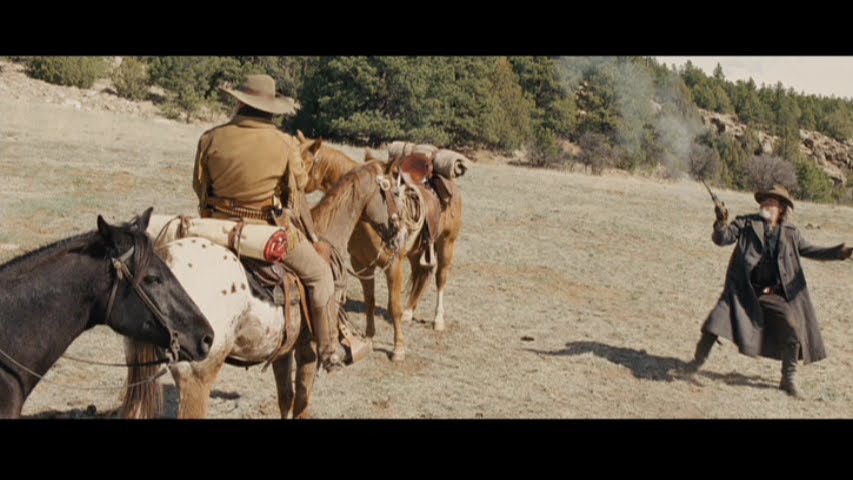 The appeal of John Wayne has much to do with the tough talk and poise of this Hollywood icon, extending beyond movies into politics and day-to-day behavior for how men should act and how women should respond to those men. Wayne won his Oscar for True Grit, but not for his acting ability. It was a lifetime achievement of sorts during a time – 1969 – when the Duke's reputation was up in the air, given the torrid politics of the time and how transparently weak and unexamined those politics were, as displayed in Wayne's 1968 pro-Vietnam propaganda, The Green Berets. Some critics and commentators think remaking John Wayne, as the Coens have done, is blasphemy. But they are not aware of how John Wayne is untouchable not because of the talent and content of whomever he was, but because Wayne is an ideology unto himself, representing a poise that so many of us wish to emulate. But that's the problem of the Western genre, if not human nature. Tough talk, posturing, style, big spurs and big guns are not necessarily reflective of the actual nature of a person or a situation. John Wayne is Rooster Cockburn, because he's a good storyteller just as he's a good bullshitter. But the character, I believe, demands the complexity of an actor's actor, being that this is consciously a story about performance, and Rooster, unlike LeBoeuf, is in on the rouse of tough guys and their talk. LeBoeuf tells campfire stories about being a Texas Ranger and having to drink out of hoof prints to stave off thirst. Rooster mocks LeBoeuf, who asks, "Do you not believe me?" "I believed it the first 25 times I heard it," Rooster answers. LeBoeuf derides Rooster's "keen tongue," and another spat of references and accomplishments begins (talk about accomplishment instead of something we can see – the grit). "This is like women talking," Rooster says, which infuriates LeBoeuf because he believes that Rooster is actively trying to make him "look small" in front of Mattie. "I think she's got you pretty well figured out," Rooster says. The parley of role-playing and performance is picked up by Mattie, who eases the argument by suggesting the three of them play "The Midnight Caller," where one of the two men are to play the "Caller" and she will tell them both what to say. At this stage in this remake of a "classic" (the 1969 film is hardly a classic), the perceptive audience member will note how well the Coens and company are jesting about the posturing featured in so many other Westerns. Later on, we'll see an absolutely absurd – and hilarious – confrontation between Cockburn and LeBoeuf as they shoot at cornbread to determine who is the more talented lawman.
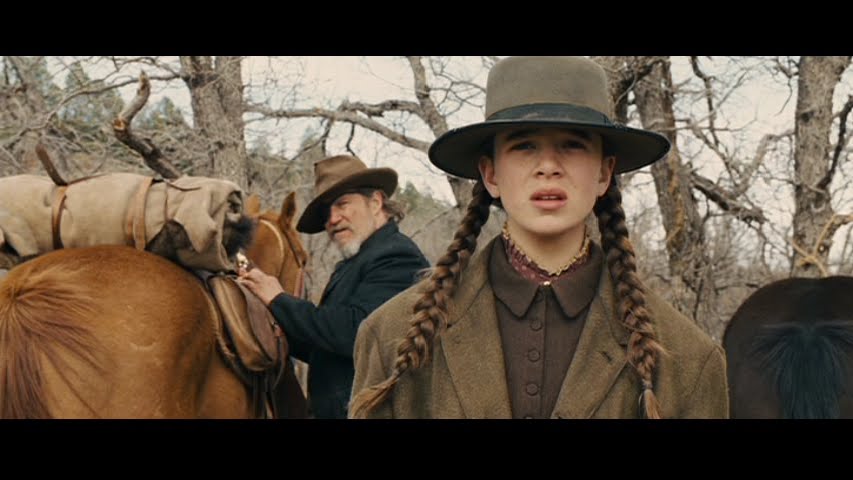 “Business talk" continues to interrupt the dynamics of revenge, as Mattie accuses Rooster of fraud if he should hand Chaney over the LeBoeuf. Even the corporeal flesh and blood punishment of the most gruesome nature – Rooster offers to flay Chaney's feet for Mattie, after which she can rub pepper in the wound – is inconsequential to the demands of the contractual language. "Are you again letting her hoo-rah all over you?" LeBoeuf says to Rooster. "Hoo-rah?" "That was the word." It's a nonsensical word, but it is amusingly appropriate in its definition of how silly contractual language can be. The spat leads to LeBoeuf ending his alliance with Rooster.
 When Mattie and Rooster go off in the woods, we notice how much Rooster seems to love telling stories about himself, though of course we can never be sure about their accuracy. Mattie may not even be listening, but on and on Rooster drawls, Jeff Bridges playing him with a vocalization not so different from Billy Bob Thornton's in Sling Blade, a choice that I believe was lovingly embraced by the Coens. Again, we note the connections between words and primal human relationships when Rooster casually talks about his estranged son, who apparently doesn't like the old man. "I did speak awful rough to him," Rooster says remorsefully, "I didn't mean anything by it." Rough talk does not denote the truth of actual emotions.

 It's funny to note the amount of times speaking – or just mouths – are referenced in True Grit. We learn that the man who was guarding Frank Ross' horse had his "teeth knocked out" by Chaney; the hanged Indian at the beginning, forbidden from speaking, is named Tongue in the Rain; early on, LeBoeuf says to Mattie in response to an insult, "A saucy line will not get you far with me," and then "You give out very little sugar in your mouth"; a man in a bear suit named Forrester, who comes upon Mattie and Rooster, claims to study dentistry, and offers to bargain the hanged man's body (acquired in a trade from the Indian Rooster and Mattie came upon earlier), though adding, "I have removed his teeth." (One of the conspicuous oddities of the dialogue in True Grit is how the characters seem to speak without contraction, as if they are vessels for the business/legal language of incessant negotiation - e.g. "I do not know this man;" "You will not do that," etc); as mentioned above, though Rooster is a story teller, he's also often hard to understand as he marble mouths his words; the well-spoken LeBoeuf nearly bites off the tip of his tongue during a skirmish with outlaws, causing him to have his own speech impediment throughout the rest of the film; when we see Tom Chaney for the first time, we notice a black mark on his cheek, indicating that his mouth has been wounded and probably has something to do with his own marble mouth; Mattie is from Yell County; Rooster’s enemy, Ned Pepper (Barry Pepper) has a scarred lip. True Grit has a lot of dismemberment – arms, fingers, tongues, teeth, and of course Cockburn's missing eye – but the mouth is the most important organ for the Coens.
 This all comes back to the meaninglessness – and paradoxical meaningfulness – of words in the Coens' universe, and as such relates to the cosmological issues in True Grit. This film is an interesting follow-up to one of the Coens' best and richest films, A Serious Man (2009), which dealt with the erratic, unpredictable, contradictory, and often cruel nature of God. Larry Gopnik is in a universe where one may do the right thing their whole lives, and then be – however unfairly – stricken with misfortune. This is the Yahweh featured in the Books of Moses, who when interpreted as a literary figure is a trickster god whose villainy seems to parallel Shakespeare's Iago and Edmund. God is something of a sadistic son of a bitch – who also speaks to us through the human body, namely teeth (the Goy's Teeth), but the significance of that communication and what the Goy's teeth mean to anybody in the day-to-day world is a baffling mystery. The world is just and unjust at the same time, like Schrödinger's cat and the Uncertainty Principle. Everything seems all right, but it's the elliptical elements that the Coens want us to note: a War in Vietnam, a war in Israel, the fact that the Jews of St. Louis Park live in a suburb of what was once the most anti-Semitic city in the nation, social unrest of the inner cities, the "new freedoms" of marijuana and casual sex, and, perhaps most significantly, Sy Ableman fucking your wife, seriously.
 The cruel and absurd conundrum of poor Professor Larry is revised in True Grit, where God is active in everything we do, but there is logic in debt and repayment akin to the negotiations that ferment the architecture of the picture. The end credit song is Iris Dement's beautiful rendition of "Leaning on the Everlasting Arms," and the rest of Carter Burwell's score uses Protestant hymns as a model. The Old Testament LORD is revised, and is not a son of a bitch, but is the benevolent “Author of all things." There is an artisan's resonance in the construction of Mattie's world and understanding of the divine, though it may not be reflective of how things actually are. Of course, upon close examination, the world of True Grit may be just as unfair and random as the worlds of A Serious Man and No Country for Old Men, when we think about how Mattie's decision to go after Tom Chaney of her own will leads to a lot of corpses, LeBoeuf and Rooster sustaining injuries, losing a favorite pet, and ultimately an arm, a maiming that may keep her unmarried and undesirable for the rest of her life (this is only speculative; LeBoeuf and the ruffian Quincy both address Mattie as being "ugly," albeit out of frustration, and Mattie's personality is not exactly conductive to any romantic sentiment). The world is chaotic and cruel, nonsensical, and unjust. But returning to the main theme here – in literature perhaps best represented by Shakespeare's The Tempest – the duty of Civilization is to label, define, and identify the chaos of unknown nature, crafting the story with an artisan's sensibility. There’s even a reference for how unwanted horses find their way to the soap factory: dead flesh and grit becomes transubstantiated as a hygiene product that makes us socially presentable.
 A central issue to the main cognitive muddle of True Grit is addressed by Mattie and LeBoeuf as they discuss the wrong-doings of Chaney, something that ties in perfectly with the accent on legalese here. LeBoeuf notes how Chaney shot the senator's dog – which he says is something that is Malum Prohibitum – and then shot the senator – which is Malum in se. Rooster, not unlike the audience, wants to know the meaning of these Latin terms. Mattie, unsurprisingly, can define them (earlier she mentioned to Stonehill how she had a “writ of replivan”). Malum Prohibitum is a term referring to something that is wrong due to it being prohibited by the "laws and mores of society," as opposed to Malum in se, which refers to an "act that is wrong in itself," violating the natural, moral, or basic principles of civilization. Prohibitum refers to something that is wrong by "statute" or legislation, a technicality (e.g. insider trading, sex with someone who is not a particular age, etc) versus the crime that is an aberration of Nature, like rape itself, murder, or robbery. This beautifully fits in with the motifs of the movie we've been witness to so far, and how we process the parleys involving revenge, bounties, and bodies used as tools for negotiation. Rooster seems to have his own opinion on the matter. After all, his testimony during the trial is put into jeopardy because of the technicalities addressed by the defense. Something "wrong in itself" is nullified by another action that is "wrong by statute," namely the irresponsible handling of a situation by law officials, akin to illegal wiretaps. Rooster also talks about how he once stole money from a bank, which outrages the law-abiding Mattie. "I never stole from a person, though," he says. "It's still wrong in itself," she retorts, and he admits, "That is about how the folks in New Mexico saw it." Rooster's not afraid to overstep statutory boundaries, but nevertheless adheres to the perennial notions of Good and Evil. Rooster's role as a Lawman makes him an interesting figure to contemplate; he bears the eye-patch, associating him with the blind eye of justice that judges accordingly, regardless of whatever nuances in a given situation; but he's only half blind, the other eye perceiving and making its own evaluative judgments of how to go about things. Of course, back to my incipient Dick Cheney allegory, does this not make Rooster more of a Cheney-esque character than Tom Chaney? After all, the pursuit of Osama Bin Laden – much like Mattie's subsequent misfortunes – will lead to perhaps an unequal amount of sorrow when compared to the initiating crime that demands punishment.

 The final act of True Grit finds Mattie unexpectedly encountering Chaney at a riverbank. His demeanor contradicts his lethal reputation. He is indeed a half-wit, a dullard and a dope, as we ask ourselves, “We’ve come all this way for this guy?” He seems to have no intention of hurting Mattie when he recognizes her, his gestures coming across as "gosh gee golly" amusement – after which she shoots him in the arm, as if to remind him of his role as genre villain. Her gun backfires as she takes aim for a second shot, and Chaney takes her hostage along with the posse of criminals with whom he rides, the 'Lucky' Ned Pepper gang. Set alongside Pepper, Chaney's feebleness is more concrete, and he is little more than a complaining mumbler: "Nothing is going my way today. This is not my week," he pitifully says. Pepper himself is vicious in his appearance, bearing ugly teeth, a maimed lip, and a horrifying scowl, making it clear that he's the real heavy of True Grit. He seems to fulfill the perimeters of the role when he puts his boot on Mattie's face and points a gun threateningly at her. But again it's all about the business negotiation, as Pepper is simply using Mattie as a bargaining tool for a final showdown with his longtime nemesis, Rooster. After this moment, Pepper seems a polite captor, offering Mattie bacon and coffee and warning Chaney to keep his hands off of her.

 To reiterate, "grit" is still something of a parody in this adventure of role players. Pepper is dangerous, but the content or tone of his conversations is not related to his lethality. Civilized human beings are still held at a distance from heroic grit, which is parodied in the Pepper gang member who only communicates by making animal sounds. There is a disparity between the politely acculturated people of civilization and raw primacy, as we may remember Forrester, a beastly figure in his bear skin, who in his handling of medical arts laments that he is only able to give medicinal treatment to "humans who are willing to sit down long enough." Beautifully as Roger Deakins' camera has hitherto captured natural landscapes in True Grit up to this climactic confrontation between the good guys and the bad guys, the conflict between Man and Nature has been kept at a tidy distance because of the movements of negotiation. The final confrontation between Rooster and Pepper's gang, one against four, is as rousing as it is troubling. The antagonism between Rooster and Pepper is mostly elliptical to the story of this film, and so this confrontation seems forced and inconsequential. But the music and depth charge of the moment as shot, scored, and edited when Rooster boldly charges to this finale (after giving, as Pepper points out, "bold talk for a fat man") is as stirring to me as any likewise moment would be in a canonical Western. It works on two levels: as a thing in itself, but then also as what I recognized as a simulation of the classical Western showdown. At the conclusion, Rooster is victorious, saved by LeBoeuf's long distance shot at Pepper after the marshal's been trapped underneath his horse. Immediately afterwards, Chaney knocks out LeBoeuf with a rock, but is killed by Mattie, who at last achieves her vengeance by blowing him off the perching cliff with LeBoeuf's rifle.

 Now, this is where the Coens' eccentricity pays off. Some viewers will dislike True Grit – or rather be confused by it – as these confrontations, as I pointed out, seem a little detached and clean. The vendettas are dealt with in a skin-deep level, and the final moment of revenge towards which the plot has been building is underwhelming and incomplete. Why should we care about what these characters are doing? But the plot is not the harmony of this symphony, only a basic melody. The formal structure of the movie has kept us away from the true grit of a genuine Western; this is the guiding idea for the way the material is handled. The motifs and repetitions that have been moving the story forth come to impactful headway the moment Chaney is shot. The force of the gunshot propels Mattie backwards and down a deep pit, where she becomes entangled in vines. She sees a corpse carrying a knife and tries to pull it close.

 Inside the remains of the decayed body is a ball of venomous rattlesnakes, which are stirred awake by Mattie's movement of the corpse, the associations to Ezekiel, God, and Biblical sensibility being limitless. This is an all-too-real confrontation with Nature, something with which one cannot haggle, compromise, or bargain. Mattie is bitten by one of the snakes before Rooster can reach her. The magnificent, cheekily humorous poise of Jeff Bridges's Rooster changes effortlessly, and from this point forth, the Coens will show us the grit of the film's title, promised by Rooster Cockburn's reputation. "Look away," he calmly tells Mattie, and he slices open her hand and tries to suck out some of the snake venom. He pulls her out of the pit with LeBoeuf's help (who, Rooster notes, can only be silenced a couple minutes with a blow to the head), and rides on Blackie towards safety.


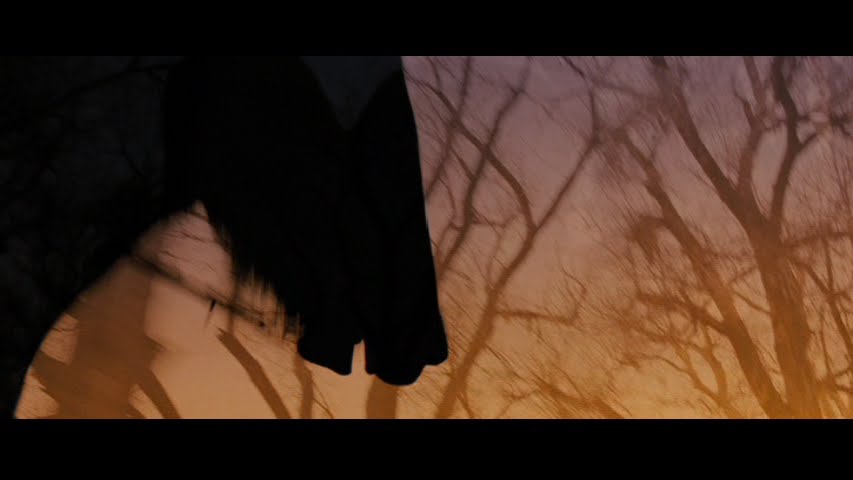
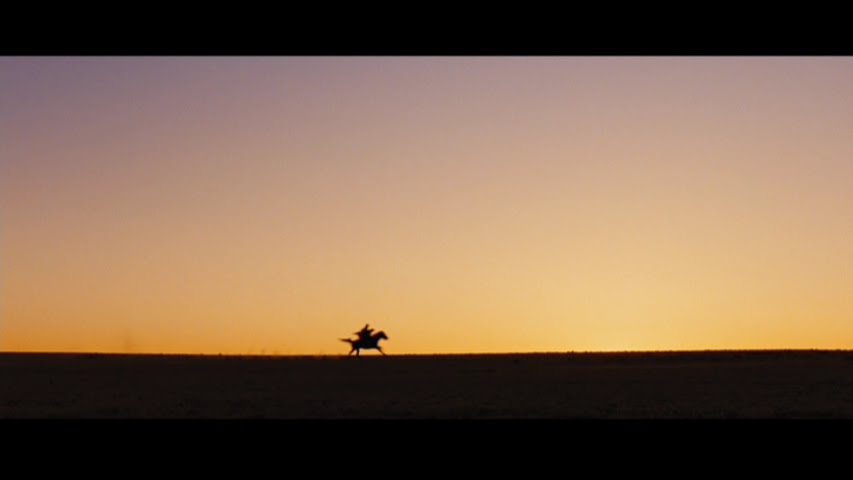


 The ride through the wild frontier is the most important part of True Grit and bears its crowning distinction. There are no words here as Rooster silently hurries forth, the images not conventionally lush but seemingly made with rear projection, the sense attaining a surreal quality. The bodies of Pepper's men pass into the night and Mattie hallucinates Chaney riding away into the distance. "He's getting away," she says in her poisoned haze. The outcome of any plot, True Grit is telling us, is totally meaningless. The ultimate destination for this story is an emotional one, beyond words. The grit is then reinforced by the necessity of Rooster having to put Blackie down after the horse exhausts itself to collapse, miles before society can aid Mattie. The music reaches its crescendo with this moment. This is the character that Mattie paid for in Rooster, and so it is what she has reaped, biblically speaking. She is resistant to it, batting at Rooster when he tries to carry her off the ground; she relents and he walks on with the physical agency of Raw Nature, Wordless Earth, and True Grit, an individual acting far beyond the demands of the capital exchange involved in his hiring. This moment in True Grit is ultimately, I believe, the most emotionally overwhelming the Coen brothers have ever constructed, the tongue-in-cheek playfulness of the previous 110 minutes having been dashed by its wordless truthfulness. Rooster sees society, falls to his knees, and fires his gun. What he says is a fitting coda to this last movement in the symphony, where bodies like memories drift away into the night, damned to decay and being forgotten, tying into the melancholy resonance of the Western genre. "I have grown old," he remarks.

 What follows is the film's epilogue, set a quarter century later, in 1903. The slow and unfinished trains of the film's beginning are now rapidly moving, the cities no longer the rough stuff of newly nailed wood, but ornately designed and painted. We see Mattie, 39 years old, one arm amputated. She narrates how Rooster never collected the remaining $50 of his bounty fee, significant because it signals the completion of the “true grit” in the ride through the night, as Rooster's final action has nothing to do with contractual agreements, but simply symbolic exchanges between breathing human beings. They had "lively times" together, a bond in spite of strife, a natural relationship of which there is increasingly obsolescence in a world of ever-proliferating empty words and simulation. Mattie discovers that Rooster is performing at one of the popular Wild West shows of the period, this one run by James Gang outlaws Cole Younger and Frank James. Younger politely introduces himself and regrets that Rooster had died three days before, buried at a local Confederate cemetery. Mattie accepts the news, and bids Younger goodbye; she utters to Frank James, "Keep your seat, trash" before leaving, a distinction she possibly makes because of Younger's documented repudiation of his crimes, versus James' blatant exploitation of them. Regardless, the setting of the Wild West show is a moving finale to this Western, which laments how the bold talk and posturing of the Old West has become nothing but posturing and the manufactured simulation of heroics, quite distinct from how Rooster saved Mattie's life, a private adventure distinct from the publically documented one.

 Mattie has buried Rooster in her own private cemetery, where he's saved from being an anonymous number in a large military graveyard, or bookmark for Wild West entertainment. His physical substance, the dry bone, is preserved in the artistry of her own sanctioned grave marking, memorialized in a private space. This is the best that any body can hope for in a universe where we all end up like grit, but only a few us can live up to the words we breath as civilized individuals. The gesture is futile (or FUDEL, as Rooster spells the word), but it is also beautiful. That is the nature of any kind of artistry, whether it be of a mortician, or of a storyteller relating the mystery of the past. Those with whom we shared "lively times" drift away from us in Time. There is sadness in the impermanence of the players in our stories, which can never be told with any kind of exacting accuracy. Mattie notes how she never knew what happened to LeBoeuf, and speculates how old he must be. Were he alive, she muses, it would be nice to see him. Of course, she will probably never see him again. The memory has its own music, though strained by the melancholy determinism of death and loss. All we can do is lean on the belief of Everlasting Arms. The content of our hymns – here in the indelible vocalization of Iris Dement – may be untrue and false, and the world factually may be godless. Yet the structural craft recalls the capabilities of human kindness and genius, and is itself capable of the deepest stirring. Maybe that's the only consolation we can take with us when our Chaney/Cheneys get away from what they deserve in a nonsensical world.


