
In his recent book Cultural Amnesia, social critic Clive James collects a host of individuals whom are in danger of being taking for granted by the modern world, be it their triumphs, failures, ideas, etc. You can imagine my enthusiasm when the book ran my two favorite Manns in back-to-back chapters: film director Michael followed by German author Thomas.
 James' reasons for including Michael Mann in his collection (one of the few directors to make the list, including Terry Gilliam and Chris Marker) had to do with his influence on other action directors, in addition to his perfection of the genre: Heat is like any number of other cops and robbers movies – just better than ever before. And other directors, on either the Western or Eastern hemisphere, big budget or indie, are so influenced by Mann that regardless of whether they choose to follow him or not stylistically, they have him in mind. As a director, Mann elevates the action dynamic to transcendent heights and marvelous spectacle; his ability to stylize a moment gives us much to chew on because, according to James, there's nothing else to look for in Mann. But it's so good, that it's all right that there's nothing to intellectually grasp in what we are viewing.
 It's a little odd to begin an assault on someone who is praising a hero, but I must clarify that James is completely and utterly wrong. This is not unusual, being that Mann has often been the victim of trivialization. But in the emerging criticism on his work, maybe too academic to be influential, his ideas are becoming clearer – in addition to being very pertinent to the cultural discussion at hand. But James’ anxieties in dealing with Mann are similar to my own in the past, before this literature (articles by Jean-Baptiste Thoret; Blood in the Moonlight: Michael Mann and Information Age Cinema by Mark E. Wildermuth; The Cinema of Michael Mann by Steven Rybin). The need to properly discuss Mann has become more important in understanding his recent pictures, which have met with much derision and lack of understanding (Miami Vice and Public Enemies).
 So how to interpret Mann? Before the recent literature, Richard Combs voiced a similar concern in his Film Comment article on Mann from March of 1996, dealing mainly with Heat. Combs stated that Heat is a crime epic unlike any other, a "cosmic crime film" where the Kubrick of 2001 is directing material by the Kubrick of The Killing. Combs was frustrated by what, if anything, was Mann really giving us that was new, beyond aesthetics and demythologizing the robber and cop? At that stage, 1996, Mann was in his fifties but only had a handful of films: Thief (1981), The Keep (1983), Manhunter (1986), and The Last of the Mohicans (1992), in addition to a pair of television shows that seemed to carry the same attitudes and motifs of his films (Miami Vice and Crime Story). He was the same age at Scorsese and the other movie-brats from the 1970s, but had emerged as merely a cult figure by the mid 1980s. By 1996, Steven Soderbergh (whose debut was 1989) had made just as many features as Michael Mann.
 Mann is not simply an elegant stylist, like so many of the Hong Kong directors he has influenced, or the Western filmmakers he emerged contemporaneously with, such as Adrian Lyne, Tony and Ridley Scott, and Alan Parker (all of whom were based out of England before achieving mainstream Hollywood success; Mann was educated at the London International Film School). Before studying film, Mann was interested in politics and literature at the radical campus in Madison, where he became enthralled with the torrent of new ideas. No generic Hollywood Democrat, Mann's belief structure is concerned with how social structures control individuals. He was one of the few Americans to get up close with the organizers of the 1968 Paris student riots, his affiliation with mass media – as a student filmmaker – allowing him to do so.
 Mann's relationship with politics extends into his tough-guy urban crime dramas: Thief isn't just about a streetwise safe-cracker (James Caan), but is about the proletariat being exploited, manipulated, and then revolting, his speech to his father/exploiter Leo (Robert Prosky) coming straight from Marx's labor theory of value; even looking at Miami Vice, the television show, the careful viewer will note how it is actually a ferocious anti-establishment show, a raw and melancholy perspective as told from the point of view of the pawn-like insiders within the system that manufactures criminals just as it swallows them up. The issues at play in Mann have to do with hegemony and control: brought about by sign systems and mass media, with great attention paid to the technology characters have at their disposal, which in fact swallows their sense of identity. The biological human yearning affiliated with love and basic relationships is at odds with the demands of the social system to which the characters belong: you can be a cop or a husband, a thief or a boyfriend – you cannot be both. The result, given the economic needs of having to work in a profession in which one is proficient, leaves the interiors of these characters blank. The cybernetic systems that link characters together (best represented by Mann with cell phones) put them in a state of dependency that destroys them as human beings. Longing for the real, they belong to the hyperreal: to airports, hotels, and hospitals rather than a Home, or with access to Freedom, an idea best represented in Mann's film version of Miami Vice when Crockett walks away from the ocean and into a hospital. The richness of Mann's ideas really came through much more clearly in his post-Heat cinema (the anxiety of which, in 1996, was: after Heat, where the hell can he go from here?): The Insider, Ali, Collateral, Miami Vice, and Public Enemies, all of which deftly deal with the Individual at odds with the social institutions that hinder his path to fulfillment, the streamlined vectors of machinery, video, and technological gadgetry at odds with the tumultuous natural environment in the background, something made explicit by his vivid utilization of high-def video's depth of field in his last three pictures. Mann is the center of Information Age Cinema.
Which brings us, finally, to The Dark Knight.
*

 I am not simply a fan-boy bringing up Michael Mann for my own selfish reasons, as I realize that at this point I must sound a little like Harold Bloom constantly bringing up how Shakespeare – or Wallace Stevens – is responsible for everything, including boiling water. But Christopher Nolan made clear his indebtedness to Mann in interviews preceding the release of The Dark Knight this last summer, often bringing up how he wanted to capture Gotham City the same way Mann captured Los Angeles in Heat: this is the story of disparate individuals within the confines of a gigantic metropolis. In watching The

 Dark Knight, Nolan's homages to Mann are so overt that we can intertextually turn to Mann – in fact I believe we must – if we are to find a resonance. Nolan doesn't simply wink with his homage here, but literally seems to be screaming it. There are the slightest references: the imprisoning buildings surrounding characters discussing issues of corruption on a rooftop (Miami Vice); the Batman fighting through a crowd of thugs in the techno-saturated environment of a night-club (Collateral's amazing Koreatown shootout); the serial killer without a practical motive, whose motives are rooted in a twisted and enigmatic psychological fantasy (Francis Dollarhyde and Hannibal Lecktor in Manhunter); the vectors of light hanging over the laboratory of Lucius Fox (too similar to Mann's visualization of the fight auditoriums in Ali); and the domination of media as a means of communication (The Insider). These slight homages can be taken on their own as just merely homages. But rather, by aligning Nolan's film and its images in relation to the cinema of Michael Mann, Nolan gives us a clue to interpreting the whole sense of The Dark Knight, and what it is pondering as regards the age in which it was made and distributed. Here, we can garner a kind of ecstatic meaning in The Dark Knight that goes far beyond the tiresome and concrete questions of the film (e.g. Is Harvey Dent really dead? and that sort of crap). It's Nolan's affiliation with Mann that makes The Dark Knight not only a greater aesthetic treat than the typical comic book film (the same way Heat handed it to the generic crime film, including the far less memorable The Usual Suspects), but how it is also philosophically more rich and fulfilling than if we were to simply investigate it by itself.
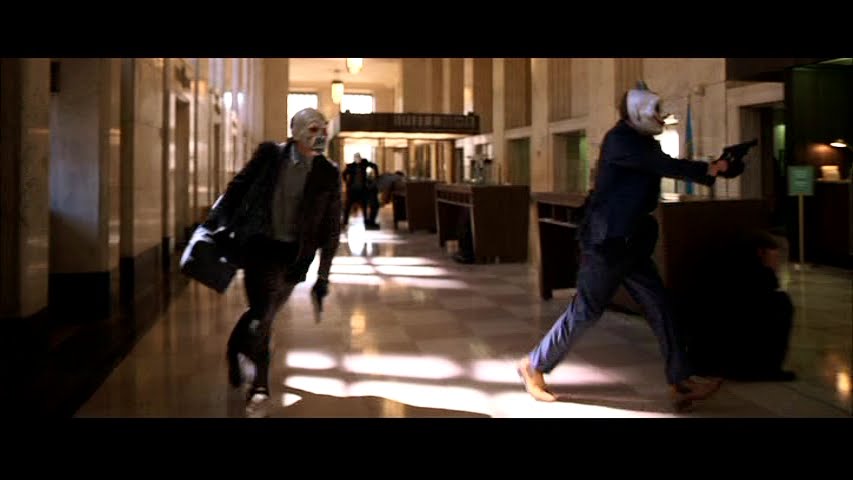 The Dark Knight begins in a fashion that seems very uncharacteristic for what its "sign" (the bat symbol) would be duly processed as by a collective audience: the Special Effects Comic Book Movie with a good dosage of gothic ambiance. Rather, it begins in the midst of action on a beautiful midday, aerially photographing a city far removed from the gothic Gotham of the past, even removed from the spectacular sci-fi metropolis of Nolan’s preceding chapter, Batman Begins. From that opening shot over the city, it sure looks a lot like contemporary Chicago. Nolan is filming a heist taking place, not pausing to let us know what exactly is happening; it is extremely well organized with professional burglary tools (the protagonist in Thief carries the exact same safe-cracking equipment used by The Dark Knight's robbers).
 When I say that Nolan is not simply homaging Heat so much as screaming it, the opening sequence is evidence. It is relentlessly Mannian, and anyone who has seen and appreciated Heat will be able to pinpoint the marvels of its influence. The daylight is the same as in both of Heat's robberies. The steely veneer of the city. The masks. The low tracking shots circling the masked robbers. The banks and how the robbers operate within the banks (one of the Joker's goons yelling "Sit down!" could have been taken directly from Tom Sizemore's Michael Chirito in Heat). And, most conspicuously of all, Nolan's use of music scoring, which in its uniqueness – electronic programming, layered guitars, strychnine strings – mirrors Elliot Goldenthal's Kronos Quartet-performed Heat score. To top it all off, Nolan casts William Finchter, who portrayed corporate criminal Roger Van Zant in Heat, in a stellar cameo as the aggressive bank manager who tries to fend off the bank robbers.
 This style may be a precise mimic, but what does it all amount to and what is it trying to communicate? How are we to intertextually interpret this, using Heat as a resource? Going back to Heat's opening moments, we are introduced to our master criminal, Neil McCauley (Robert De Niro), melding into the crowd at a train station, dressed in an ambulance driver uniform, so attuned to remaining inconspicuous and not leaving a trace of himself that we notice that he uses his elbows to open doors, so that he will not leave fingerprints. Like a ghost, he is able to slip from one hyperreal environment (a train station) into another (a hospital), casually stealing an ambulance which will be used for a complex armored car heist. We see the heist in progress – McCauley working with his close associates, each relying on the other like parts of a working clock. Before the robbery begins, each robber puts on a hockey mask – some black, others white, introducing the fogginess of moral stances in the picture. There is no black and white, only grey.
Most appealing is the moral position of both pictures. Mann's thieves, whether in Thief or Heat, may be social criminals, even sociopathic (Mann is fond of saying of his criminals: "He cares about his kids, he doesn't care about your kids."), but they have a kind of fraternal morality – a deep camaraderie based on trust, enabling them to act effectively. When someone decides to forge a kind of singular "self-ness” and thereby imposing his ego on the clockwork process, like the new-hire rapist Waingro (Kevin Gage), the result is disorder (McCauley's solution is simple and mechanically reflexive: kill him and get rid of the body).

 The bank being robbed in The Dark Knight, it turns out, is a bank used by Gotham's gangsters for funneling their money. The bank manager (Finchter) reminds this to the clown-faced bank robbers while firing his shotgun. He mentions "honor, loyalty," and seems to represent a kind of closet morality amongst gangsters, an underworld conscience and coherent structuralism. Appropriately, this group of masked thieves is a wildcard, lacking a moral code. The perfection of the constructed plan (just as precise as we would expect from a McCauley in terms of timing) is dependent on one criminal killing another: The alarm expert is shot by the safe cracker. The safe cracker is shot by the man covering bank customers. The bus driver kills the coverage guy. The Joker kills the bus driver. There is a pronounced lack of the individual here: the masked criminals are a clone of each other, with no common denominator or base, indicating that the Joker truly is a wild card worthy of his title. More than a character with a body, he is more of a force, not restricted by real space or time. With no ground, he has no Identity – no morality, no ethics, no structure, nothing. "What do you believe?" the bank manager demands to know. Nolan responds with the stunning revelation of the man behind the mask: The Joker (Heath Ledger), his actual face a replica of his persona, the impact of the revelation matched by the burst of music: "I believe…that whatever doesn't kill you…makes you stranger." The Joker then disappears, McCauley-like, driving a bus into the simulacrum: other buses in front and behind it, a hyperreal

 element dissipating into the ether of binary repetitions. That his face uttering cryptic credos should match the mask on top indicates that the Joker is not a Self with a genuine center, though Ledger occasionally may give hints of a person with human motives. He is masks all the way down, far removed from the Jack Napier (Jack Nicholson) of Tim Burton's 1989 Batman. He ultimately lacks explanation, existing in no geographic reality with no Reason – which is why it is not entirely too bothersome that, for closure's sake, the Joker does not die a comic book villain's death at the end of the picture.

 This leads to the compelling juxtaposition between Batman/Bruce Wayne (Christian Bale) and the Joker, both men wearing masks, and both men with moral cloudiness surrounding them. In Heat, McCauley is devoted to keeping himself away from a "ground self,” a philosophy disrupted by a love relationship with a graphic designer, Eady (Amy Brennenman).
 Having initially told her that he was a businessman “working in metals,” it is through the television that Eady learns of McCauley's real identity and occupation as a bank robber, indicating that the post-modern technological world in which this film takes place acts as more of a cover for individuals in real space and time than for hyperspace or hypertime (the television, or heat-sensing surveillance tools). McCauley's double is Al Detective Vincent Hanna (Al Pacino), a great investigator who cannot sustain a meaningful relationship with anyone, as we observe friction with wife Justine (Diane Venora), in this his third marriage. As long as he is committed to his work, Hanna’s relationships can never be fulfilling. A master detective who is bent on intimidating snitches for information (his histrionics are not Pacino overacting; they are essential to the performative character), Hanna can never turn off, and when he does, he is exhausted with little left to give his family. Instead of conversation or discussion, he turns to the television, which emerges as his closest link to intimacy, indicated by the hilarious, if wrenching scene where he discovers Justine’s infidelity.
 The TV being watched by the poor, awkward Ralph, Hanna grabs it, taking it with him, angrily intimating Ralph just as he does to his snitches: “You do not get to watch my fucking television set!” McCauley and Hanna emerge as a perfect marriage, and the most honest conversation between two characters in Heat transpires during their mid-movie cup of coffee, where their technique of trying to intuit information about the other gives way to a discussion about dreams and motivations. McCauley reminds Hanna that his pursuer will not be able to sustain a marriage if he continues his work as a detective, just as the Joker reminds Batman, who – as Bruce Wayne – cannot have a relationship with Rachel Dawes (Maggie Gyllanhall) as long as he's a masked crime fighter, that there is no place for normalcy in his life: "You complete me,” the Joker tells him. The one needs the other.
 The paths to freedom and fulfillment that McCauley and Hanna seek in Heat are obscured by their occupational personae – or superhero/supervillain masks, in accordance with the comparison to this comic book film. The final moments of Heat visually communicate this idea. The wonderfully spectral chase through LAX leads to a environment full of technology, where the machines are built solely for other machines. The passions of the two men disintegrate beneath the booming airplanes above. McCauley, having been shot by Hanna, dies holding his shooter's hand.
 In a wide shot, Mann shows McCauley on the left, the runway lights flashing behind him, indicating his need to be in constant movement, always hiding, while Hanna is on the right, the city's buildings behind him, positioning him (in a very Batman-like fashion) as a doomed administrator/crime-fighter. The two are opposites and yet strangely mirrors of the other. The Dark Knight's relationship to Heat relates to a cyber noir motif, based on the fatal dance between doubles/opposites that are microcosmic representations of a technologically advancing world disallowing individuals to realize any genuine and grounded sense of Identity, technology being tied with corporate and social structures.


 Mann's attention to technology and communication is vital here. No other director has characters utilizing a telephone so often (the cell phone is a character unto itself in The Insider); the era of Information, where everything is digitized, compresses space and time to the extent that the meat-self evaporates and becomes virtual.
 In The Dark Knight there is confusion over the real and unreal, or rather the hyperreal, where meatspace, or physical geography, is taken for granted. Notice Maroni's (Eric Roberts) flippancy after being threatened by Batman with a two-story fall; Batman soon reminds Maroni of the actuality of real space when the gangster's ankles are broken upon collision. As I said, the Joker seems to transcend temporal and spatial boundaries, which is why he is such a horrifying villain. He emerges as a walking panopticon, always seeing, always present, in any disguise or form. He has no concrete origin or past; his stories deliberately contradict each other, much like Mann's character of Vincent from Collateral, who chooses not to exist in a real link-chain with other beings. He also flies between genders, wearing a female nursing outfit at one point. The Joker seems to want Batman to give into the same virtual identity, embracing his freak-ness, which places him outside of the circumscriptions of morality and humanist thought structures. This is the Joker's challenge when he desires Batman to hit him with the Batcycle. The head-on collision would be a confirmation of the Batman's neglect for appreciating the physical impact of real space. The Joker would fuse his rival with the deadness of just another digital movie effect, of bodies without blood and space without substance. "In the real world, there are ramifications," Michael Mann has said, an existential reference to chains of human relationships. This philosophically relates to how human beings interact with their environment: a kind of base nature that technology, the digital, is seeking to obscure.
 The Joker, or the technological post-human, wins the battle. His plot literally evaporates Bruce Wayne's love, Rachel, into nothingness (the impact of the explosion would leave little trace of her physical existence), and in retaliation, Batman (who 'has no limits'), adopts an unethical technique of mass surveillance – utilizing a sonar system via cell phones enabling him to completely master space and bear the same panoptical capabilities possessed by the Joker. Technology, the cell phone, the tool of disembodied information, is what separates us from the human world of honest relation
 ships. Batman becomes 'the dark knight,' someone morally or ethically ambiguous with his techniques, committing – out of necessity – to the hyperreal designs of social structures more than to the integrity of the people he seeks to protect. Notice how he engineers the fate of Harvey Dent (Aaron Eckardt), a once idealistic DA who has become a sociopathic killer seeking vengeance: Harvey Dent? Alive or dead? Doesn't matter. The visible sign as given by the system – "Mission Accomplished" – is all that matters. Harvey's own flesh has evaporated too, simply in the design of politics and mass control. It is similarly by the tools of disembodied information that the Joker finds his release from the confines of his cell – or body: it is inexplicable how an inmate got a cellphone implanted within his flesh, which is triggered to explode by the Joker. Technology decimates the Real Body. We are all sonar in the anarchy given by the villain.

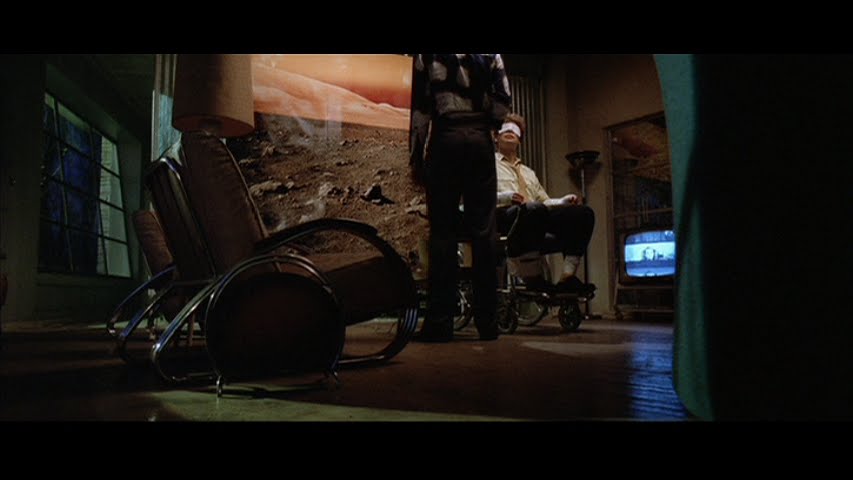 It is here worth pointing out how the Joker is similar to the kind of criminal Mann portrays in his Red Dragon adaptation, Manhunter. Francis Dollarhyde (Tom Noonan) and Hannibal Lecktor (Brian Cox) seem to have no boundaries – or motives. Regarding inexplicable murders, a detective admits, "In the case of a robbery, I search fences, because I know a robber's motive is cash money. Here, none of us have motive. None of us have shit and we know it." The motives exist in fantasies, the hidden spaces not having to do with physical causality. "Some men just want to watch the world burn," Alfred (Michael Caine) notes in The Dark Knight, commenting on the kind of criminal Batman might be dealing with in the Joker. These characters are more threatening – Dollarhyde, Lecktor, the Joker – because they are untraceable. Their point of origin is scrambled, like the television set image in Dollarhyde's house. He is a transmission signal and, in a videoscopic world of mass images and screens, we too exhibit signs that may be interpreted as sociopathic regarding the acknowledgement of fellow beings. As Muhammad Ali (Will Smith) says in Ali, "Yeah I know where Vietnam is. It's on TV."
Even so, there is hope. The Joker's plan to have one boat-load of hostages kill another boat-load (the question being, who will kill in order to save themselves first?) backfires; he is depending on the humans in either boat to take the real existence of the people on the other boat for granted; yet both sides acknowledge the sentient beings they are able to kill, and they choose to act altruistically.
 Nolan's picture is asking questions about moviegoers in general: he is insistent, much like Mann is, of using real spaces and bodies for shooting, and dislikes the hampering dependence on CGI effects. The action hero has forsaken itself to the land of the unreal and into the realm of Resident Evil-like pretenders, the scallywags of cinema, Indiana Jones being the latest casualty this past summer. Just as Mann was taking the crime film back from post-modernist irony in 1995 (in the wake of Pulp Fiction and the Tarantino copycats), Nolan is acting with a similar sincerity in salvaging superhero fantasies from being full-length videogames, and back to the richness of raw meatspace moviemaking. In discussing the quandary of the real and the unreal, the crime fighter and the criminal, the analog and the digital, the meat vs. the hyper, The Dark Knight warns of the danger in surrendering giving to the virtual identity as opposed to the grounded, examined Self. To fall back into technology for convenience's sake traps our heroes in a confused pixilated mist.


