Everywhere we go we encounter language, whether it regards the social functions of spoken dialogue or the meditative functions of what is unspoken and interior. There nevertheless remain words, symbols, signs, syntax, oftentimes incomplete and fragmentary, so intimate as to be embarrassing at times, and incoherent. Articulation is something that we might take for granted. Words and language are the fabric of our thoughts and consciousness, though maybe the content of those words are closer to Gertrude Stein than to a conventional prose stylist. It might not sound logical, and yet linguistics – since Chomsky – reveal how Stein was correct in her deconstructions. The ability to fluently express, socially, thoughts as language is terribly complicated. How do Beings reveal themselves? Perhaps one's relationship or attitudes regarding God – in whatever form or absence – and Love – perhaps also in whatever form – are the most perilous things to replicate through words, even though they inspire people to do so, again and again, too often faltering, too often being dishonest even against one's realization. God and Love have given birth to some pretty good poems, and countless bad ones.
 Terrence Malick's The New World is as encompassed by Language as it is by Romantic Love. It is probably the filmmaker's most maddening picture (I would say it is much more dissonant than The Tree of Life, though the latter remains a more audacious work), and having a familiar, archetypal narrative (the story of Pocahontas and John Smith), it is as avant-garde a moderately budgeted film a studio (New Line) has ever released. The New World shows the traps of language and thought, in addition to its liberations. Formally, it is as unbounded, fertile, and filled with growth as the unconquered natural environment of early 17th century Virginia that it depicts. Luxurious in its beauty, though hardly lush in the same way as every other historical epic or romance, it nevertheless persistently chimes notes of dissonance with the audience, deliberately colliding and overwhelming, much as the reeds and grass do to John Smith (Colin Farrell) when he's lost in the forest, shortly before his capture by the Native Americans, here dubbed "the Naturals" by Captain Newport (Christopher Plummer). Spaced throughout its fertility are moments of complete aesthetic arrest, denoting spiritual ascendency – also unmatched by other historical films and romances. Through its storm of Nature, conquest, passions, and discoveries, characters are searching for the sublime, both in the Ethereal (Pocahontas' need to understand the Mother, which is the Over-Soul in Nature) and the Terrestrial (John Smith's quest for the Indies, or a new land where civilization can essentially start over, away from the materialist spoils that have corrupted things elsewhere). The journey takes an outward trajectory, but leads ultimately inward. The only Truth is in that space, the mythological "romance in the forest" that is colored and framed by ingenious subjectivity.
 The New World begins over water, the sky and looming trees above reflected on its surface. We notice an array of contrasts, calling attention to the nature of binaries. The water seems still, but it becomes evident that the camera is moving over it. The world above is replaced by the world below, as the dense plant life beneath the water becomes more visible. "Come Spirit," Pocahontas' voice narrates. "Sing us the story of our land. You are our Mother. We, Your field of calm. We rise from out of the soul of You." Malick cuts from the ground perspective, as Pocahontas (Q'orianka Kilcher) raises her arms to the sky, a bird calling distantly. As in the conclusion of The Thin Red Line, being "in one's Soul," which is say "Being," is to be in the Soul of All. Beings are elsewhere trapped within their flesh-selves, either pining for freedom or dominating other beings. The cycle of colonial power and domination is laid out in three dimensional drawings during the credits, showcasing slaughter as explorers arrive in the Americas.
 Wagner's Das Rheingold music begins to stir awake. Under the water, three fish pass by, then three naked women swimming freely. Above water three great ships approach the shore. The Wagner grows in its glorious momentum as characters from both cultures – the Natives and the Colonials – stare in amazement at what draws nearer. Emerging from a dark cell and in chains is John Smith, who regardless of his present situation (he's apparently been accused of mutiny and is to hang) is rapt and filled with happiness. Through his cell window (shaped conspicuously like the film's photographic aspect ratio) he frames the glory of this present moment.
 The use of Wagner is more effective than an original score ever could be, and Malick's talent for using source music remains close to incomparable; the Wagner music is known for how it flows like water, which is the same instruction the director often gives to his composers. But the music intertextually also reinforces particular themes, suggesting the hidden ideas implicit within The New World. In the Wagner opera, this prelude is the score to the dwarf Alberich rejecting love and stealing the Rhine Gold from the Ring Maidens (of which there are three). We can paint some parallels between Alberich's rejection of love and quest for Gold that will enable him to rule the world, and European explorers who will pillage and exploit resources. But it also gets to the heart of Smith's tragedy, who is the most noble and possibly intelligent of the ship's crew. He dreams of his Utopia and New World which Virginia seems to offer: "A world equal to our hopes. A land where one might wash one's soul pure. Rise to one's true stature. We shall make a new start, a fresh beginning. Here the blessings of the Earth are bestowed upon all. None need grow poor. Here there is good ground for all. And no cost but one's labor. We shall build a true commonwealth, hard work and self reliance our virtues. We shall have no landlords to wrack us with high rents or extort the fruit of our labor." (I find it interesting that before The New World, Malick was preparing a biopic of Che Guevara, eventually directed by Steven Soderbergh; there seems to be similarities of idealism in John Smith and Che). Other passengers proclaim how they'll "live like kings," with the oysters in the ocean and "fish flapping against your legs."
 We know how Smith will fall in love with Pocahontas, the Native princess who saves his life from an execution by her father, Chief Powhatan (August Schellenberg). And yet something puzzling about The New World is the struggle Smith has in remaining with her. He is very wary of social duty and making his affections for Pocahontas known. Ultimately, he will choose the false path of glory, his high calling to "cross the threshold" in exploration and charting geographical territory, in favor of loving Pocahontas "in the forest." His rejection of love leads him to have a melancholy realization about his ideals, his "Indies." "I may have sailed past them," he says, knowing that Pocahontas was the embodiment of all that he ever dreamed.
 I have to go back to language in discussing The New World, associating it with the dreams of human beings that steal into their destinies. The first diagetic words uttered in the film are by Newport: "Let him go," in reference to Smith, waiting at the gallows with a noose around his neck. Smith, like Europe, is offered a new start and the potential for Freedom, which is a powerful Malick obsession in a world featuring frames, cages, and markers of merit and identity. Smith must have a rather unruly personality to have wound up on the gallows to begin with, just as his nobility and intelligence compel Newport to free him. Smith's impulse to freedom (so leading to "mutinous remarks") associates with how he follows his intuition, intuition being related to some elliptical voice. "Who are You whom I so faintly hear?" he asks in his mind. "Who urge me ever on? What voice is this that speaks within me? Guides me towards the best? Where? Always the star was guiding me. Leading me. Drawing me on to the fabled land. There life shall begin."
 Intuition is the gift of listening to the voice that speaks within, as opposed to the "blah" existence of blindly following sensations or impulses ("I'm hungry" and "My stomach hurts," or "Just felt like it," as in Badlands; the blinding jealousies and desperation in Days of Heaven). Smith's is not a passive existence. The world lives for him. The first time he sees Pocahontas is, suitably, as she seems to materialize out of the grass, as if she too was grass (and later on she will tell John Rolfe, "We're like grass.") This points to the purpose of Malick's voiceover, which too many critics and commentators believe is a gimmick, or a simple lazy tool for relaying narrative. The voice within the conscious individual, aware of Being and receptive to it, never ceases to speak. The New World, more than any other Malick picture, submerges into the inner voice of its three principle characters (Smith, Pocahontas, and John Rolfe). We may notice that another character, the brutish and opportunistic Captain Argall (Yorick van Wageningnan), does not speak in voiceover, but one moment speaks aloud to himself: "Conscience is a nuisance. A fly, a barking dog. If you don't believe you have one, what trouble can it be to you?" That these words are spoken aloud and not in Malick's voiceover is significant, because it demonstrates how Argall, like most of the characters in the film, is too extroverted in his thinking to have any insight or sympathy. We can compare Argall's thinking to what immediately follows, as his captive, Pocahontas, closes her eyes and raises her hands to the sky, thinking her meditation: "Mother, You are my strength. Or I have none." In estranging ourselves from the inner voice, by "being in the world," we lose our connection to Being – in the World.
 This large issue of language and communication is naturally evident in how we observe two cultures unable to comprehend each other, and often not attempting to even imagine that the Other is unable to comprehend them. When the two groups first meet, a Native and Newport seem to have a basic understanding, as the Native taps Newport's chest and then his own, so as to acknowledge how they are both sentient beings. But this focus is quickly lost, as Natives pick up objects and are interpreted as thieves. They are assaulted or shot. Disruption and distrust follow, and the explorers find themselves lost at their fort. "We might as well be shipwrecked," Newport laments. The only language that ultimately seems to be universal is that of bartering (a notion that Malick disciple Kelly Reichardt plays with in her magnificent recent film, Meek's Cutoff). Objects like gunpowder and metals take precedence over symbolism and life.
 Smith, who understands communication (when another Englishman shoots a Native, he takes the Englishman and suffocates him in water in front of the Natives, so that he can clearly show how the English are still friendly), is sent upriver to find the Native "king," Powhatan, and to trade with him. Smith's crew is lost and presumably killed by the Natives, while he stomps through the tall grass of the foreboding environment which comes to overwhelm him. He finds himself under attack in a marsh and surrenders. He tries bartering with his captors by showing off his gunpowder and a compass, attempting to draw the analogies of direction (sun, moon, East, West) with them.
 Powhatan's judgment and proposed execution of John Smith is a perplexing moment where all continuity of experience is excised. A shaman lurks with menace while Powhatan takes counsel from his advisors and issues forth Smith's fate. He raises his arms and howls, and Malick cuts his film together in a way that is uneven and ecstatic, tearing us apart from a reliable ground for any dramatic framework. Just as the clubs are about to come down and kill Smith, the image cuts to black and silence is all. We then see Pocahontas laid out in front of him, protecting and asking for his life. The scene transforms into a kind of goosefleshed glory, as the Naturals ceremoniously resuscitate Smith, their hands on his chest and then fluttering upward, conveying the ascendency of his spirit. Malick cuts to the sails on a ship's mast falling, an image that seems nonsensical but is demonstrative of how Malick understands the psychology of human experience (similar mast images occur at the beginning of the film, when the Europeans discover the New World, and in the film's final movement, when Pocahontas has discovered the truer New World of England). Played so as ritual, I think Malick wants us to wonder whether Smith's trial/execution/salvation is real or a kind of performance of which he was unaware. He will serve a function for the tribe, who will use him in attempting to understand the Europeans' language and culture.
 Smith feels like a child in his illusion of freedom, seeing the tribe as an ideal civilization which has "no sense of possession or jealousy." The love of freedom he has in this ethereal sabbatical (or imprisonment, depending on how you look at it) finds equal in his enthrallment of Pocahontas, the favorite of Powhatan's children who is loved by all in the tribe. Pocahontas has been enlisted by her father to draw information out of Smith, but their lush meandering through grass, often wordless, becomes the stuff of a remembered romance, set to music by Mozart's Piano Concerto No. 23, a piece of music from the late 18th century which reinforces notions of how everything we are seeing is memory, and reimagined as such. Malick has no such ambition to necessarily create an anthropologically correct vision of the early 17th century settlements and tribal cultures. There is no "objective" viewpoint for him, and we should think of The New World being a vision through the same glass of 19th century Transcendentalism that colored World War II for The Thin Red Line, similar to how Hawthorne's The Scarlet Letter belongs much more to the 1850s than to the time in which it is set.


 From Smith, Pocahontas first learns the words of the body: eyes, lips, ears, and then the forces of nature: wind, sun, moon, as if to imply the equivalency of Being that Malick holds for the personal self and the large oneness of Nature. My Beingness is grounded in Nature, linked to basic and universal objects. Pocahontas twirls around, singing "Wind" repeatedly, as if she was a part of the thing she was seeking to describe: in essence, it's not even a description, it is. She is wind. The word does not exist alone, in and of itself. We should compare Smith's education of Pocahontas to what she learns later, as an adopted colonial in Jamestown, from John Rolfe (Christian Bale). Rolfe turns pages of literature and learning for her, and lists out the days and months of Time (Monday, Tuesday, Wednesday, etc). She then asks Rolfe, "What is a day?" What is a day? An hour? "Why does the earth have colors?" Rolfe is offguard, but completely charmed by Pocahontas' perspective, which has no sense of Time and the compartmentalization of concepts: She wants to get at the heart of language and definitions. Rolfe's own idealization of Pocahontas is voiced in his narration, "She weaves all things together." Everything flows together in and through her. "We're like grass," she tells Rolfe while he attempts to court her. The groundlessness of civilization acts in such a way that individuals are distracted and estranged from that Ground that "weaves all things together," enabling one to make metaphors and see an Other as a Self.

 The early scenes between Smith and Pocahontas are some of the most incredibly sensual ever filmed. While not sexual, in the way Emmanuel Lubezki films the two actors we can see an immense longing of one flesh for another flesh, Smith's fingers coyly rolling along Pocahontas' arms in close up, James Horner's piano melody coming in like a gentle wind. Freedom and Life become abstracted in each other. "I was a dead man," he narrates, "Now I live. You, my light, my America. Love. Shall we deny it when it visits us? Shall we not take what we are given…There is only this, all else is unreal." She speaks to Nature in her own adoration of him: "Mother. Where do you live? In the sky? The clouds? The sea? Give me a sign. We rise. We rise. Afraid of myself. A god he seems to me. What else is life but being near you?" At this moment in Malick's montage of images we see Smith showing Pocahontas a reflective surface, so that she can see her reflection (earlier she seemed very interested in the word "Moon," and the moon is a symbol for reflection and identity, its presence being unreal, and merely the light reflected onto it). Her own self is being born, while she also feels utter unity with him. "Two no more. One. One. I am. I am." The music of Wagner again is roused on the score, as if Love itself were a New World of discovery to be colonized with possibilities and dreams. This is Malick's stages of New Worlds, all three set to Wagner's prelude: the first is geographical discovery, where ideals are placed onto land; the second is in love for another being; the third and final will be the great All, which is both immediate and eternal, Right Now, with us and with everybody, the Self of Malick's searches that bridges space, time, and all beings.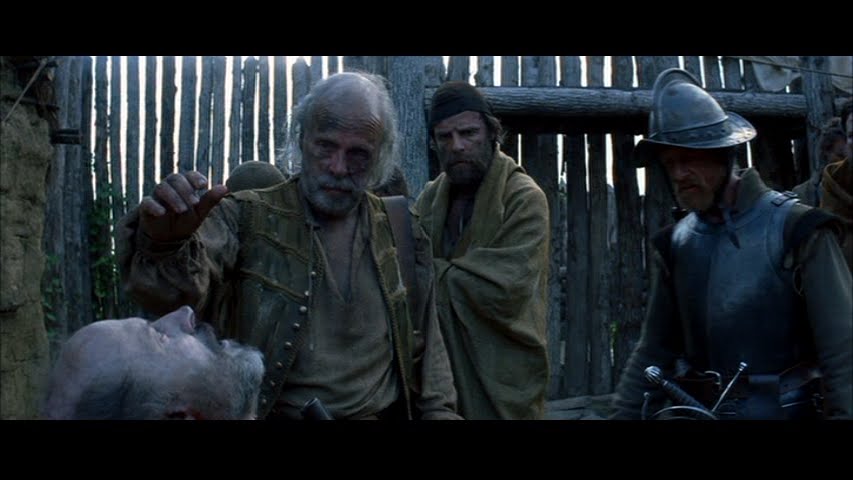
 The ideal fades fast as Smith is sent on his way back to the fort. He has promised Powhatan that the Europeans will soon leave; if they do not, Powhatan will drive them off the land by force, "into the sea." The euphoria of the Forest Romance becomes a completely dissonant movement in The New World. The inhabitants of the fort are starving and diseased, with disarray governing everything. Language again becomes a key factor to how Malick wants us to process this highly frustrating section of the picture. The spoken dialogue here is barely coherent, as interior reflections of Smith collide with the rants of the colonials. At the base of our consciousness is our language. It is in that and the formulations of words and symbols we put together in reflection that we may grow and become more aware of Being. But as a character observes here, "Starvation does fearful things to men." Starvation, disease, impassioned and jealous love or sexual desire, and anger all function as unfortunate clouds to the coherence of words, where the body becomes driven by impulse. The world becomes an extroverted experience, barren of inwardness. The starving children accost Smith, asking where he's been and voicing information of what has happened in his absence: but they are maddeningly incoherent to us – and to Smith. They starve. There is no room for reflection or grace. They embody Nature at its most desperate, losing track of the You, which is the same as the explored "I." In this irritating segment, we notice one man (John Savage) yelling about sin and God, "Love good! Hate evil!" he shouts, his words literally dissolving into each other. But his words are that of a religious fanatic who has lost all sense. His sanctimony is flung out of his mouth. Men here are eating their belts, and cannibalizing corpses in desperation. "Bad water," Smith narrates, as we see a snake swimming. All is aggression, argument, and selfishness. Words themselves are deliberately so rough in their dialect that they harshly fall on top of each other without any meaning.
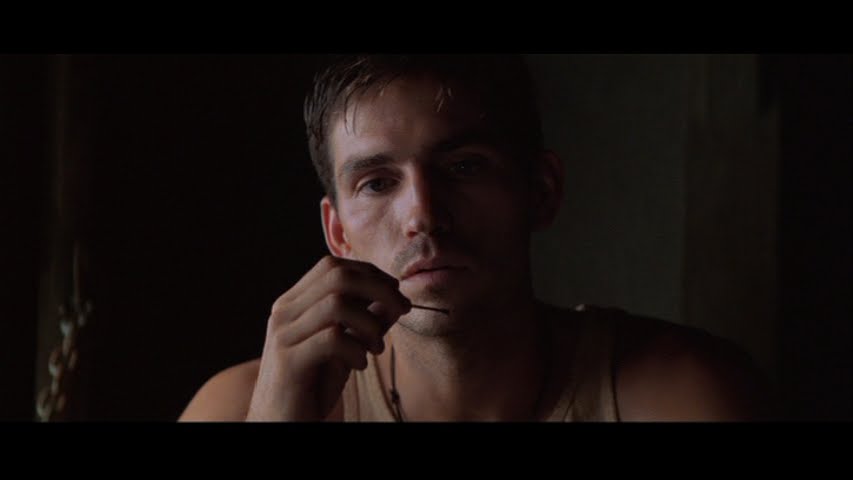
 Smith is made the new president of the colony after Argall defends Smith and kills the tyrannical Wakefield (David Thewlis), who had convicted Smith "on a chapter of Leviticus" in his absence. But as president, Smith is unhappy in his relegated social duties. "It was a dream," he says of his time in the forest. "Now I am awake." The freedom of his love for Pocahontas can never be realized. "I love you, but I cannot love you." He contemplates a feather that serves as a private ornament, reminding him of her. "I let her love me. I made her love me." As president, he cannot take his duties lightly. And yet he tells himself, "Damnation is like this," his inner words over the social words he issues to two arguing colonials, who have come to odds because one thinks it is the 15th of October, the other the 17th (complete groundlessness, Heidegger would say). "The country is to them a misery, a death, a hell," Smith says of his men. "While they starve, they dig for gold. There is no talk, no hope, no work but this." The men will not work proficiently at making the fort work. Ironically, they also are existing in a private, subjective world. But whereas his experience opened him up, in their squalor they seal themselves shut.
 Pocahontas arrives as the fort's salvation, defying her father by bearing food and seeds for agriculture. The Europeans look at her as a kind of world-saving goddess, but her true motivation is to be once more close to Smith. He warns her not to trust him, being cold. A key word is uttered by her as her fingers reach out to touch him: "Remember," not so much heard by us as clearly mouthed by her. Memory is a burden, a haunt more than an escape for a man living in bad faith and removed from what he really desires. It's not entirely clear where Malick is going as the action moves into Spring, as the Europeans trade with Natives, though Smith's mind is painfully elsewhere while the transaction is taking place. As the Native talks, he is thinking of Pocahontas. Smith voices the problem of money to the Native: "The source of all evil. It excuses vulgarity, makes wrong right, base noble." The tools of the Europeans will corrupt this other civilization. Smith finds relief once more with Pocahontas.

 Together again, this is a calm repose for both individuals. "True," she narrates. "Is this the man I love? A ghost?" As president, he is not free. He is only half there with her, as with the bargaining Indians he is barely with them and thinking of her. "We can't go into the forest," he tells her. The other option, England, is too far away. Enough for her is to be with him. He reflects, "That fort is not the world. The river leads back there. It leads onward too. Deeper. Into the wild. Start over. Exchange this false life for a true one. Give up the name of Smith." She too has conflicts with her father, who has discovered that she has given seed to the Europeans, indicating that they have no plans of leaving. She is necessarily exiled. "How false I am," she thinks. "I have two minds…What was I? What am I now?" We see her looking at her eyes in a mirror, and then her shadow on rock, a Malickian motif denoting the presence of Being (and very pertinent to The Tree of Life). We all have two minds. In Smith especially we see the difference between spoken language, in how he communicates to his villagers, and inner language, where he wrestles with his confused soul.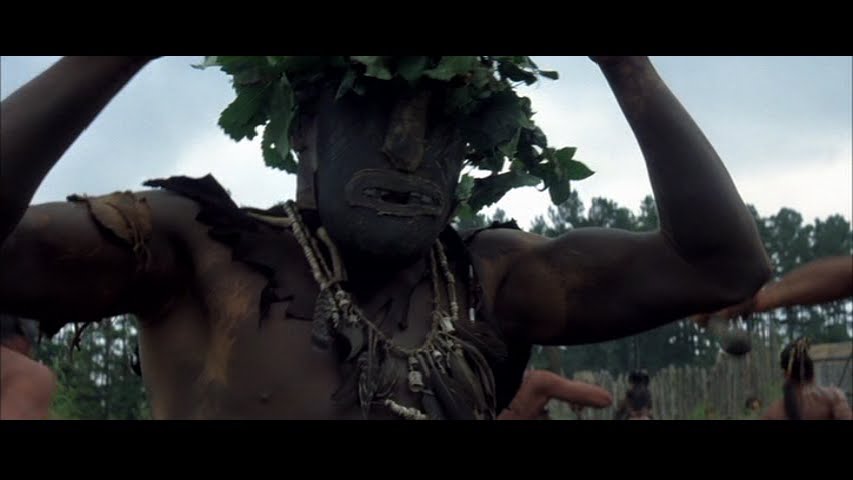
 Battles between the two cultures ensue, a war that is particularly painful to Smith being that he loves the enemy culture and feels that to open fire on them is to kill his own brethren; indeed, Pocahontas' actual brother will be one of the first to die. The other Europeans angrily project their hatred: "How can you own land!" one of them shouts, adding that the world should belong to those who can do right with it. Smith prays while bodies fall: "Lord, turn not away Thy face. You desire not the death of a sinner. I have gone away from You. I have not harkened to Your voice. Let us not be brought to nothing." His compassion for the savages is interpreted, correctly (as in Days of Heaven), as a forbidden love for the princess. His position as president is usurped and his resentful men torture him and put him to hard labor. Pocahontas is taken as a hostage and acculturated.
 Newport returns and once more frees Smith, chiding Argall while doing so. But he also offers Smith an opportunity to run his own expedition, endorsed by King James I (Jonathan Pryce), "to chart the Northern coasts for a passage to the Indies." Just as the film stylistically has implanted its own dissonance in us as viewers, there is dissonance in Smith's soul. His desires, between geographical exploration and romantic fulfillment, conflict. He takes the king's post, asking that Pocahontas be told that he has died. With this news, she says that he has "killed the god in me." She wanders around Jamestown as a walking ghost, grieving in dirt: "Scorned. Cast out. Cut off. A dog. Come, death. Take me. Set me free. Let me be what I was." Her only repose is to look at trees, where we see a shaman (or a spirit?) talking to her.
 It's here where Rolfe enters the story, observing her and saying, "When first I saw her she was regarded as someone finished, broken, lost." He falls in love with her, while in her broken-hearted grief she takes to him as a kind of protective shade, though she does not feel any sense of the same passion she did for Smith. She is baptized, renamed Rebecca, and has fully acclimated herself to European dress. But Rolfe's labyrinthine desire for her is grounded in a kind of desire to know the spaces not associated with her social self: "Who are you? What do you dream of?" We hear Malick's protagonists ask the same question of God, as Pocahontas does of the Earth Mother, Pvt. Train does of God in The Thin Red Line, and Jack O'Brien and his mother do in The Tree of Life.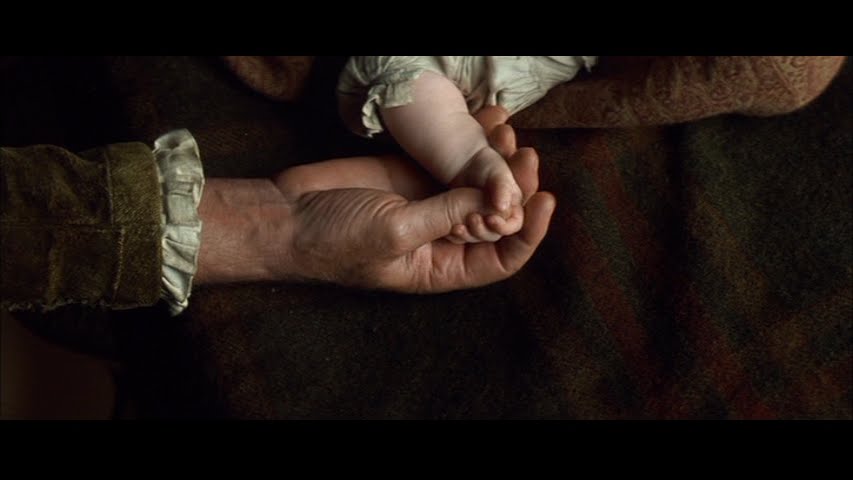
 There are then similarities, however more benign, here between The New World and Days of Heaven, where the woman is torn between a more passionate and earthy love, and a calm and stable one. Rolfe is similar to the Farmer, but his jealousy will not dominate him, perhaps because Pocahontas, unlike Abby, is completely honest with him. Even so, we hear the words "dreadful day of judgment" uttered by Newport during the marriage ceremony, just as we hear them during the marriage in Days of Heaven. But whereas Days of Heaven climaxed in apocalypse, The New World will conclude in an Earthly Paradise. In Rolfe's kindness, Rebecca senses echoes of the magnificence she once possessed: "He is like a tree. He shelters me. I lie in his shade…Mother, Your love is before my eyes. Show me Your way. Give me a humble heart." She has a child with Rolfe, Thomas, whom she loves dearly and teaches an appreciation for Nature and other beings, such as ducks and cows, another glimmer of Mother to Son that will be repeated and further developed in The Tree of Life, in which we will notice parallels of mercy to criminals, as both Pocahontas and Mrs. O'Brien - the capacious Earth Mother, giver of Life both - will give incarcerated men water.
 Rebecca overhears that Smith is still alive, which almost effectively ends her relationship to Rolfe. She cannot be Rolfe's wife, because, in the most natural of ways, she is already "married" to Smith. "Married?" Rolfe asks when she has told him. "You don't know the meaning of the word exactly." That's a significant line, because it gets back to language and how, for Pocahontas/Rebecca, a word does not exist by virtue of itself. It is one with its definition (It also should make us think about her baptism and her acquisition of a new name). She loved and gave herself wholly to John Smith, and so is married to him, the essence preceding the name. Marriage is customarily an agreement, a contract, something written, preceding its definition, and so almost absurd. Pocahontas/Rebecca may not understand the meaning as it relates to the word, but she does understand the meaning, at its basic essence, in a way that no one else understands.
Rolfe's disposition is one of tragic acceptance. "Love made the bond," he says. "Love can break it too. There is that in her I shall not know." The pain of love and desire is that, as Malick understands, everything is subjective, and even in the most overpowering feeling of unity and vision of a river in which we are all flowing through, we are nevertheless still subjective. We can never know another's desire and possess it, a melancholy thought that we see in Bell's relationship to his unfaithful wife in The Thin Red Line.


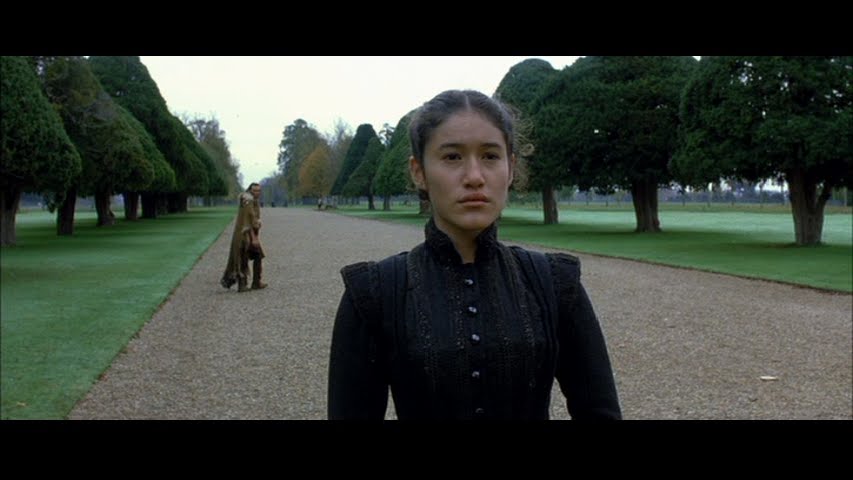 Rolfe tries to remedy this splinter, by the fortune of having the King's invitation for himself and Rebecca to appear at the royal court in London. "Life has brought me to this strange new world," she says to one of her father's chiefs (Wes Studi) in London. For her, London is as peculiar and beautiful as Virginia was for Smith at the beginning. At Westminster Abbey, we may interpret her as being something to be ornamentally displayed, stared at as a curiosity like the caged raccoon (for which she has great sympathy) and a shackled bald eagle, images which continue Malick's interest in notions of imprisonment vs. the longing for absolute freedom. Whereas the world was unbounded in Virginia, London is laid out in sculpted stone, music set to perfect beats and constructed harmonies, with trees trimmed with symmetrical handsomeness. The myths of Christ's passion are displayed on stained glass windows. We might interpret these spaces as sterile, much as some will look at contemporary Houston in The Tree of Life, but I don't think that is Malick's aim. He finds this world beautiful also, even though it is also rife with distractions that result in groundlessness. "Mother, stay near me," Pocahontas says at this point. In her clothes, vanity mirror, and hair brush, we may see in Rebecca a mere ghost of the Pocahontas observed through nature. And yes, the outlay of London and Westminster Abbey displays how civilization is in its representation of our world a shadow. Something is lost, just as a few particulars are heightened.

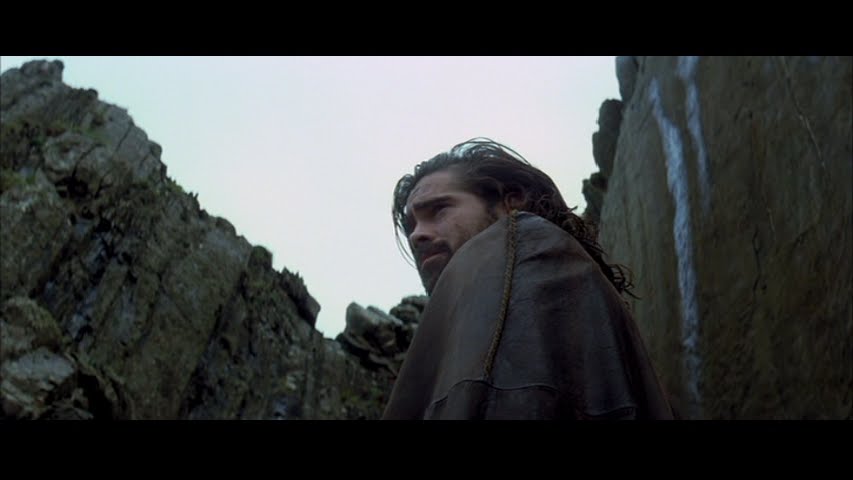 The conclusion of the journey has Rebecca/Pocahontas confronting Smith, who has returned from his fruitless travels that found him stopped at the cliffs of Newfoundland. Rolfe understands that his belief to make Pocahontas love him was "vanity," and "that one cannot do that, or should not… I will not rob you of your self-respect." "You are the man I thought you were," she tells him, "and more." When Smith sees her, now as Rebecca, he admits that it feels like it is seeing her for the first time. He has remained changeless, trapped in the past, imprisoned by the lost chances for Love while searching for his Indies. He was sidetracked just as Mr. O'Brien finds himself in The Tree of Life. He confesses to her his torture: "I thought it was a dream, what we knew in the forest. It's the only truth." He lost touch with the glory in bending himself to a social duty, falling in line with the objective, exterior voice instead of the interior one, which originally guided him "towards the best." "Did you find your Indies, John?" she asks. "You shall." He is overcome with remorse. "I may have sailed past them."
 Rebecca is reconciled with her present, being with Rolfe and living as a citizen in the large structure of a sculpted civilization. Playing hide and seek with her son, Thomas, maneuvering around thick hedges, Wagner's prelude once more begins. She is not Rebecca, nor is she Pocahontas (the classic name is, after all, not once uttered in the film, and Malick relies on us to know our own mythology), even though she is both. She has discovered the glory in every moment which was always with her, and so is everywhere. The incident of spaces and times are like masks that Eternity wears, something wholly abstracted in The Tree of Life, where during the "Shores of Eternity" sequence we see a floating mask. "Mother," Rebecca/Pocahontas reflects, closing her eyes, "now I know where You live." Malick does not spell out the concrete answer for us, because it is not concrete. It's felt by Pocahontas. It is intuited.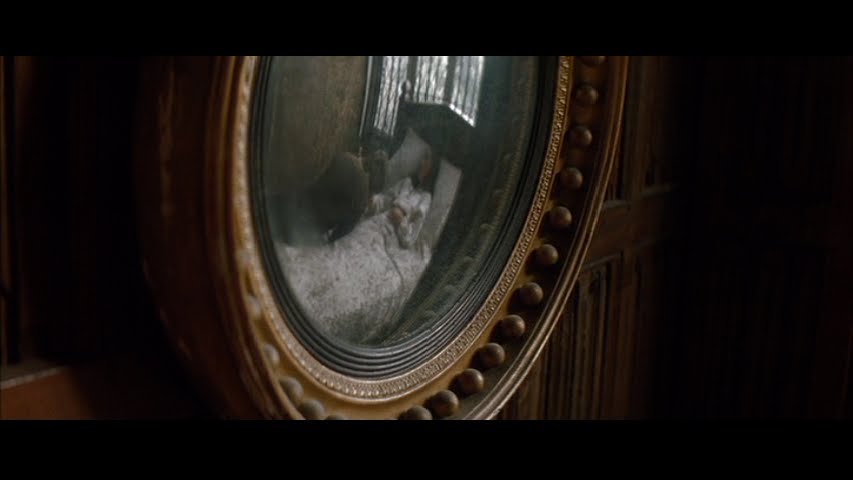

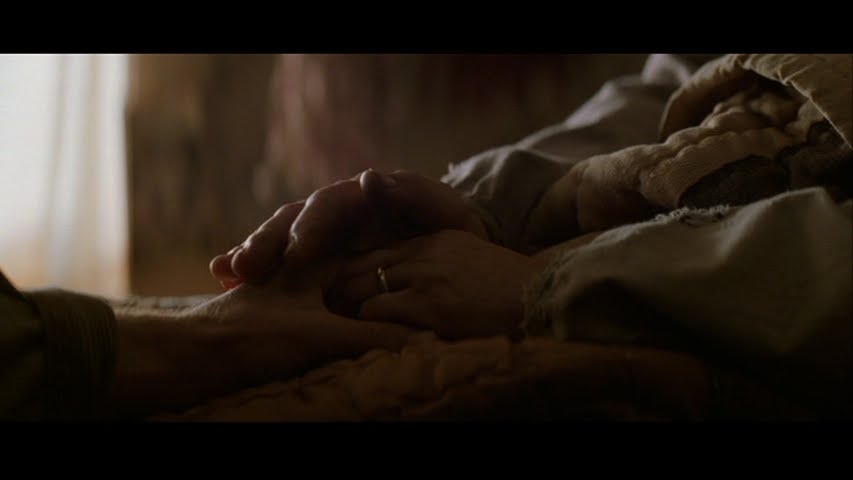
 This epiphany cross-cuts with Rolfe's written narration of how Rebecca has died, an event that for Thomas will one day "be a far and distant memory." We see Rolfe mourning at her bedside, the two figures reflected in a picture frame. "She gently reminded me all must die," he says, and this moment powerfully recalls the death of Witt's mother in The Thin Red Line, where the Mother is joined to her own child self, her spirit. Rebecca does cartwheels, and it is apparent that she is one with her original self, Pocahontas. Her death bed, empty, cuts to the opposite view where a shaman sits, looking back. Another angle shows the shaman, who may well be Pocahontas/Rebecca's spirit, running freely through a doorway, into the wild. Rolfe's ship docks back in Virginia, the camera returning Pocahontas to her home, just as we see her gravesite at Gravesend, England. There is no more Time. Eternity is present: she can dance and run with joy just as she can die and be buried, and then have her spirit return to the land of her birth. Just as there is no time, there is no division here. This is a challenge for us when Hollywood has conditioned us to look at colonial dramas as being Nature Good, Civilization Bad, as if the binary was irreconcilable. Malick certainly has his heart in Nature, but he understands that the dichotomy is a false one. Everything flows into everything else, much as Past, Present, and Future do. The music ends with water flowing over rocks in the Virginian wilderness, a tree looming over us. It is not until we see a creature (Insect? Bird? Maybe a flying squirrel?) fly away from the tree that Malick ends his picture, perfectly.
 The New World is a document that lays out our language, histories, and civilizations, a beautiful revelation of false contradictions, how nothing is permanent just as how it is nothing but. In observing spoken language, both interior and exterior, Malick magisterially makes the language of cinema startling and new also, looking for a filmic syntax that is expressive of who we are, how we think, how we reflect, our consciousness. The film plays out, much more radically than The Thin Red Line and Days of Heaven, as a collage of fragments, or moments that cannot be held onto though they linger on in their unlikely unity later on as endless echoes.