Search This Blog

Sunday, June 23, 2013

The Last Generation: Richard Linklater's "Before Midnight"


The fixture of her eye has motion in’t,
As we are mock’d with art. — The Winter’s Tale
“Every generation believes they’re witnessing the end of the world,” says the revered writer Patrick (Walter Lassally) to the dinner guests of his Greek isle  summer house. He wearily undercuts the practicality of hindsight, saying, “But I feel that I’m actually living it.” But the new Vesuvius eruption is more abstract than viscerally cataclysmic. The world that’s changing is the notion of what is human, and how they relate to each other.
Before Midnight
Jesse (Ethan Hawke) and Celine (Julie Delpy) in "Before Midnight"
This eschatological thought is from probably the central conversation of Richard Linklater’s Before Midnight, the third film in the trilogy that began with 1995′s Before Sunrise and 2004′s Before Sunset. This pivotal section is the moment when the series opens well up beyond its principle characters of American writer Jesse (Ethan Hawke) and the more jaded but politically activated Celine (Julie Delpy), the twenty-something lovers who met on a Vienna train in 1994 and had a one night stand, and met nine years later in Paris, disappointed with where their lives had drifted, dreaming of each other (Jesse writing a book of that Vienna one night stand, Celine a song) while attached to other partners.  Now, on the precipice of middle age, we see that Jesse and Celine have long been committed to each other — though remain unmarried — with a pair of twin girls, living in Paris, and struggling to make time for Jesse’s son from his failed marriage, Hank (Seamus Davey-Fitzpatrick). On holiday, the couple again reflects on romance and existence. The ideal consummated in a long term relationship, they’re no longer the only two people in the world, as it were, and the fulfillment of longing brings no finality to regret and uncertainty. We’re with them. A generation of moviegoers has grown up with Jesse and Celine, and Before Midnight reminds us how the world — romantically, existentially, technologically, cinematically — moves on without us, a thought that is both simple and horrifying.
Though driven by dialogue and the pretense of ideas, these three films all transcend any limitations of scope by the rich undercurrents suggested by those ideas, particularly how one Self relates to their surroundings, which Linklater has explored from his entry to the public eye, himself playing a philosophical dreamer wondering about the matrix of life paths in the opening moments of his first film, Slacker (1991). Before Sunrise was marked by its carpe diem longing and wistfulness, hopeful romance in seizing hold of an opportunity with another before time runs out. Before Sunsetponders the regret associated with such passion — the exuberant recklessness of reaching out for a beautiful stranger and connecting has haunted these two, the romantic getaway of the one-who-got-away festering over “Real Life,” real long term relationships, children, and responsibilities: “Forget me not” has the flip side of, as Celine says, “I didn’t forget you — and it pisses me off.”
Well — now they are together, they have children, they’re on vacation. But, as Celine notes while looking at Grecian ruins, the world is (still) fucked. The two attractive youngsters, Delpy making her initial mark for the great cinematic iconoclast Godard and Hawke who was encouraged to “seize the day” by Robin Williams in Dead Poets Society (soon taking it easy as the era’s definitive slacker in 1994′s Reality Bites), are visibly aging, in form and in spirit. Young romantics yearning to take a leap of faith may have fallen in love with Before Sunrise in the post-grunge 1990s, Gen X’s postmodern awareness encapsulating a historical notion of consilience through its abundance of recorded images and references so as to master the flaws of previous and less enlightened generations, but satisfaction is less a tangible thing than something consecrated in stone or a memoir. As the movie continues after the credits, the characters continue to struggle. Life changes around them, and consecrated experiences eventually undergo abuse, like the chapel of St. Odile, patron saint of eyesight, whose shrine is visited by Jesse and Celine in Before Midnight, the iconographic faces having their eyes crossed out, probably by Turkish conquerers. Illumination is no guarantee of progress or finality.
Before Sunrise
Seizing the day: "Before Sunrise" (1995)
In an era when the End of the World is a conceptual interest to filmmakers — The Tree of Life, Melancholia, Seeking a Friend for the End of the World, The Road, all things Richard Kelly (Donnie Darko, Southland Tales, The Box),Collapse, Children of Men, 4:44, Herzog’s documentaries Encounters at the End of the World and Cave of Forgotten Dreams, the hilarious 2012, so many superhero films, the Walking Dead series, and the recent all-star comedy This is the End, plus so many more — I don’t think the sense of “the end” has hit me more palpably and with such force than with the comparably subtle Before Midnight. It’s not a devastating apocalypse or rain of fire, but the aging writer’s acknowledgment of “the end” more relates to a current generation’s anxiety with an oncoming “Post-Human” condition, a new sensibility altering the steady and romantic new religion of Humanism some have struggled to erect. Sometimes I feel like one of the Elves in The Lord of the Rings, moving on and away in a world that’s turned upside down for me.  A new system of virtual romance and sexuality, suggested at the dinner table, humiliates the cherished notions Jesse and Celine have embodied, for themselves as characters and for us as moviegoers. The kind of Hegelian “completion” of romantic love is something the younger couple, beautiful actress Anna (Ariane Labed) and her boyfriend Achilleas (Yiannis Papadopoulos), realizes is preposterous, impractical, and out-dated: they casually remark how their heated relationship will end and life will go on. It’s liberating, but also relates amorous feelings to mortal ones. Time matters, Linklater understands, and while Anna and Achilleas are probably more wise than Celine and Jesse at the same age, it’s worth wondering if they have any sense that they will get old, as the information bomb of virtual efficiency keeps them fixed, without any temporal context beyond Right Now.
The Grecian setting matters not only for the ruins accentuating the sense of erosion in time, but because we understand that this country is a hotbed of heated political unrest, a beautiful vacation spot that could erupt in a revolution at any moment, much like the Vesuvius volcano that swallowed Pompeii and held victims in the grapple of permanent death. The flash-heated bodies of solid ash, who experienced what was to them the end of the world, were a central aspect of Roberto Rossellini’s Viaggo in Italia, another film about a strained relationship which, in this film, Celine half-remembers seeing as a child. Under the inevitable cloud of death there’s a tension of independence and union, shrewdness and empathy, selfishness and compassion. Invoking Skype, Facebook, and smart phones, Before Midnight shows how the world has changed since 1994, when a long-distance couple like Celine and Jesse couldn’t have thrived because of the necessities of recognizing the physics of spatial relationships between people, even as the technologies that surround us presently were thriving in a healthy infancy. The ash bodies of Pompeii desperately held each other close in those final moments (“Life is so short,” Ingrid Bergman says while looking at the bodies inViaggo in Italia), even though one body self must differentiate itself from others. “Know thyself,” the writer Patrick recalls the Delphi oracle at the Temple of Apollo. But, Jesse asks, how do we know ourselves when so much of who we are is automated anyway? Is the Self an illusion of free will, without a need to seek out silly concepts like completion or a “soul mate” in an Other?  “The future of humanity” means the possibility of selfishly fulfilling corporeal and carnal pleasures, like the lab rats Celine recalls, who would rather have constant orgasms than food.
Before Sunset
The burden of memory: "Before Sunset" (2004)
That last point is applicable to where the movies seem to be going, the Before trilogy being the ultimate anachronism in franchise films (probably the lowest grossing mainstream franchise in history) when an imploding system swerves away from hard-copy economics to virtual efficiency and streaming exhibition, its profit margins diminishing and forcing studios to take fewer risks with substance while amping more money in carpet-bomb marketing and escapist, high-voltage non-stop stimulating aesthetics where the content has minimal ambiguity, character, dissatisfaction, and strangeness: in a time of uncertainty, economic and romantic, the only thing that seems fixed, so tweets critic Guy Lodge, are super-hero sequels.
This goes beyond content and more so applies to form. Gradually, summer studio blockbusters have shifted away from any relationship with real environments in favor for the weightless, if 3D, surfaces of computer generated animation. The trickery of the camera eye lying 24 times a second has become technological wizardry. By contrast, Linklater’s film is abundant with seemingly endless takes, the camera following its subjects for over 10 minutes in one case. It’s a technique that not only sutures anxiety into the story, the viewer’s cinematic unconscious thirsty for a cut so as to blink or breathe, just as these characters are stuck with their emotions and sometimes ill-chosen words that alter existence from one second to the next, but it also seems in line with a longing so specific to the visual and aural medium of film, where time is luck, time is precious, and the filmmaker desperately clings to passing moments, refusing to let the physics go. By contrast, the ultra-sensory filmmaking of Man of Steel or Iron Man 3 or even a drama like The Great Gatsby, whether they are good films or mediocre, have let the ramifications of space and time go. Hollywood has embraced the unbearable lightness of the new. Its spectacle sells itself and is the cinema’s way of competing with television and video games, which continue to boom as the private living room with its ready-made subscription services replaces the public sanctuary of the theater.
Alluding to Milan Kundera’s 1984 novel seems fitting because the heaviness that plagued Jesse and Celine in the past now rolls over to a contagion of lightness in relationships, for better or worse. Skype and Facebook can allow young Hank (whom we hear had his own summer romance before flying back to America) or Anna and Achilleas to carry on a friendship or relationship, where two people simulate sleeping together by falling asleep with open laptops on their pillow.  Another dinner guest, the middle-aged Stefanos (Panos Koronis), an affable man who appears to be very happily married with the equally playful Ariadne (Athina Rachel Tsangari), admits, “Sex of the near future…is going to be just like plugging in, attaching something to your genitals, and you’ll be having virtual intercourse with anyone of your choice. You’ll be able to program in all of your preferences. You’ll be able to type in exactly what you want.” Celine, perhaps mocking Jesse’s romanticism, jokes that she likes that idea. But there’s a graver and melancholic implication. The chess master Kasparov is mentioned, who eventually was bested by Big Blue. The machine would seem to “lack that ineffable human element,” but it’s coming to a stage when the humans can’t compete. In the supplication of orgasms or movie special effects (could Francis Ford Coppola be allowed — or would he even consider – the live-action helicopter attack from Apocalypse Now in 2013? Would Regan in William Friedkin’sThe Exorcist be the construct of an actress and special makeup effects, or would he be pressured to defer to computer efficiency?), that “human element” existing on a plane of real time and space is losing out, its downward spiral ineluctable as much as “privacy” is in a world of increasing social networking and surveillance. Lightness in sex and love and economics and politics and cinema, without the weight of commitment to people, space, and time constraints, is not a temptation but a mandatory expectation.
Before Midnight
Back to the future: "Before Midnight"
In love or economics or cinema, which could all well relate to one another, it’s difficult to make a judgment without sounding appearing somewhat pedantic and old fashioned. Categories are being redefined and a post-modern atmosphere of interpretation opens up everything, especially ethics, to revision. Increasing technological progress and knowledge has given us, according to Steven Pinker, the least violent period in our short history. But altruism, charity, and compassion remain specialized and diminishing tastes. After the 2008 economic collapse, Ayn Rand became insanely more popular. Celebrity culture engenders more vanity and narcissism. Bigger box office doesn’t only matter, but immediate first day box office carries with it a film’s lasting legacy, and tabloid stories about a film’s actors are more significant than the film’s (or performance’s) substance (for example, in 1993 Winona Ryder’s performance as May Welland in The Age of Innocence was universally praised and rewarded, for good reason; the social modern-day perception of Ryder has tainted the memory, becoming fodder for lame Family Guy jokes), a point vibrantly essential to Sofia Coppola’s new, and I think angry, film The Bling Ring.  In Before Midnight, the once idealistic activist Celine is done being a do-gooder, and sees the light in lucrative opportunities, eager to take on a high-paying government position even though she dislikes the man for whom she’ll be working. “The world is fucked,” she says, giving up on idealism. This is not at all to say that she’s wrong in seeking a good job offer (Jesse’s protestation, decrying how this new boss only represents “ambition,” points to something may be just as much petty resentment as it is a disdain for capitalism and greed), as there’s practicality and reason in the self-reliance success affords: why the hell not? She deserves it, and in this family she is self-identified as “the general,” whereas Jesse is stuck in his literary thoughts. With accomplishment, pleasure, leisure, and individuality are granted, along with liberation and freedom. At the Greek dinner, Anna and Achilleas accept an eventual severance, which both of their parents either had or would have hadcould they afford it. Meanwhile, the gracious flux of technological interactivity and practicality — superseding the Gen X matrix of immediate hindsight — dismisses tired concepts like “romantic love,” or a “soul-mate” who will “save us from loneliness.”  In the digital/virtual prism, there is no distance between individuals, and there no longer is “time.” Though the aging writer is conciliatory with the young couple, saying that he and his late wife “were never one person, always two, and we preferred it that way,” and that “it’s not the love of one other person that matters, it’s the love of life,” there’s an uneasy feeling of luxurious solipsism, assuming you can afford it along with the adequate technology.  Indeed, the big impediment for Celine accepting this new position is her relationship with Jesse. With so many opportunities in a global landscape, how is a monogamous “forever” relationship feasible? Celine herself sees the End as she mentions her prospect and Jesse intimates moving to Chicago to be closer to Hank: he’s headed West, she’s headed East. This is how things fall apart. And being that everyone’s free to pursue their passions, shouldn’t it be so?
Meekly countering these insights is the elder woman at the table, Natalia (Xenia Kalogeropoulou),who did feel complete with her husband. When he used to lie next to her, she “felt safe. Complete. Lately, I’ve been forgetting little things. He’s sort of fading and I’m starting to forget him. It’s like losing him again. So sometimes I make myself remember every detail of his face. Sometimes I can actually see him. But then — the real world rushes in and he vanishes again. Like sunlight, sunset, we appear, we disappear. We are so important to some, but we are just passing through.”  The woman’s touching speech is sort of patronized by Jesse, who raises his glass and says, “To passing through” (he can’t witness anything poignant without consecrating it through ritual), but its sentiment captures the precious longing in Linklater’s cinema, or an idea of cinema generally: the futile yet beautiful pursuit of permanence, which was once captured in explosions of photochemical idiosyncrasies, and now is the reprojected data of binary units. The slackers and dreamers, who in their twenties thought they were doing so many important things (Celine as activist, Jesse as writer), wander around through ruins and interrogate each other by setting expectations of the present against the past (would you get off a train with me today?), Jesse sometimes wearing a record store shirt, denoting a dead method of recording sound, while Celine’s smart-phone has the outward appearance of the similarly extinct analog cassette tape. From these environs, Socratic philosophers debated the value of memory vs. recorded writing (and the Before films play so much like a series of Socratic dialogues), Socrates himself signaling writing as the beginning of forgetfulness. But the impulse in witnessing an important  sound or thought or image is to transmute it through recording it (on paper, on vinyl, tape, film), owning time like love gives way to, as one character implies, colonizing the beloved, maybe a present day wedding ring being to love what a film is to fragments of time.  But it can never be fully owned, colonized, possessed, etc. The old woman’s frustration with the phantom of her late husband, vividly remembering him just as he becomes vague and blurry, is a paradox of memory. As a character remarks in Sarah Polley’s investigation into her parents’ love lives, Stories We Tell, love is short while forgetting is long.
*
Before Midnight‘s anxiety about past and future hinges on the impact parents have on children.  This plays out with humor in the early car ride, Jesse and Celine’s twin daughters sleeping in the backseat and missing out on the Greek ruins. Jesse eats one of their apples and Celine snaps a picture of it, to prove how he took food out of the mouth of his children. But Jesse is wondering about Hank. “It’s a crucial time for him,” he says, wishing that he was there to be the guiding light his own father never was. When it comes to throwing a baseball, “a father is supposed to teach you.”
Before Midnight
The film’s first scene, with Jesse saying good-bye to Hank at the airport, shows the disconnect between generations, Jesse’s questions of concern given one-to-three word answers.  We gather Hank plays piano and has important recitals. He used to play team sports like soccer but, believing he’s not that good, might give up. “Team sports are important,” Jesse stresses. But Hank doesn’t care. When Jesse mentions visiting later in the fall to see a piano recital, Hank is irritated. He doesn’t want his father there, because it would bring a lot of tension into the environment considering how much Hank’s mom hates Jesse (though we gather she might hate her new husband more). While Jesse wants to be there for the classically important moments in a child’s upbringing, Hank just wants to spend leisure time with his dad. This might be something that Jesse doesn’t understand, in parenting or in life generally. Everything is a ritual for him, and Linklaterian slacker that he is, his moments at St. Odile’s chapel, in addition to his wine toasts (“I don’t want this meal to go by without just saying ‘thank you’ to everyone”), denotes an impossibility to “just be,” to let time go leisurely without sanctifying it.  As a film character, Jesse has always embodied “carpe diem” but still things slip away from him, as we see in one of the most moving shots I’ve seen in any film of recent years when we watch him watching Hank solitarily disappear into the airport’s halls of electronic efficiency and security.
Jesse was given an impossible riddle through time: pursuing and attaining the one that got away, Celine, and letting go of an unhappy marriage when he already had a child, whom he loves very much. There was no way to ensure anyone’s happiness in the scenario in which he found himself. He could go back to America, where he would be able to see Hank every other week instead of every few months — something we understand, along with Celine, isn’t worth it. The book’s been written and can’t be revised — and maybe worst of all, he made it a “book” in the first place.
Jesse and Celine’s romance was put into print by Jesse as two novels, This Time (which is basically Before Sunrise) and That Time (Before Sunset), where the latter film’s ambiguous ending is explained for us as the two of them making love for days. (His unease with time continued with a longer and more ambitious third novel, Temporary Cast Members of a Long Running But Little Seen Production of a Play Called ‘Fleeting’). This means reducing Celine to a character, the projection of his fictional representation of reality. Creative as he is, and as conciliatory as he is during many of the couple’s arguments, Jesse struggles imagining the reality beyond his bubble of sight. Everything is not only sanctified, but aestheticized — a play, a novel, a story, a myth, which is the romantic’s foil: “This place is full of thousands of years of myth and tragedy, and I thought something tragic was going to happen,” is said, as if with disappointment. As Jesse’s work-in-progress indicates, perception is a bigger problem than time: his characters include an old woman in a perpetual state of deja vu; a man who can’t recognize faces alongside a woman who can remember vividly every face she’s ever seen; and a young man who only sees the transient nature of everything: he sees a beautiful lake and then only senses the dry fossil bed there in the future. The characters are linked through various time periods (1954, 1979, 1993) by the film On the Waterfront, a picture (which through film studies and Elia Kazan retrospectives, is constantly reevaluated) about a man whose chance came and went.
Before Midnight
Framing his story: Ethan Hawke
Life is written and presented for Jesse (he even reads books in his dreams), made concrete, whereas for Celine it’s more ephemeral and abstract (in her dreams, she flies around like a super-hero; she’s like the air). The horrible mother Medea, equated with Hank’s biological mother, is a myth for Celine but is Euripides’ play for Jesse, something authored and performed to script. But he’s wrong — the more generalized myth of Medea predated Euripides. In the chapel we also feel that Jesse would feel more comfortably if the two of them were married, while Celine — who’s been lying to her family about them being married — is more content to be legally single. The relationship is harder to pin down for her, and she is resistant to signing a copy of Jesse’s book for his fans, who connect her with his autobiographical heroine. “It’s me, but it’s not me at all,” she says to Jesse’s readers, a couple who connect their own relationship to the novel’s characters. “Women explore for eternity,” she says, while Jesse wants to lean on permanence and something solid.  When Celine righteously voices her indignation, he says, “The Nobel committee is taking note,” meaning that any gesture or thought is complemented with a plaque or award. Meanwhile, her way of getting on Jesse’s good side is to play a role – in particular, and quite humorously, a bimbo, an affectation she demonstrates for Patrick’s dinner guests to great amusement and then, I think something of which we should take note, during the film’s closing moments, when we think we’re safely wrapped in a happy and safe ending.
The film’s most painful section transpires in a hotel room, where Jesse and Celine have accepted a gift of spending a night together along with free wine and a massage. Jesse has sex on his mind (himself playing the role of a Spanish — or Greek — lover), while Celine misses the girls. The inability to relax with each other connects to how change is a constant issue. “All the red in your hair is gone,” she says to him, the red being something she found very attractive. “You’re not going to tell me that love is dependent on pigment, are you?” he replies. Ideal love, never relaxing, gives way to endless projection of how I see you and you see me. Would the 41-year-old Jesse ask Celine at the same age to get off a train with him? He says he would, and I believe him when he says that it was the best thing he ever did, butright now, his wandering and sad eyes indicate that he’s miffed on what he’s missing out on: we saw him look attentively at Anna’s luscious 20-something body earlier, and it’s basically validated that he had a quick affair while on a book tour. Celine could herself be so far ahead in life without the pressures of this relationship, with someone more successful and accommodating. Jesse’s insecurities are revealed in his certainty that Celine gave former Soviet leaders blow-jobs, which are probably the result of his own transference of guilt.
The scene is a collision of masculine and feminine, his approach being conciliatory if condescending, a degree of rationality that leads her to press all the right buttons for his undoing — specifically, mentioning how he’s “no Henry Miller, on any level.”  The way we take our own sides in this scene could waver back and forth, because their flaws both are nakedly flapping before us. The slight against Jesse’s sexuality and artistic talent is unnecessary and makes me more sympathetic to him. She wants to stir things up. He sees anger and sees something negative (“the perpetually discontented” human state), while she sees great things in their children fighting.  But maybe her motives are in the right place. Jesse has become a colonizer in this relationship. He lives in France but doesn’t speak a word of French (less so than in the previous two films, when he was a tourist and not a resident) while Celine and the children speak good English (with his occasional correctives). He’s presumptive that she would go along with his plan to move to America and abandon her occupational ambition. Jesse, the writer, can only see the narrative, the script and words, the documentary and film. Celine arouses the volcanic and unpredictable chaos swirling around the words chosen to document memory and reality. “This world has been fucked by rational men,” she says, bringing up Cheney, Rumsfeld, and the Final Solution.
Before Midnight
It feels very close to Stanley Kubrick’s remarkable Eyes Wide Shut, when sexual arousal and deep arguments waver finely together like the crimson reds and deep blues of the color scheme. The woman obliterates the man’s certainty and calm with something very self-evident to which he’s been selectively blind. Throughout his own psychological odyssey, at the conclusion he still wants the reassurance of “forever,” which the woman can’t give him. It’s a word that frightens her. Before Midnight doesn’t indicate the same kind of illumination Kubrick’s couple may have. Jesse continues to play a role, this time as a man from the future sent by Celine’s elderly self to go back with that boy she first met on a train. It’s sweet and funny, but note how Jesse is still resolutely writing his version of Celine, even if it’s an 80-year-old incarnation. And though he may get the satisfaction of sex and togetherness at the conclusion, she has to defeat him before she gives in. Jesse has to stretch out his story to absurd lengths, realize its stupidity, and then say, “I give up” before the fascinated naive girl comes back to play.  Linklater pulls back and the two are once again affable, playing roles, forgetful or running from the confusion of the last 24 hours. It’s neither happy or sad, but it is fiction, emblematic of the illusory nature of this kind of idealized love.  He’s selfish and she’s “the mayor of fucking Crazy Town,” and even though the world is moving on and away from Jesse and Celine, they’re not ready to yet drift apart.
It then comes back to us. The Before trilogy has overstepped big budget franchise competition in becoming the first truly interactive experience for the generation that grew up with videogames — and for whom movies, at least as we knew them, threaten to go extinct.  As much time has passed between now and the release of Linklater’s Dazed and Confused as that film’s documented time of the mid-1970s and its realization.  Here he pays reference to The Winter’s Tale, the young beauty Anna having played Perdita, a character who grew through 16 years believing she was one person — through the fault of her father — and then realized she was someone else; Shakespeare likewise features the Delphic oracle, that bestower of the wisdom to “Know thyself,” and like Jesse, the king Leontes is unable to see anything beyond his own self.  So it is with me. My memories of Before Sunrise in 1995, conjoined with fanciful projections with this couple who predate my first long term romantic relationship by a few years, are always shifting, along with Before Sunset and now Before Midnight (I think I nowadays most readily identify with the 30-something Celine from Sunset). In the last year I’ve been fortunate to have very significant reconnections with some treasured partners, seeing how we’ve moved on and in other ways haven’t. Linklater draws awareness to the implications of time and vectors of movement, and to the ongoing trajectory of emotional connections along with lapses or silences: Jesus, the things we’ve seen. Like Moonrise Kingdom last year, Before Midnight so greatly affected me that I required long periods of walking and wonder afterward.
Before Midnight
Some frustrations of my recent moviegoing experiences connect to how several (not all) spectacles go through me like a bag of prunes: loudly and, ahem, explosively, leaving me empty inside — two hours in a Thunderdome disconnected from everything else; life is forgotten, and so is the film. Everything is numbed. Before Midnight brings me back to the curves and reservoirs of my life and memories. We see how Viaggo in Italia and On the Waterfront figure into characters’ lives (or the lives of characters who are the inventions of characters), as Linklater’s trilogy does with us, expressing that sentiment in that moment from Citizen Kane, where the aged Bernstein says how a day hasn’t gone without remembering a girl with a parasol he spotted as a young man. Cinema is in dialogue — often selfishly, sadly, and in disagreement — with life, and not apart from it, like the statue coming to life in The Winter’s Tale. Moments are set against other moments, and people project onto other people, for better and for worse. It’s all commensurately valuable and heartbreaking, maybe the paradoxical bargain of both movie love and people love. When all things are predisposed to change and decay, I don’t know if the pain’s worth it, yet what would life be but listless automation of an endless series of satisfactory Now moments were it otherwise?

Monday, May 20, 2013

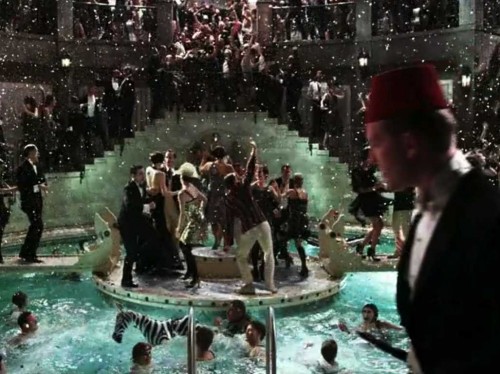
The One That Got Away: Baz Luhrmann's "The Great Gatsby"

Writing about The Great Gatsby might be like making a film of it. I can hear Mickey Rourke in Body Heat telling me, “There are 50 ways to screw up when you’re doing Gatsby. Figure out half of those, you’re a genius.” And, though you don't have to rub it in, I’m no genius.

I do love F. Scott Fitzgerald and his heralded novel, though I’m not sure I love it for the same reasons a lot of other people do. Reviews of Baz Luhrmann’s new and mostly faithful adaptation of Gatsby are divided, sometimes condescendingly hostile, sometimes suspiciously defensive (they kind of sound like me talking about Godfather III). There’s an inconsistency to what works and what doesn’t, what Luhrmann should have done vs. what he did do, and a lot of it goes back to critics’ impressions of the novel. Did Luhrmann respect the text, or did he trivialize it? My conclusion is that he respected the plot and incidents, but a refusal to let the story breathe along with ignorance to the novel’s stinging ironies and textures has resulted in a gross, even insulting, trivialization.

The themes of Gatsby are repeatedly thrown around: the Jazz Age, class, lost love and lost time, the frenzy before the storm of the Depression, and “America,” whatever that is. Then there’s the iconic symbols and images like the Green Light, the Eyes of Dr. Eckleburg, the Valley of Ashes, the new rich of West Egg vs. the old rich of East Egg, and the unforgettable description of Myrtle Wilson’s detached, floppy breast. There’s the familiar cast of Gatsby (Leonardo DiCaprio), Nick Carraway (Tobey Maguire), Daisy (Carey Mulligan) and Tom Buchanan (Joel Edgerton), Jordan Baker (Elizabeth Debicki), George and Myrtle Wilson (Jason Clarke and Isla Fisher), spread widely apart in a web of passion across New York and then tragically tied together in the final act. Fitzgerald’s novel carries intimations of transcendence while wearing the costume of hopeless romanticism. It’s about accomplishing aspirations and moving beyond the confines of a given identity, the hero as shape-shifter. It centers on the boy/man “child of God” who moves mountains to win the girl/woman he loves, while she embodies the fantasy anyone may have of being so loved that another would do anything to be with them.

Because of that, Gatsby is misinterpreted as a love story, a kind of Jazz Age Tristan and Isolde (which, with the novel’s references to mythic and medieval images, was probably on Fitzgerald’s mind) with the poor boy trying to win the rich girl, climbing high, grasping for satisfaction, and failing, the lovers foiled by the mores and structures long held in place. Certainly this is pertinent to the tale, especially when one thinks about The Great Gatsby as being set in a world of tribes dictating identity and what a person can legitimately accomplish, an American ideal that is nevertheless repulsive to the ruling class who seem transplanted from European nobility, and who’ve evolved alongside the infrastructures of power.
My assessment of the film might not be fair, because we’re judging something apart from the book, and whether it’s Kubrick’s The Shining, Cuaron’s Harry Potter and the Prisoner of Azkaban, Davies’ The House of Mirth, or Fincher’s The Girl With the Dragon Tattoo (which addresses a similar point about remakes), the film must be ingested and processed by virtue of its own integrity and consonance.

The problem is that films don’t exist in vacuums, and Gatsby brings with it some great baggage as, um, one of the main contenders for The Great American Novel. Luhrmann relishes the big city verve and delectable vice while neglecting the significance and lost simplicity of the whole nation behind the extravagance — the place that all of these characters are from, and from which they’re running. Luhrmann is also telling a sincere love story, when Gatsby was undermining a love story. A number of critics have alleged that the fault of this film is that old tired trope of “style over substance,” but that’s crap. Even if Baz Luhrmann’s style never hits the right register for Fitzgerald, the problem is his calibration of the (quite) abundant substance.

Bluntly (and with apologies for the cliche), Luhrmann doesn’t know the music, but he certainly knows the words. The aforementioned films, most particularly The Shining (detested by author Stephen King), effectively built atop their source material to become  richly fascinating independent organisms, yet Luhrmann’s The Great Gatsby refuses to free itself. The writing is literally scrawled out for us and several passages are spoken with Tobey Maguire’s sludgy narration as Nick Carraway — ironic, because Fitzgerald’s Gatsby could be interpreted as a story about the insufficiency of words, which we use to capture lost time in a script (Daisy must repeat Gatsby’s dictated words to Tom: I never loved you). The structure, even repeated flashbacks, is scrupulously in accord with Fitzgerald’s eight chapter chronology. Luhrmann fetishizes Fitzgerald’s particular details, such as the curtains at the Buchanan residence which blow through the room “like pale flags twisting…toward the frosted wedding-cake of the ceiling, and then rippled over the wine-colored rug, making a shadow on it as wind does on the sea,” while literalizing others, like when Nick says that he’s both inside and outside of the decadent world of New York, looking out over the city with the camera falling onto him looking up from the street. Luhrmann throws in most of the plot points, even some details and dialogue from other Fitzgerald stuff (such as “The Crack-Up,” selected letters, biographical data, and Gatsby‘s inferior early draft, Trimalchio) but he fudges with the nuances in between the incidents. It can perhaps be defended then as a dazzling auteur statement, Baz Luhrmann’s The Great Gatsby, but it’s rather infuriating when you consider how the filmmaker panders for an audience that indulges in blindness and illusion (and yet again — a postmodern reading here justifies this Gatsby entry, what with its 3D cinematography and the motifs of seeing and blindness taken from the book, even including Jack White’s cover of U2′s “Love is Blindness”).

Luhrmann’s made a Gatsby that’s more palatable for audiences, his renowned (or infamous) PG-13 Ken Russellfied visual audaciousness hushed by textual cowardice. The Great Gatsby becomes a Moulin Rouge! tempered love story, a big city tragedy with East Coast decadence doubling for the TMZ Kardashian madness of the 21st century where we’re pretty sure who to root for. The full story, framed by the original device of the now morbidly alcoholic and depressed Carraway writing his reminiscences of 1922 at a sanitarium months after the 1929 crash, warmly blankets the wounds of a crippled and hungover nation after its expired Gilded Age.  The titular Gatsby here is indeed, as the final moments emphasize, great — and not “great.” What would originally conclude with a hushed death rattle of wasted melancholic futility before the future, where longing leads nowhere, is now reverent and consoling.

The problems of the novel — the amoral character of Daisy, the ambivalent presence of Henry Gatz and Gatsby’s relationship to his origins, the symbiotic relevance of George and Myrtle Wilson in relation to the question of marrying for love, Nick’s questionable sexuality and how his adoration of Gatsby might be, as Tom Buchanan tells him, based on the same kind of blindness that’s trapped everyone else in the narrative — are worked out for us or ignored.

In the film, the love between Gatsby and Daisy is total and mutual, without her apathy, privilege, or his resentment that flows between the tenders of his affection. In truth, Gatsby doesn’t simply want to love Daisy, but he wants to control her, an adoring and adored puppet of flesh and blood representative of a world that’s been denied him because of his station. He lied to seduce her initially, and he schemed his way with a variety of other fronts to “earn” her as a wealthy man. There’s a lot of contempt for the object of desire in The Great Gatsby, and one might remember that Fitzgerald wrote it while nursing wounded pride, recently discovering his wife Zelda was having an affair with an aviator (he also apparently called his first love, Ginevra King, the primary influence for Daisy’s character, “an unprintable verbal insult” when they met again).  “Her voice is full of money,” Gatsby says to Nick about Daisy in the novel, something carefully omitted by Luhrmann, a director who wants his (mostly) female audience to identify with her, when in fact her privilege makes her something of another species from the worry-laden lives of Gatsby and Nick — and us.

In the novel, Nick deducts that Daisy is turned off by Gatsby’s West Egg party with the wild outsiders who come without invitation (“She was appalled by West Egg, this unprecedented ‘place’ that Broadway had begotten upon a Long Island fishing village–appalled by its raw vigor that chafed under the old euphemisms and by the too obtrusive fate that herded its inhabitants along a short-cut from nothing to nothing. She saw something awful in the very simplicity she failed to understand”). Not so in the film. Nick also believes that she’s responsible for Gatsby laying off his servants (“So the whole caravansary had fallen in like a card house at the disapproval in her eyes”). Again, this trait which would make us feel differently about her is left alone. And while we know that it’s her behind the wheel, crashing Gatsby’s yellow car into Myrtle, not only does Luhrmann’s Gatsby plan on taking the fall, but he also verbally says in the film repeatedly, “It was my fault.” Luhrmann cuts to a flashback of the accident and amidst the confusion of the wheel, with Gatsby grabbing it away from Daisy at the crucial moment, we are invited to believe him. Luhrmann also gives her the benefit of the doubt that she’d be tempted to call Gatsby after the accident.  No longer does she show off her daughter Pammy as a plaything who is handled by silent servants, but Daisy attends to the child in her closing moments, carefully preparing Pammy for a journey the Buchanans will take. Luhrmann’s Daisy gets a free pass, and I call total bullshit.

The aspirant glory of the Green Light loses its magic for Gatsby when it appears he’s won Daisy back while Daisy, though not happy with Tom Buchanan, isn’t unhappy. She’s contented enough and electively vapid, devoid of responsibilities while suffering Tom’s infidelities. Her lack of concern for her daughter, who emerges as a plaything to show off to Gatsby, demonstrates a present weightlessness. Time isn’t a burden for her. The Daisy Gatsby loves is in those fading words and promises in Louisville, five years before, a ghost roaming the West alongside the diametrically opposed ghosts of the rejected father, Henry Gatz, in North Dakota and Minnesota. It’s a faint echo that tantalizes while refusing to materialize into clarity.

All this kind of makes me wish that, with Luhrmann’s pop soundtrack sensibilities, the filmmaker would have included Jarvis Cocker and Pulp’s “Common People” from the Different Class album, a song about a privileged girl who wants to walk with the bohemians and stragglers, but will never understand them. (I also can’t help but feel Arcade Fire’s Suburbs album, where the sprawl of youth becomes spoiled with passing time, would fit in better with Gatsby than Jay-Z, Fergie, Jack White and others on this soundtrack, but maybe that’s just my stupid taste). Class is more tribal than race, and just as there have been theories of Nick Carraway’s bisexuality, there are literary theories that Gatsby is black. I don’t necessarily believe it, but there is definitely a racial subtext in the book, beginning with Tom’s praises for eugenic pseudo-science which predicts the end of civilization with the ascendancy of African descendents, and images like the black individuals riding in a limo–driven by a white man. The implication is that anything is possible on this side of the world.

Later on at the Plaza Hotel, Tom relates a roughneck like Gatsby romancing Daisy to “intermarriage between black and white.” This is in the film, followed by some original dialogue where Tom differentiates Gatsby from everyone else in the room, based on his poverty, but Luhrmann omits something Jordan says after Tom’s insinuation: “We’re all white here.” It’s something she doesn’t have to say, obviously, or which the narrator Nick wouldn’t have to remember. But it’s there for a reason, and the irony of Jordan’s line – of which she’s probably unaware – is that for Fitzgerald, the rich are different from “us,” or as Warren Beatty points out in Bulworth (a film remembered this week because of political happenings in the Obama Administration), “Rich people have always stayed on top by dividing white people from colored people. But white people got more in common with colored people than they do with rich people.”  For a viewing audience, the world of the Valley of Ashes feels much more alien than the Buchanan residence. I’m also not sure how I feel about Luhrmann’s casting of Bollywood star Amitabh Bachchan as Jewish gangster Meyer Wolfsheim, which is partially a playful reference to deceiving fronts cutting across tribal boundaries, and has been admired by critics as a way of bypassing the perceived anti-Semitic stereotype Fitzgerald created in the novel, Wolfsheim being a stand-in for real-life gangster Arnold Rothstein (played by Michael Stuhlbarg in Boardwalk Empire and Michael Lerner in Eight Men Out).  But it also feels like another refusal of Luhrmann to confront the troubling aspects of Fitzgerald. Is Fitzgerald, who elsewhere seems so sensitive to racism in the book (two characters use the word “kike”: the intolerant Tom and decidedly unlikable Mrs. McKee), the anti-Semite, or is Nick? Or is Wolfsheim’s conspicuous Jewishness another tribal marker in the chaotic power-grab of Gilded Age New York, his illiteracy and barriers requiring him to use the “fine breeding” of Jay Gatsby as his front?

Making matters easier for us, Tom becomes a bigger jerk, less humanely drawn. Fitzgerald certainly doesn’t allot him much sympathy in the novel, but Tom is still unexpectedly grief-stricken when Myrtle is killed, and hurt when confronted with the possibility of Daisy never loving him. Such feeling isn’t afforded him in the film, certainly when the talented Joel Edgerton plays him like a cartoon. There’s a telling alteration in the story during Gatsby’s party, with Tom becoming entranced with a movie actress and following her inside Gatsby’s castle for some certain debauchery (earlier with Myrtle, he is quite loud and impolite with his lovemaking as Nick awkwardly sits and stares at the couple’s dog — in the book he’s more discrete). The scene is different in the novel, as a drunken and suspicious Tom stumbles apart from Daisy and Gatsby’s flirtations. It’s Daisy who has her eye on the actress, the only familiar face for her at the party, and instead of Tom salivating over her it’s the actress’ producer, whose gaze falls closer and closer on her, as if spellbound — and rendered ridiculous — by an obscure object of desire. It’s an image that would be so wonderful for a Gatsby film, reinforcing the story’s paradoxical themes of gazing and blindness, of moth-to-flame obsession with an ungraspable surface of beauty, like a celluloid screen gem or wealthy and beautiful person (Daisy to Gatsby, Tom to Myrtle). But no, obviously there’s still some ambivalence about Tom for Luhrmann, so he makes the hulking husband more of a douche.

And so, faded are complexity and ambiguity. The villain is made worse while the damsel in distress and her knight are made better. A token tip of the hat is given to expectation that the rich are assholes, while the devastating disparity between wealthy and poor remains unexplored. Our ideals of pure love (while it may be quashed by social mores) are validated and unquestioned.  Then there is an all-star cast, a pop soundtrack, the dynamic fast-moving rhythm, and clothes, clothes, clothes that set tabloid radio and TV talk shows afire with delight.  How are we not surprised that Baz Luhrmann’s The Great Gatsby is adored by audiences and a solid hit in spite of its reviews?

It’s not that filmmakers can’t lick Gatsby. This new movie is well loved by some, and a commercial success — as was the listless and gauzy 1974 adaptation directed by Jack Clayton and starring Robert Redford, Mia Farrow, and Bruce Dern (who, despite his lack of physical similarity to the book’s Tom, gives an incredible performance that’s leaked into my subsequent readings of the book).  Sumptuously dressed and melodramatic, these two films aren’t Gatsby. They refuse to focus on the mystery of Gatsby and the distance of Fitzgerald, needing us to get close with Gatsby and Daisy through either lovely and romantic montages or scenes of awkward dialogue.  The filmmakers can justify this by citing Fitzgerald’s own dissatisfaction with the way he treats Gatsby too vaguely, and yet, if you read Trimalchio (which inspires the new Gatsby with a revealing scene between Gatsby, Daisy, and Tom), you see why the mystique of the final draft works.  Breaking through the walls to bring us closer to Gatsby, one wishes Luhrmann had completely reframed the story — which means taking it away from Nick Carraway. Luhrmann should have “betrayed the novel to be true to it,” as David Cronenberg repeatedly says of his adaptations, or as Milan Kundera simply told Philip Kaufman regarding the adaptation of The Unbearable Lightness of Being (another seemingly unadaptable book), “Eliminate.”

The truth is several filmmakers could probably give us the Gatsby Fitzgerald deserves, but if you look at my suggestions (Sofia Coppola, Terrence Malick, Terrence Davies, Andrew Dominik, David Gordon Green, Andrea Arnold, and considering the Before trilogy, particularly Before Midnight, Richard Linklater) it’s clear that — what I consider the appropriate sensibility anyway (excluding possibly Martin Scorsese, whose The Aviator with DiCaprio is a fantastic film about predestined apart-ness amidst the whirlwind of a luxurious in-crowd, so akin to Gatsby) — audiences wouldn’t bite and probably be turned off.

I also think of David Fincher’s most divisive of his recent films, The Curious Case of Benjamin Button, which was deplored by many moviegoers and critics as overblown Oscar-bait courtesy of Forrest Gump screenwriter Eric Roth, humorously castigated on both The Daily Show and The Colbert Report as a bore in December 2008 (meanwhile, both Jon Stewart and Stephen Colbert have been quite welcoming to Luhrmann’s Gatsby). Adapted from a Fitzgerald short story with which it has virtually no similarities other than the bare premise (Benjamin Button is born an old man and ages backwards), Fincher and Roth nevertheless were drawing from the author’s well, particularly Gatsby, the golden girl lead (Cate Blanchett) named Daisy, as the film is in tune with Gatsby’s desire to repeat the past.  Kent Jones writes about it, “Every second of Benjamin Button, every shot and every cut, every gesture and every facial expression, every turn in its narrative and every visual effect, is devoted to the contemplation of time’s passing.” He adds, “[It] is easy to imagine the film directed by someone else, anyone else apart from Fincher, and made into a poignant love story about two people who ‘meet in the middle,’ set against the backdrop of the American century. I’ve ready many descriptions of this phantom movie, Roth’s script as directed by Ron Howard or Nora Ephron. They are very far from the mysterious and troubling film Fincher has actually made.”

Fincher’s Button may have its flaws, but Jones is right about how it captures the passing of time, in addition to the “troubling” film Fincher has made. Like Fitzgerald, Fincher dresses up the film as an inspirational “poignant love story,” but reading the film closely reveals a journey toward entropy, about the omissions people make in their reminiscences and the lies they tell themselves in pursuit for an everlasting moment. As Benjamin (Brad Pitt) moves into youth with the future, he throws off connection to the past. A masterly display of digital cinema, Fincher’s Button is about the digital, the posterboards of Citizen Soldiers and inspiration (“You can accomplish anything”) underwritten by the ghastly silence in the final images, a Hurricane swallowing the Blind Clockmaker (Elias Koteas) ‘s clock, alongside the the dissolved memories of Benjamin. As readers misinterpret Gatsby as a love story, so did viewers misinterpret the misanthropic Fincher’s film as inspirational woo-woo, labeling it a Forrest Gump retread.  His next film also seemed to cover Gatsby ground more effectively than what other Gatsby films have offered, as cyborg Mark Zuckerberg invents a virtual world after being rejected by a woman in The Social Network.
*
Almost totally excised along with ambiguities about character is the memory of the “Middle West,” the haunting breeze of which gives the novel its wistful ache, a great tangible space that doubles for the prospects of a country and of a romance, though it’s empty with the echoes of what-could-have-been. “I see now that this has been a story of the West, after all — Tom and Gatsby, Daisy and Jordan and I, were all Westerners, and perhaps we possessed some deficiency in common which made us subtly unadaptable to Eastern life.” With that excision of space goes the sense of loss and longing, Luhrmann working on the more familiar and snazzy turf of the Big City, with which Luhrmann relies on a popular pastiche associated with Fitzgerald’s Jazz Age. This Gatsby is more like one of those flapper parties local fashionistas organize than Fitzgerald’s novel. And in presenting us a party, Luhrmann also refuses to make us feel the downside of excess, like the incoherent drunks who people the novel, unable to walk or communicate, their resentments uninhibited. Luhrmann will give us “Owl Eyes,” the old man in Gatsby’s library, but he’s not the bewildered coot from the book, but a funny looking old man who wants to bathe us in the amazement of Gatsby: “He doesn’t exist,” he says in the film, while in the book “Owl Eyes” is overwhelmed by how this “theatrical production” is, in fact, real, as he inspects the volumes on the wall.

Behind the allure of decadent parties and modernity, though, is the Frontier, the hallowed thing around which the American Romanticism of Whitman and Emerson developed, or the river of Mark Twain, leading to a vast elsewhere of possibilities and freedom. With Gatsby, Fitzgerald not only prophesied the end of the time for which he was a sparkling representative (the Crash was four years after the novel’s publication), but, I think more importantly, he sees the end of that Frontier’s possibilities, the emptiness in a space that’s been conquered and canvassed by pilgrims who moved westward against midnight and exhausted themselves with dreaming before tidally curving back to the Eastern shores where they initially landed, or as Fitzgerald’s Nick Carraway puts it so much better than I ever could, “I became aware of the old island here that flowered once for Dutch sailors’ eyes–a fresh, green breast of the new world. Its vanished trees, the trees that had made way for Gatsby’s house, had once pandered in whispers to the last and greatest of all human dreams; for a transitory enchanted moment man must have held his breath in the presence of this continent, compelled into an aesthetic contemplation he neither stood nor desired, face to face for the last time in history with something commensurate to his capacity for wonder.” The Great Gatsby is the death knell of American literary Romanticism.

The “green breast” the Dutch see parallels the Green Light Jay Gatsby associates with his much longed-for Daisy, a woman so disparate from his origins and temperament, yet the only person who can unlock his intimacy. Courting and making love to Daisy in Louisville is presented as a memory of religious significance, a consecration with the moon looking on in benediction, the woman compared to the “grail.” As a grail myth, we can wonder if Gatsby is the fool Parzival, suddenly conscious of himself and searching for the grail castle that’s disappeared from his view, or the Grail King Amfortas, who was overwhelmed with a dream of glory and triumph with the grail instead of humility. The grail is lost and, imprisoned in his own castle, he is maimed and permanently is discomfort, restless (Nick notes how Gatsby is always jittery, never at ease), the resultant world a “Waste Land” much like Fitzgerald’s “Valley of Ashes,” where George and Myrtle Wilson are used and forgotten — by the Buchanans, and by Baz Luhrmann. The rich display vicious negligence with the bodies and souls of others.  Romantic desire isn’t sentimental but amounts to corpulent selfishness and excesses of countless shirts, mistresses, servants, and opulence. The rapturous promise of new discoveries is married to some diabolical transgression. Fitzgerald’s epilogue reminds me of the prologue of Terrence Malick’s The New World, where the wide-eyed enthusiasm of Europeans and Native Americans at the Jamestown landing is scored to Wagner’s Das Rhinegold prelude, referencing the dwarf Albrecht’s theft of the Ring of Power, setting the Ring Cycle into motion, and soon later scores the recognition of love between John Smith and Pocahontas. It’s a dangerous and unquenchable love that can only exist in “the forest,” the magical Frontier. The toll of this enthusiasm will be, on a grand scale, thousands dead, and on an intimate one, broken hearts stirred to look both forward and back to a horizon that beckons silently.

The “green breast” is trampled upon and chewed up, and finds a gruesome parallel with Myrtle Wilson’s breast, “swinging loose like a flap.” A resident of the Waste Land, she also had aspirations for social climbing and was swept up in amorous feelings congruent to that goal.  Myrtle’s corpse is seen in the film, but the grotesque detail isn’t emphasized at all: yet it must be.  It’s another example of Luhrmann cowering to the challenge of Fitzgerald and to confront the corporeal reality of a suffering human being. Myrtle’s “mouth was wide open and ripped at the corners, as though she had choked a little in giving up the tremendous vitality she had stored so long.” The death visage recalls Nick’s thoughts after hearing Gatsby’s reminiscences of Louisville, where he’s “reminded of something–an elusive rhythm, a fragment of lost words, that I had heard somewhere a long time ago. For a moment a phrase tried to take shape in my mouth and my lips parted like a dumb man’s, as though there was more struggling upon them than a wisp of startled air. But they made no sound, and what I had almost remembered was uncommunicable forever.”

The inability to fully articulate a feeling, a memory and longing, the failure of words (in such a well-written novel), connects to the novel’s unbearable ache, a paralyzing longing for something one can never have. The Great Gatsby isn’t simply Horatio Alger gone wrong, but is a wrenching siren song of restless hope writhing to its last breath and beat under the annihilation of hope, F. Scott Fitzgerald interrogating his own desires and appetites, much as he did in This Side of Paradise‘s Amory Blaine and would with Dick Diver in his more ambitious Tender is the Night. Gatsby and Dick Diver are Faustian figures, exposing a devil’s bargain etched into the rock of American dreams, played out in similar variations with Charles Foster Kane, the Corleone family, Noah Cross, and Daniel Plainview. Gatsby, surrounded by “child of God” references (for example, up to “his father’s business” much like Christ in Luke 2:49, the son of God having thrown off his biological parents), is also a Miltonic figure. He’s like the Satan who cannot abide his place in the scheme of heaven, and is resolute in committed and absurd defiance. The American Paradise is lost, and in lieu of a Frontier the American Dreamer (Gatsby, Kane, Plainview — or how about Jack Torrence?) encloses himself hermetically in a self-made compound, submitting to ungraspable dreams and staring out of a magic play-set castle. Out of space, they try to buy time, or “The future!” as Noah Cross puts it to Jake Gittes in Chinatown. Laced in with the dream is dismemberment. The rich don’t only silence the poor, but what Fitzgerald observes between disparate worlds is utter destruction, rapacious, repugnant, and dismembering: literally cutting off the fleshy Myrtle’s organ of enticement.

A defense thrown about for the film is that The Great Gatsby isn’t simply an adaptation, but is Gatsby himself, drawn up of the same imagination, hope, and enthusiasm he’s said to represent. The film’s best scene, the reunion of Gatsby and Daisy, hints that Luhrmann has this in mind when Gatsby asks Nick of the abundant flowers he’s brought over the occasion, “It isn’t too much, is it?” The director is winking, asking us the same question. The film is as garishly affective and clothed as Jay Gatsby, and it’s true that with its opening moments as the green light reaches out to us in 3D that I felt stirred by the associations Fitzgerald’s novel has cemented into my mind over several readings of the book.  When Lana Del Rey’s theme song (which I admit, I kind of guiltily like) asks “Will you still love me when I’m no longer young and beautiful?” I want to think it’s Gatsby asking, and not, as would be supposed, Daisy. His floating corpse is a blatant allusion to William Holden’s in Sunset Blvd, the dead narrating his story in the reflective palace of movie excess, quashed hopes, and faded glamor.

The film then is a glorification of weightlessness, an evasion from its source material as Jay Gatsby runs from James Gatz. Maybe that’s why Daisy comes off so well here, and Tom, his nemesis, so bad. Luhrmann is a filmmaker whose scenarios are hidden in theatrical curtains and art: the ballroom dancing of Strictly Ballroom, the modern stage of a television set that opens William Shakespeare’s Romeo + Juliet, the cabaret and written reminiscence of the poet in Moulin Rouge!, and The Wizard of Oz finding correlation with aboriginal Dreamtime and Rainbow Serpent mythology in Australia: love and war are safely enclosed in the filmmaker’s egg, his tools shamelessly on display. The Great Gatsby reminded me particularly of Francis Ford Coppola’s 1992 adaptation of Dracula, a deliciously over-the-top extravaganza also in love with its artifice; interestingly, Luhrmann has said Coppola — who is credited as adapting the 1974 film — advised him on how to approach writing the Gatsby script.

The weightlessness, though, is aggravating when we consider Gatsby and Gatsby‘s origins, his quest to reclaim the past and fading away as Louisville drifts away into the prairie night from his train view, time and love moving quickly away as forgetfulness clouds the horizon. Luhrmann quotes most of Fitzgerald’s concluding words, “And as I sat there brooding on the old, unknown world, I thought of Gatsby’s wonder when he first picked out the green light at the end of Daisy’s dock. He had come a long way to this blue lawn, and his dream must have seemed so close that he could hardly fail to grasp it. He did not know that it was already behind him–” but then he cuts the following passage, “–somewhere back in that vast obscurity beyond the city, where the dark fields of the republic rolled on under the night.”

Hope relies on the memory of something hoped for. Luhrmann’s sin is to remove that memory, those dark fields of the republic that bore James Gatz, a shape shifter not unlike Robert Zimmerman, and with the filmmaker’s omissions and emphasis on delight, his film can’t be defended as being “Gatsby.” The obsession he’s tried to dramatize is as thin as the paper on which the depressed Nick writes in the picture. The German author Thomas Mann, whose renderings of hopeless longing were so similar to Fitzgerald’s (The Magic Mountain was published within a year of Gatsby), had his bourgeois engineer Hans Castorp pursue the cat-eyed Clavdia Chaucat while saying “Love is an adventure in evil,” later observing in Joseph and His Brothers, “Too much evidence goes to show that [man] is headed straight toward ecstasy and ruin — and thanks nobody who holds him back.”   The haunting “disembodied face” that “floated along the dark cornices and blinding signs” entreating the lover Gatsby to a Danse Macabre is now just a beautiful love story and unboring melodrama — and so the fascination and danger of desire isn’t there.

Friday, May 10, 2013

The Worms Crawl In: Shane Carruth's "Upstream Color"

“The intellect is a cleaver; it discerns and rifts its way into the secret of things.” — Henry David Thoreau, Walden

I don’t know what it means that the two most beautiful films I’ve seen so far this year, To The Wonder and Upstream Color, are premiering on iTunes and Video-On-Demand at roughly the same time they’ve hit theaters. Both are gorgeously shot and edited, with a symphonic rhythm calling out to each other as cinematic brethren, as if DIY directors old and young, Terrence Malick and Shane Carruth, were content to be mutually accelerating on this new celestial sphere with the camera eye registering the various phenomena of nature, drawing from the forgotten gospel of Dziga Vertov’s Kino Eye philosophy of the 1920s, life “caught unawares” by omniscient lenses canvasing the totality of space, offering a gesture of the soul. The Kino Eye references something transparently religious in Malick and his cinematographer Emmanuel Lubezki, but Carruth’s more secular sensibilities, while hinting at the sci-fi conceptualism of David Cronenberg, also bend to something Transcendental, as both filmmakers are engaged with “cosmic loops”: Malick’s “God” whose “seeing” the director’s boyhood alter-ego yearns to identify with in The Tree of Life, and Carruth’s pig-farming “Sampler” (Andrew Sensenig), recording sounds, creating (analog?) synth melodies, and, so it seems, associated with the invasive trickster “deity,” the malevolent “Thief” (Thiago Martins), the two of them manipulating and reformatting the “narratives” – and so identities – of their clueless victims.

To The Wonder and Upstream Color are already notorious for their narrative obliqueness. They’re destined for limited audiences who will likewise debate the merits and debits of both films. The masterly control that strings both pictures together, though, not only in images but in two extraordinary sound designs, demands the sanctuary of the theatre, of an imposing and overhanging flux of flickering images. Shuffled on to immediate streaming access, To The Wonder and Upstream Color are the efforts of two filmmakers  who, in addition to those “large questions” we always hear about in reviews, are wondering where their vocation of cinema is going: a vocation they’ve both mastered, yet have been seemingly reluctant to embrace at full-force: six films over forty years for Malick, while Upstream Color is only Carruth’s second picture, coming almost 10 years after the startling, $7,000 cult time-travel marvel Primer.

READ THE FULL COLUMN HERE AT L'ETOILE MAGAZINE