(First written in February, 2010)
I'm not a stranger to unhealthy relationships, where one may be loyal to a fault and in effect end up taking the side and exhibiting sympathy for someone who in the grander scheme of things may not perhaps warrant such good feelings. Sometimes I end up like Philip Marlowe in The Long Goodbye, driving my best friend to Tijuana, only to have the police show up at my door the next morning, arresting me for aiding a wanted fugitive who apparently just murdered his wife. That's kind of what my relationship is with Mel. If only you knew Mel, and understood him like I do, why, then maybe you wouldn't be so hard on him. I implore to his accusers, "Let him off the hook this time." And then I end up like Marlowe, feeling taken advantage of by my "friend." I should've listened to everyone else after all, maybe. Maybe.
The Mel I'm talking about is Mel Gibson, a Hollywood movie-star who went from respected Aussie actor to action hero to marquee heartthrob to Oscar winning director…and from there went to paranoid conspiracy nut to religious reactionary snuff filmmaker to anti-Semitic alcoholic creep, perhaps with the respectable note of being an advanced student of dead languages. Truth be told, I can't say I was ever that particularly close to Mel Gibson, at least when compared to other actors and directors, though I certainly always admired his work. But I got engaged in an argument concerning his motives and execution behind the 2004 film The Passion of the Christ during its release, an argument which strangely found me, an irreligious left-winger who takes occasional delight in religious satire, defending Gibson and his film while dismissing the motives of his critics, whether it had to do with alleged anti-Semitism or the story's extreme violence. The issue seemed handled at the time, but then in July 2006, Mel got pulled over while driving drunk, called his arresting officer "Sugar Tits," and then began to blame the Jews for all of the wars in the world.
Ouch. Was my face ever red.
Gibson had to go on damage control because his new film Apocalypto would be coming out the next December. He did the alcoholic meetings and sensitivity classes, but there remained something of a taint. Though well-reviewed and acknowledged by some to be proof of Gibson's mastery of filmic language, Apocalypto was moderately successful at best and it would seem that no one in Hollywood would really care to take anything old Mel had to say with much seriousness again. It would seem that the South Park episode parodying The Passion of the Christ, entitled "The Passion of the Jew," where Gibson is seen as a sage by born-again believers and as a Nazi by Jews, only to ultimately be a mentally unstable asshole, was completely prescient. Gibson's conservative base of fans was betrayed while his liberal enemies were justified. That his negative persona seemed to be equally in line with ideology as much as it was with lifestyle could only mean things were worse and impossible to rebuild. It didn't help that this self-righteous Catholic cheated on his wife of many years with a younger mistress, with whom he's just had a child.
 As a movie star, Gibson always had his public face as something to help his damaging antics. For example, his much-reported misogyny and homophobia documented throughout the 1990s was playfully quelled by his performance as a scoundrel who is able to read women's thoughts and tries on pantyhose in Nancy Myers' What Women Want (2000). The daffy doofus Gibson capable of self-deprecation in Conspiracy Theory, Maverick, and the Lethal Weapon sequels always worked to temper true-life rumors of political and religious wackiness and politically incorrect diatribes which would, coupled with his blood-soaked vengeance-seeking heroes, make one associate Gibson with a kind of unattractive and self-righteous fascism. Without his goofball face, or at least projection as a sympathetic movie-hero through which the audience achieves catharsis, Gibson can only be an ugly celebrity persona when words such as "racist" and "homophobe" and "sadomasochist" are flung in his direction. Perhaps more damaging than anything, in light of The Passion tumult and his 2006 arrest, has been his absence as a film actor since 2002's Signs.
 But Mel Gibson's a fighter, and far from finished. Three years after the unfortunate events of 2006 and the insult to injury his infidelity has caused, he's committed to rehabilitating his celebrity by finally appearing on screen for the first time in nearly 8 years. He's greyer, balder, more grizzled, and stiffer than when last we saw him, rougher around the edges and looking appropriately irritable. But that's fine, because that's just what his role in Martin Campbell's Edge of Darkness demands. Gibson knows that to return in a warm and fuzzy romantic comedy would only come across as bullshit right now (he's saving that for second, with Jodie Foster's The Beaver); the Mel Gibson that needs to come back first, for better or worse, just to know that the Duracells are still intact, is the pissed-off and world-weary Mel Gibson, out for revenge and calling for blood. A lot of blood, with his cold eyes staring into your soul as he empties six rounds into your chest, sending you to hell, his face expressing nothing. The question has become, upon Edge of Darkness's release, if people will care to empathize with Gibson's vigilantism again. Reviews have already been mixed, many of the negative ones outright dismissive and condescending.
Regardless of how we evaluate the end-product of Edge of Darkness, given what we know of Mel Gibson the Man and how unappealing he may be to us, do we actually buy him as Thomas Craven, the Boston detective seeking answers after his daughter is killed outside his front door? It's a part that has become the staple of his career, beginning with the tortured Mad Max in George Miller's brilliant series (the second of which, The Road Warrior, I would argue being one of the best films ever made), running through the suicidal Martin Riggs in Lethal Weapon (1987), the title character in Franco Zefferelli's Hamlet (1990), Scottish revolutionary William Wallace in Braveheart (1995), the father trying to find his kidnapped son in Ransom (1996), the frontiersman threatened by the British in The Patriot (2000), or even the widower who seems to have it in for the Almighty in Signs. The movie Payback (1999) may have seemed like an insignificant effort precisely because its title and star indicated that whatever movie it was, it was probably on autopilot. So though it's become almost something worthy of parody to see Gibson play the Man Out for Vengeance, you have to admit that he does it very damned good. The reason why, I think, is built into his body. Even as a much younger actor, he had the pained weariness on his face – handsomely heroic while simultaneously being weathered and tortured, a cross between Man and Burned Boiling Kettle. He could be cinematically the son of Lee Marvin, whose own face made his performances (particularly the revenge film Point Blank) so vivid. Like Marvin, a WWII vet with painful memories of combat, Mel Gibson's own life is fascinating terrain ripe with demons that can be seen on the actor's face and heard in his voice. Those demons have gotten only darker and more malevolent in the last few years, and in Edge of Darkness Gibson lets them shine without any of the warm comic comfort we're granted elsewhere, even in his most vicious characters. The way the performance is then exploited by director Campbell serves the grander purpose of resonances of Edge of Darkness and why I believe it's an extraordinary success as a genre film: Thomas Craven loses his humanity and becomes a determined one-purpose machine when his familial tie is cut off from him. This is contrasted with the alternate forms of dehumanization associated with corporate entities to which individuals fall victim. The film is then a rather interesting study on the many faces of nihilism, which appears at times with the exchange of a paycheck, and other times when your daughter is killed. The moment when Craven unflinchingly stands firing his pistol head-on towards a car racing towards him, I not only experienced a basic thrill of movie vigilante catharsis, but realized how well Gibson worked as this single-minded man with nothing left to live for.
 But the things that make Gibson's heroics interesting on screen may be the same things that disturb us about his social life: his single-minded obtuseness, unwaveringly raw principles, and complete faith in the individual as opposed to imposing social frameworks. When he's politically incorrect in interviews, Gibson's not so on any kind of playful or ecumenical level. While explaining the differences between men and women and how sometimes a partnership doesn't work, Gibson is asked why one of his own former partnerships didn't work. Knowing full well how he'll be scrutinized by the feminist community because of his answer, Gibson replies, "Because she was a cunt." Gibson's social life proposes the problem that a lot of bleeding hearts have with people that consider themselves "rugged individualists": namely, all too often "Rugged Individualist" simply translates as "Dick".
I want to evaluate Gibson though. As I said, I've defended him to my own detriment before, but I'm still inclined not to dismiss him, certainly as an artist, and also as a celebrity with a point of view. Learning about those opinions he holds, and where those opinions may come from in the context of his own life, then relating those perspectives to his films, I can't help but admit that I'm fascinated by Mel Gibson. Perhaps that will help explain why people either avoid or choose to see Edge of Darkness, shunning or embracing the future of Mel Gibson in our politically turbulent times when media image counts for everything, in this world and the next. Edge of Darkness is about the duality of public and private Self, and how the official story recorded in the media or medical and police records holds more water than the naked truth of a given situation with an infinitude of nuances and motivations. It's then maybe a perfect comeback vehicle, assuming audiences will be curious enough to watch it.
*
 The thing that makes Mad Mel erupt and seek out retributive blood is the death of a family member, often a child. Father-Child relationships in the Gibson universe are of cosmic importance in dictating how the character – whether father (like The Patriot or Edge of Darkness) or child (Braveheart) – will develop in the time frame of two-plus hours, so in examining Gibson's personal demons, we have to wonder about his own relationship to his father and who that father is. Immediately, there emerges a mirror. Hutton Gibson has eleven children, just like Mel, and would seem to actively work towards preserving those children from the spoils of the outer world, nurturing them philosophically in separatist churches.
But beyond the talent to be fruitful and multiply, Hutton Gibson also seems to share with his son the knack of perhaps being his own kind of troubled genius. Born in 1918, Hutton took his faith very seriously as a young man, studying for the seminary, only to abandon that avenue of life for perhaps a myriad of reasons. The primary reason was a distaste for how the modern Church seemed distant from the original dogma of the Church Fathers and the Gospels. The other, according to a 2003 interview, had to do with not wanting to become a missionary traveling to New Guinea. He served in WWII, fighting in Guadalcanal, disliking the taste of war that he experienced, and also growing distrustful of the authority of militaristic power. Hutton moved his growing family from America to Australia in the late 1960s so that his boys wouldn't have to serve their country.
Hutton apparently had a genius-caliber IQ, and took his knowledge to television in 1968 where he became the year's Jeopardy! Undefeated champion. Yet however adept he was at utilizing his brain, Hutton's impressive intelligence would go on to serve fringe ideas and theories, very much associated with his religion. The books he wrote decried the Vatican II reforms of the early 1960s and the progressive direction the Church was going during the period. According to Hutton, all of the popes since the 1950s have been illegitimate. This new Vatican council was not just any kind of "reform" but rather a Masonic conspiracy backed by Jews, and Jews, according to Hutton Gibson, were bent on achieving global dominance and a one-world government. After all, the Jews were powerful enough to distort history with the Holocaust. Though Hutton is not an outright denier, he has claimed that there were more Jews in Europe after WWII than before, and that there weren't even six million Jews in Europe to start with. Hitler made things rough for the Jews, Hutton claims, so that they would all migrate to Israel, so that Germany would have people to fight the Arabs.
These complicated conspiracy beliefs do not only relate to early 20th century anti-Semitic plotlines that found their voice in the infamous Protocols of the Elders of Zion, which alleges Jewish global domination and one-world government, but also find many connections to the more seemingly benign current craze of conspiracy theories found on Alex Jones' radio show and documentaries (The Obama Deception), which collectively warn about financially-backed hegemonic structures seeking to stamp out individualism and private enterprise, seeing evil in all taxes and foreign investments, precursors leading towards the slippery slope of the New World Order, a one-world government with several fundamentalist Christian and Traditionalist Catholic ties. It's not surprising that in 2008 Hutton Gibson endorsed Ron Paul for president, beloved candidate of the Alex Jones audience (probably much to an embarrassed Ron Paul's own chagrin), in addition to secession of the states from the Union.
 Even if Mel Gibson doesn't agree with his father on the old man's more radical beliefs, which apparently is the case, I wonder if it's impossible to not have a kind of interior contradiction. Gibson has said that he believes the Holocaust happened, but he also says that his father has never lied to him. He has said that he believes in an old Church doctrine called extra ecclesiam nulla salas – a decree that prohibits all of those not in the Catholic Church from entering heaven – while telling Diane Sawyer that he believes some non-Christians may go to heaven (again though, "only through Christ.") Our childhoods make us who we ultimately become, particularly regarding the youthful experience religion and political ideology. There are some binds that will forever be in place. The question has always been if Gibson was culpable of his own guilt in the spreading of reactionary ideas.
His films are certainly political enough with some haunting reflections to life. After his debut as director, the middling Man Without a Face (1993) which feels like the work of a novice, Gibson tackled the historical epic Braveheart, a three-hour extravaganza with epic sweep (thanks to John Toll's beautiful cinematography and James Horner's rousing score), thrillingly violent battles, mournful passages of familial grief, and perhaps too much historical revisionism for some critics (in addition to arguably too much homophobia and Anglophobia). The biopic of William Wallace may not be great cinema, but it's exhaustingly entertaining, even beloved in many circles (Renaissance festies of Scottish and Irish heritage in particular love it). But right off the bat, there are moments that make us think of Mel Gibson the Man. After his father and brother are killed by the British, young William Wallace's uncle Argyle (Brian Cox) instills the necessity of knowing the Latin benediction for Catholic ritual, which cannot help but make one think of the Gibsons' distaste for the Second Vatican Council and Mel Gibson's obsessive though admirable depiction of stories in original, even dead, languages. You also have the larger imperial powers infringing on the private sanctity of family, such as a particular decree that allows the English to couple with the wives of the colonized Scots before the consummation of marriage (apparently a historical inaccuracy). There's also a graphic depiction of the main character's torture and martyrdom, which nowadays cannot help but have one think of Christopher Hitchens' Vanity Fair article accusing Gibson of being a snuff-filmmaker for The Passion of the Christ (or of Trey Parker and Matt Stone's depiction of Gibson on South Park, where the lampoon version of the actor/director repeats in masochistic glee, "Oh, my nipples they hurt!")
 But what kind of bugs me about Braveheart (though not to the extent that it's ever gotten in the way of me enjoying it) is in its infantile fantasy. Gibson's William Wallace is given cause for revenge on raping imperial invaders, but only after getting to beautifully consummate his marriage. He becomes a great warrior and righteously bloodthirsty leader, who ALSO gets to have sexual intercourse with the bride of his enemy – a tryst that is somehow romantically justified because she doubles for his murdered wife. He not only has sex with her, but he impregnates her, thus achieving biological immortality and victory as it becomes clear to the audience that it is Wallace's bloodline that will rule the English crown for centuries to come, while his enemies are not only defeated, but completely emasculated. Part of this kind of salvation – found in the Gospel of Luke – is not only oneself achieving heaven, but getting to point and laugh at your persecutors as they burn in hell. It is, for me, the fantasy of an undeveloped child which nevertheless many adults never shake because it feels so good. It is a megalomania and barbarism that makes me a little uncomfortable when exhibited in an Alpha Male like Gibson. And to cap everything off, God is on Wallace's side.
This is all very interesting to me, because of what would be Gibson's next film as director, nine years later, the loved and hated The Passion of the Christ. Even given that aforementioned moment in the Gospel of Luke, which is the fulfillment of what Nietzsche called "slave morality" where the servants have conquered their masters, every other infantile element in Braveheart runs counter to the character of Jesus Christ in our Christian mythos. More interestingly, this is something that was communicated to me in The Passion and Gibson's handling of the material. Many criticized The Passion of the Christ for what it chose to portray, namely its intense graphic violence as we watch a man being tortured and nailed to a cross for a couple of hours. As noted, Hitchens called the film 'snuff,' as did Parker and Stone in their South Park satire. Some religious thinkers, like the novelist and pastor Andrew Greeley, believed that the film erred in focusing on the death of Jesus instead of the "message" of Jesus. This ideological criticism was echoed by many film critics. The biggest issue was that of anti-Semitism, as some believed The Passion of the Christ pinned the blame of Christ's death on Jews, with Christ's main accusers bearing stereotyped physical Semitic traits, and the inclusion of the moment when Pontius Pilate famously passes the buck onto the Israelites. You also had the villainous King Herod portrayed as something of a decadent homosexual. Some people don't believe in bad coincidences, and with certain portrayals of gay and Jewish stereotypes coupled with Mel Gibson's past comments regarding gays and Hutton Gibson's paranoia regarding Jews, The Passion of the Christ was ripe fodder for condemnation.
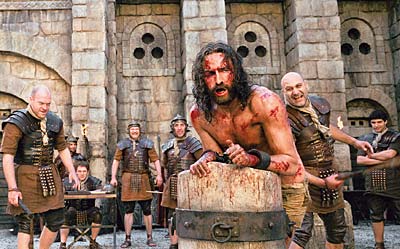 That noted, I confess that I whole heartedly admired The Passion of the Christ, not only as crafted cinema (for example, Caleb Deschanel's superb cinematography) but also as a bizarre endeavor of form (a storyline focusing on the last 12 hours of a man's life) and the personal need of the artist. The one major critic who seemed to feel the same way about The Passion as I did was Roger Ebert, who like me saw similarities here between Gibson's film and Martin Scorsese's similarly controversial The Last Temptation of Christ (1988), which was also a work of passion on the part of the artist. Opposing political wings attacked the respective films (the Right against Scorsese, the Left against Gibson), but beyond politics was the religious and sacramental framework of the Passion story. Though I can certainly empathize with the pleas of Andrew Greeley to focus on the message instead of the death of Jesus, the Passion of Christ is itself, as I understand it, a metaphor for the main message I intuit from the Christian religion.
Echoing my sentiment that it's hard for one to break from rituals instilled during childhood, when I viewed The Passion as a non-believer, I was still incredibly moved by it (another famous atheist who admired it was Religulous and Politically Incorrect star, the comedian Bill Maher). To get stuck on the gruesome violence, like Hitchens (who carries animus towards religion to begin with), is to completely miss the point. Christianity is, after all, absurd – and I say that not in a disparaging light (for this argument anyway) but in a Kierkegaardian one. It makes no rational sense to adopt the tenants of Christianity in this world – those tenants, according to the New Testament, being a complete suspension of attachment to earthly life, money, comforts, materials, etc. It is resigning oneself from this world and submitting, peacefully, to God, with an accent on the Afterlife, a notion quite fiery during Jesus' time as there were many convinced that it was the Last Generation. Jesus was one of many Apocalyptic personalities preaching in the Roman Empire. Selflessness was the answer, and part of selflessness meant a willingness to suffer, and what more, having the strength to forgive those who cause suffering.
Freud noted how this made absolutely no sense to him: forgiveness, let's face it, does not make sense. It is hardly rational to turn a cheek after you've been slapped. Even with hundreds of millions of professed Christians, Freud appears to be right. Like Kierkegaard, I can't help but think while reading the Gospels that I do not know an actual Christian. To be such a person, one must be more than a man, a superhero of sorts.
This is what makes The Passion so interesting to me formally. Its violence is part of its form, as it assaults the viewer just as Jesus is endlessly assaulted, undertaking a chore that he (like Scorsese's Jesus in Last Temptation) does not want to go through. The grotesqueness of the violence doesn't make things any more easy for us. Finally, when Jesus' cross is erected, the picture's momentum of suffering reaches a symphonic crescendo that it had been gradually buildings towards: Jesus' plea of forgiveness to the Father for his torturers. It is a moment that generates true selflessness, absurdism, and emotional power and ultimately gets to the heart of raw Christianity, which is, after all, a blood cult. Just as Jesus achieves his goal of retaining his compassion through suffering, Gibson has infused his portrayal of the myth with something that is ultimately lyrical. In forgiveness, one grants one's enemies what we instinctively in our caveman (Braveheart) mentality want to take away from them: their soul. If The Passion didn't make Christ's suffering so brutal, for me this realization (which is what I feel Christianity is ultimately about) would have been compromised.
Maybe I can say that because I'm not a Christian. But I grew up one, and like Mel Gibson and Martin Scorsese did, I took faith very seriously. For me, breaking up with one's faith and cosmic orientation of Meaning in the Universe is a lot more difficult than breaking up with a lover. So as a child I was enthralled by the Stations of the Cross and the disturbing image of Christ's crucifixion and what it meant – the blood element, the suffering, the passion, certainly had been watered down and taken for granted at Catholic school. And what did the crucifixion mean to me? This is the problem of religion in the post-modern age, where the symbols of religion have dried up and lost potency under the weight of science and secular discovery, pertinent as I see it to how one may view things from the curious case of Mel Gibson to the Fort Hood shooting in 2009. In light of the meaning in canonical texts, as a youth there were two directions I could go: opt out, or become, basically, Mel Gibson. I opted out. As the Bible notes, "I will take the hot and the cold, but the lukewarm I will spew out of my mouth." As a believer, I could never be anything other than lukewarm.
But for Gibson, that's not an option, and consequently perhaps it's fertile for a major identity crisis, regardless of how intelligent and talented he may be. In a 21st century context, particularly in celebrity culture, the private struggle with faith often may result in a doubling of consciousness, where one is loudly religious on one end while ending up with a mistress and prone to drunken rages against one's accusers on the other.
 Was The Passion anti-Semitic? Not any more than the Gospel of Matthew, a defense Gibson has used and to which I have to say to Andrew Greeley, "He has a point." Political correctness is handy, but I don't know if it can be enacted on texts that are seen as the Holy Writ of the Almighty. The Gospel of Matthew, from which The Passion derives most of its material, was after all the most "Jewish" of the Gospels, composed around 70 A.D. during the siege of Jerusalem, its intended audience being Jews, meant to win their attention with numerous Old Testament references and relation to the politics of its day (for example, the Pharisees were politically powerful in 70 A.D., whereas the Sadducees were in charge during Jesus' time; Matthew had something of a grudge against the Jewish leaders of the present).
And so I defended Mel Gibson and The Passion of the Christ. But a problem I had, in observing Gibson himself, was where he chose to make his own alliances in public life. He granted interviews to Fox News and Bill O'Reilly instead of the rest of the mainstream media, reaching out to a conservative Republican audience. Furthermore, an ugly truth is that most Catholics, as far as I can tell, fall into that "lukewarm" category in terms of religiosity. Gibson, via Fox News, was not really targeting mainstream Catholics so much as he was targeting the burgeoning born-again Christian audience, which was similar to Traditionalist Catholic circles in how it felt that the Catholic Church was stale and lifeless – "lukewarm" again. In selling his product, Gibson made something of a Faustian pact, even if his own politics (which I think may actually be libertarian as opposed to a mainstream conservative Republican) were not necessarily the same as Sean Hannity's or Bill O'Reilly's. As a defender, I too felt like I was in uneasy company. I wanted to ring Michael Medved's neck, telling him that the religious sensibility in Mel Gibson's film was, in my opinion, parallel in ways Medved would never acknowledge to Scorsese's Last Temptation. Gibson himself may have realized how at odds he was with his project early on while he first encountered negative publicity during shooting at Cinecitta Studios in Rome. Frustrated, he vented to director Paul Schrader, who was directing Exorcist: Dominion. Schrader agreed, noting that whenever you handled this material you made yourself vulnerable to attack. According to Schrader, Gibson suddenly fell silent when he realized that Schrader was Scorsese's credited screenwriter on Last Temptation, and that he (Gibson) was one of the voices loudly attacking that film.
But after The Passion of the Christ had grossed its $375 million domestically, the lines were drawn and sides taken without much of a compromise. Gibson had taken his side and would ultimately have to pay the consequences. His drunken outburst in July 2006 confirmed for many what they felt was already obvious: Gibson came from an anti-Semitic family and was himself anti-Semitic. He was also a very troubled man with too many vices to be sanctimonious to everyone else. This did not deflate my feelings towards The Passion of the Christ, but it certainly made me embarrassed for Mel Gibson and his religious sensitivities, his "double consciousness" as a Traditionalist Catholic and as a Modern Man in the 21st century. With the admission of his infidelity and impending divorce, his new born-again Fox News fan base also silently walked away, seeing him as a scumbag rather than a sage.
 Apocalypto again reaffirmed Gibson's talent as a director and adventurousness as a cinematic formalist, as the film seems to be a wonderfully relentless chase through jungle, with some grueling torture thrown in (again…not a good PR move for a guy accused of being a sadomasochistic snuff director). South Park again made delightful commentary on his talent while comparing him as a director to the "plot twist" gimmicks of M. Night Shyamalan and special effects addiction of Michael Bay: "Say what you want about Mel Gibson, the son of a bitch knows story structure!" Gibson's ability to use filmic language is akin to the great Silent directors, particularly in an era addicted to clever dialogue and Telling rather than Showing. As such, he may be ultimately judged as arguably the best of the Movie Stars turned Directors, including Kevin Costner, Warren Beatty, George Clooney, Sean Penn, and Robert Redford (though he's never made a film as good as Redford's A River Runs Through It and Quiz Show, or Beatty's Reds and Bulworth). But its lack of "huge" success led many to feel Gibson was not forgiven by a disgusted public, even if $50 million is probably fairly successful for a movie told completely in a dead language with no known actors.
*
 Which leads me to Edge of Darkness. Critics are hot and cold on it, some extremely impressed and finding it to be an exemplary genre film, while others obstinate in their refusal to see anything beyond big bad Mel Gibson. Admiring The Passion and Apocalypto as I do, I can't help (Mel Gibson like) but wonder if some of the negative reviews are perhaps, after all, a part of some great conspiratorial cabal against Mel Gibson and that some critics are allowing their prejudices and projections get in the way of their analytical senses. Critics are human as well, and sometimes perhaps too fickle to be anything more than dismissive (the best example being Heaven's Gate, which in retrospect is a movie superior to most Best Picture nominees). Like half of the Supreme Court, they can resemble Culture Warriors instead of objective evaluators. In the Minneapolis Star Tribune for example, Tom Horgen notes obvious cultural observations: Mel Gibson the revenge-seeker, Mel Gibson the aging actor, Mel Gibson the sadist who tortured Jesus and the Mayans (it should come as no surprise that Horgen is actually the Night Life critic for the Star Tribune's VitaMN rather than a film critic – one wouldn't expect him to go beyond what's skin deep and glossily fashionable). Consequently, from this superficial TMZ-like perspective, Edge of Darkness has nothing new to offer, precisely because it refuses to fit neatly into the standard revenge thriller genre (more than a couple critics have compared it, unfavorably, to the more conventionally audience pleasing and cathartic fantasy of Taken, which I think is a terrible movie). Of course, it doesn't help that Mel has lines like, "You have to decide if you're the one being nailed to the cross or if you're the one doing the hammering" – the kind of fodder that the conspiratorial "They" (whoever "They" are) are looking for in Mel.
But to me, not only is Edge of Darkness a good place for Mel Gibson to begin something of a comeback as a celebrity. It's also a very well-directed suspense picture that has broader points to make than, as Horgen alleges, "corporations are bad." Well, of course they are, but they also conflict with our primal and private development and identities as human beings. It's no surprise that one of the credited screenwriters is William Monahan, who won a much-deserved Oscar for The Departed. Like The Departed, Edge of Darkness is only on its surface a typical Boston cop yarn; it's bizarrely veiled science fiction, an Information Age cyber noir closer to William Gibson than to Dennis Lehane, its visual look complimenting its layered plot of conspiratorial corporate espionage in communicating the notion that the Future of cyborgs is in fact happening Now if we would open our eyes. Also like The Departed (and another Monahan script, Ridley Scott's adaptation of David Ignatius' Body of Lies), the protagonist here is struggling with every ounce of his being to hold onto the importance of biological familial existence in light of a world where truth is written on Official reports and social security numbers, genuine feeling being lost to the flux of constant information and simulated lives. It's not just that those who are antagonistic to Thomas Craven, such as Danny Huston's corporate head and Ray Winstone's mysterious clean-up man, are men without souls; it's that they seem to, like beings devoid of emotion or soulfulness (robots), be very curious to know what it is like to have a soul to begin with.
Beginning with three corpses bopping up in murky water under a full moon, followed by a home video recording made by Craven of his daughter on the beach when she was a child, we're given two old norms: the mysterious bodies that propel a mystery thriller into motion, and the pathos intrinsic for a family revenge story. But to me, this sets up the whole abstract nature of dehumanization that Edge of Darkness will be about. The corporation standing on the hill, overlooking the water, is responsible for these lifeless bodies, seeing its victims merely as raw materials to be silenced and cleaned up. The videotaped images may also reduce a being to mere data, but it expresses something that the murderous corporate entity does not know how to fathom. When you kill a body, you are also affecting a multitude of other beings who were close to that person and grew up with that person (as Francis Ford Coppola said, murder is terrible because you're not just killing that one person but really dozens of people). In the electrically streamlined world that the corporation, Northmore, dwells within, they cannot anticipate that their "cleaning up" of a security breach threatening to expose them may stir retributive fire. People, after all, do not exist in this world. Whatever human beings are, they can be manipulated by mass media production and capital exchanges. Politicians don't vote on principle; they vote based on how many lobbyists visit them.
Northmore invades family the same way that radiation invades the body, which we witness when Em Craven visits her father. She is prone to fits of vomiting and mystifying nosebleeds, which prompts Thomas Craven to help her to the hospital. Exiting his house, they both hear an armed assailment scream out with malice, "Craven!" and blast at them. Em is killed, her blood on her father's face.
 Craven and his cop buddies of course assume that this was some criminal trying to settle a score with him, and Em was simply collateral damage. He's told, "It's a cop thing, officer involved," meaning that he technically is not allowed to handle the case, but also that no matter what, his brethren in arms will finish this with the kind of attention that they wouldn't offer any other citizen, a realization that disturbs Craven and relates to the theme of the public versus the private. The mask of a police badge is an official marker that shouldn't, but does, affect how business is done, when the sanctity of the private family violated should be equal notwithstanding: an official marker, a badge, should not be the thing that triggers special attention when compared to the simple fact of a father losing a child.
Craven descends a spiraling staircase of clues leading him to believe that he was never the target in the first place. Rather, Em was interning for the mysterious Northmore company and was a possible whistle blower who would soon be labeled a terrorist. Craven interrogates some of her colleagues, such as a boyfriend and an activist, who are unwilling to spill too much information because they are being watched. The nervous tension these paranoid observances spill into Edge of Darkness, coupled with Martin Campbell's almost Polanskian usage of controlling what the camera allows us to see and the soundtrack allows us to hear (the rhythm of passing cars deliberately lulls us before something shocking), make this a terrific master-class of paranoid cyber noir, where we realize that the world is something of a cruel panoptical prison in which there is no private existence, and "they" can get you at any place, any time. The constitutional system of the United States government (yes, so dear to a libertarian like Mel, after all) has perhaps long been nullified, and Edge of Darkness expresses the key anxiety of cyber noir, where the authoritarian regime is not a political system of "government" but an economic (and by association political) system of monopolistic corporations driven by efficiency and profit motive, futurist speculations of Blade Runner and Neuromancer that are too easily found in a world saturated with processed food, isolated communication via cell phone and "Space-Book," advertising images, American Idol, 24 hour news cycles, and a complete inability to do anything about health reform.
Craven encounters two separate individuals – though "individuals" is possibly not the correct word. Rather, they are "bodies." One is the Northmore head, Jack Bennett (Danny Huston), who offers his condolences while informing Craven about Northmore's practices which are, more or less, totally classified. "We don't build weapons. We handle the materials used to make weapons." Gross materials to a reductive base is how Bennett sees things, not as complete ends. People are no different, we learn, when Bennett tells Craven about how each Northmore employee is well insured. Translation: Em Craven's death will give you, Thomas Craven, a large chunk of capital, for which your pain can be eased and questions answered. Bennett then asks a very strange question, "How does it feel?" It's an odd question because of how it's played by Huston. It's not intended as a malicious threat, I believe, but rather as an unexpectedly offbeat insight into the nature of the Bennett character, who asks the question almost like the android Data in Star Trek: The Next Generation. This is a man completely separate from human attachment and sentiment, devoted instead to production, consumption, and the will of the corporate demand.
The question is asked again by the other Body Craven confronts. A wide and imposing but softly spoken British man named "Jedburgh," (Ray Winstone, in a part originally to be played by Robert De Niro), who is hired by Northmore political associates early on to clean up the mess that Craven is creating with his reckless questions. We don't know where Jedburgh comes from or what his history is. He tells Craven his job and threatens him without being violently overt about it, as the two can have a good talk on a park bench about the Northmore mystery. As Thomas walks away he amiably says, "Thanks for not killing me." Jedburgh is not unlike the hitman Tom Cruise played in Michael Mann's excellent Collateral, who's also a digital human being estranged from human biological contact, or the more conflicted Colin Sullivan (Matt Damon) from The Departed. As he observes Craven, Jedburgh is honestly curious to know, after all, "what it feels like."
Jedburgh is then the abstract center for the film's conflicts about the post-human condition. He sees in Craven someone who is every bit as capable of mechanically reflexive action with Terminator-style precision and direction as he is. But Craven's loss of "humanity" is created by something personal, not economic or corporately mandated. This intrigues Jedburgh, not only intellectually but also as a biological entity. We observe how Jedburgh is taking pills and understand that he may be very ill. In a doctor's office, it's insinuated that he is probably dying from cancer with not a lot of time left. As the doctor points his light into Jedburgh's eyes, the sick man sardonically says a trademark Monahan line: "Do you see a soul in there?" That Winstone has small beady dark eyes works for his own conflict. If the eyes are the gate to the soul, he may not have one, which in the course of his limited time on earth is something he regrets.
 The last act of Edge of Darkness shows the extent of Northmore's power. They are backed by a twig-like Republican senator who is every bit as synthetic in performance as something you would see in the Hall of Presidents – and that is not an all-too conventional presentation of a villain so much as it is an offbeat way to show the banality of evil, much like Jack Bennett. What use is vengeance, after all, if your intended targets may not have a soul to give? As we see with Bennett, one only has to point a gun to find out, which addresses the juxtaposition of images that opens Edge of Darkness. Death and Love give us meaning in a dead universe. But in an economic apparatus where the infrastructure that keeps the family intact is inherently corrupt, one may have a conflict of interest, living in bad faith. We see this happen when Craven's life-long friend and partner (Jay O. Sanders), in order to save his own family, is willing to cover things up for Northmore at the cost of his friend's life and reputation. In a world of capital exchange instead of meaningful symbolic exchange, where the "official mandate" dominates the private sphere, there is only mandated sanctity backed by dollars – not biology and feeling.
Not that this stops Craven. Or for that matter, the mysterious Jedburgh. These two ultimately become two noir archetypes, one willingly burning himself through hell in order to get retribution, the other resigning himself to the darkness like a digital drifter sucked into the ether of the non-space compression from whence he came. Economic values and social signs mean nothing in a wasteland contaminated with cancerous radiation and invasive structures. "Wife and kids?" Jedburgh asks as he points his gun at a security officer stumbling upon a harsh scene. It may be the first time Jedburgh has asked the question, as he realizes the value of a soulfulness that has departed the terrain of modern existence.
Craven's ghost departs a hospital with Em at the conclusion of Edge of Darkness. Anywhere else this would be a sentimental image if the film hadn't spent as much poignant time examining the private sphere of a human being's consciousness. We notice the dolly shot going away from Craven's hospital bed haunted by the markers of police uniforms, again reminding us of The Departed, where "signs" communicate everything while simultaneously being symbolically empty. Like Billy Costigan in that film, who holds onto the birth canal of his departed mother through his fascination with personal photographs, Thomas Craven has realized how meaningless a social security number and a job badge are when compared to the naked primacy of basic human warmth and contact.
 Which returns us to the curious case of Mel Gibson. Edge of Darkness is, for me, a spectacular return to form not only for Gibson (not that his form really went anywhere, unless you want to discuss the meaningless – though frivolously fun – Lethal Weapon sequels, and dreck like Forever Young, Bird on a Wire, etc), but for its tired genre, where self-righteousness drowns out observances of human nature. Though Gibson is here again both the bloody vengeance seeker and martyr, hammering the nails while also hanging on the cross, his worn and demon-haunted face makes it work. Like the great film noirs, Edge of Darkness is not merely escapist entertainment but a well-crafted voyage into the darkness of human nature, and how that "human" part of the equation is always under attack from the seemingly benign structural forces surrounding us, the audience, day in and day out. Of course, this bespeaks a kind of paranoia that is uncomfortably close to the Mel Gibson we would like to forget about. The troubling aspect of conspiracy mindsets is how it breaks down the comfortable separateness of political ideology: the extreme right and the extreme left are often confused for each other when it comes to these discussions, becoming unlikely bedfellows in the object of their derision. Though once the Jews enter the discussion, people rattle awake and out of bed quickly, like Steve Martin and John Candy in Planes, Trains, and Automobiles. It would seem Gibson remains unapologetic about who he is, at least to us in the public sphere. Yet this may drive towards its own greater truth. Gibson has repeatedly doused himself in public, referring to himself disparagingly with the stereotypical guilt of a hard Catholic. He's called himself a monster. It was he, after all, who nails Jesus to the cross in The Passion of the Christ. "My sins put him up there," Gibson said. With his platform of passion, Gibson is a rare artist who exposes his heart nakedly, simultaneously being sheepish about apologizing for his faults to the profane media. Strangely like his doppelganger Catholic brother/opposite Martin Scorsese, for him, even in our cynical age of blockbusters (some of which he has taken part in), art is itself an extension of religious and holy sentiment, Film being a sacramental act of passion/suffering in which the audience partakes in that suffering also (or: compassion). Though public expression, art here is also a dimension of the "private" sphere as we get insight into a man's soul, which tacky tabloid journalism and the selectiveness of "words" can never really nail as anything other than clever sound bites. His films being a part of his private and unknowable Self, we can never expect Gibson to make himself a two-dimensional emblem of "public" apology where he follows the mandate of the general (read: "officiated by media and culture") will. In some sense, this is certainly maddening when we think about the Mel Gibson we hate, while in another more ecstatic light, I find it glowingly admirable and unique at this time in celebrity culture.
Of course....until he screws up again. Boy will my face be red.