II. GOD'S LONELY MEN
The Question of the Knight of Faith in Taxi Driver and The Last Temptation of Christ
There are few mainstream films that invite a range of speculation and expansive interpretation as does Taxi Driver (1976). Produced in Hollywood's most artistically proficient decade, it emerged as an unlikely critical and commercial success, its main character an undesirable and pathologically obsessed isolated individual, similar in his thoughts and relationships to Dostoyevsky's Underground Man. The viewer struggles with identifying the nature of Travis Bickle (Robert De Niro): Is he a hero or an anti-hero? A madman or a murderer? Deranged or lonely? Damned or righteous?
An application of Kierkegaard's philosophy to Taxi Driver is as appropriate as an application of it to Notes from Underground. Issues of the aesthete, isolation and introversion, resignation, and the religious, and the individual vs. the community are all completely pertinent to a critical approach of the material. What insight does Taxi Driver give us to our own natures, if we allow ourselves to identify with a person that may be interpreted as psychotic? The film is wrought with ironies in its depiction of Travis, voyeuristically giving us a full portrait of his mind and actions, in public and in solitude, and how his voiceover narration (scripted into his diary) are contrary to what we actually see. It calls into question Kierkegaard's subjectivity, and how much Kierkegaard may be asking of us by a relationship with "the eternal."
Ten years after Taxi Driver, the same themes would drive Scorsese's passion project, The Last Temptation of Christ. Here we have another character that is in many ways comparable to Travis, as perverse as that may sound. Jesus (Willem Dafoe) could be interpreted as a pathological megalomaniac, just as he could be literally read as the savior of the world. Scorsese's approach to the material is different from Taxi Driver – rather than an ironic approach, what the film unveils on an "objective" level is what Jesus really experiences with his eyes and heart (and Scorsese has said that Jesus is the messiah in the context of the film). But Jesus’ Passion, the crucifixion, is still no less absurd than Travis' violent and suicidal actions in saving the teenaged hooker, Iris (Jodie Foster) – or for that matter, no less absurd than the demand made upon Judas (Harvey Keitel), who must betray his best friend and master so that this ultimate sacrifice may occur. Both Travis and Jesus are held at length from a normal life, believing theirs is a unique destiny, and they voyeuristically yearn for the lack of responsibility that plagues them just as they would like to be like “other people.”
 Both films were scripted by Paul Schrader, who was raised Dutch Calvinist and never was allowed to even see a motion picture into his late teens. Similar issues of faith and isolation persist through his own films as director (such as Mishima, Affliction, and the unreleased Exorcist prequel), much as they do through Scorsese's, who immediately identified with the original screenplay of Taxi Driver upon discovering it in 1971, and was able to filter Schrader through his own obsessions and themes. Interested in how Schrader’s Dutch Calvanist background would mesh with Scorsese’s Catholicism and author Nikos Kazantzakis’ Greek Orthodox background, Scorsese asked Schrader to adapt The Last Temptation of Christ in 1982. The Schrader script would go through countless rewrites by Scorsese and Jay Cocks. For this reason, and given their similarities, these films will be studied side-by-side, while I will later evaluate the pair's most recent collaboration, Bringing Out the Dead.
 Both Travis and Jesus are singular individuals, which is not an easy place to be in a societal context. In Fear and Trembling, Kierkegaard notes that the single individual "knows it is dreadful to be born solitary outside of the universal, to walk without meeting one single traveler. He knows very well where he is and how he relates to men. Humanly speaking, he is mad and cannot make himself understandable to anyone." This statement is essential to evaluations of Travis and Jesus, in how they relate to their sense of "the eternal" and how they cannot relate to other people. They are mad just as they are alone in the eyes of the ethical people around them. But they also may project something ecstatic and transcendent, if not unfathomable.

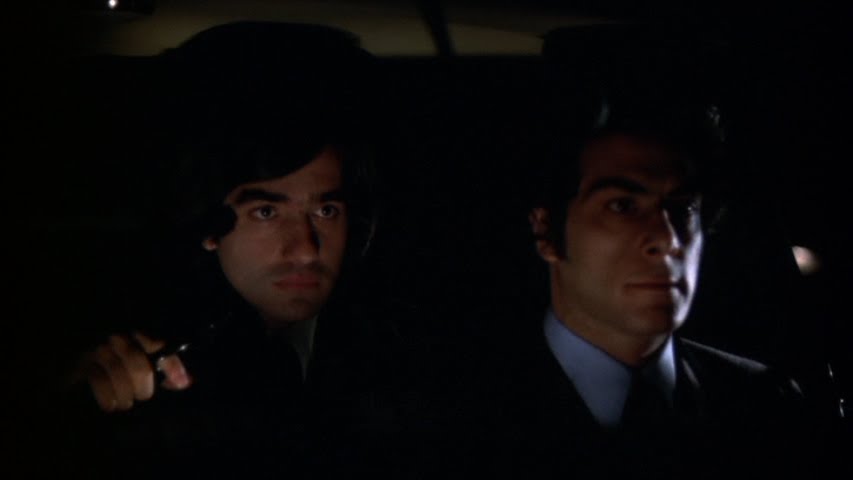
 Taxi Driver begins with Travis' cab emerging from smoke, like an object emerging from hell, complemented by Bernard Hermann's foreboding score. By giving us the feel of a horror film, featuring a solitary wanderer (on wheels) surrounded by an urban inferno, a religious sensitivity is introduced. "All the animals come out at night. Whores, skunk-pussies, buggers, queens, fairies, dopers, junkies. Sick, venal. Someday a real rain'll come and wash all this scum off the streets," Travis' voiceover begins as he passes through the neighborhoods. The use of the word “venal” reinforces an ecclesiastical mood, and the awareness of sin. While Charlie from Mean Streets was able to commingle in carefree worlds of pleasure, for which he may be moved to guilt afterwards, Travis is separate from any sense of community by class and consciousness. While applying for a taxi job, he insists, somewhat jokingly, that his driving record is "clean, like my conscience." The taxi manager (Joe Spinell) accuses Travis of busting his chops, which is the first of many awkward rejections that occur to Travis. He desires to reach out and be "one of them" instead of a solitary individual. He narrates, "All my life needed was a sense of some place to go. I don't believe that one should deviate his life to morbid self-attention. I believe that someone should become a person like other people."
 This odd statement is humorously ironic, given how Travis seems to only exude "morbid self-attention." When he tries to get to know other people, the result is usually disastrous. He takes speed, casually drinks bourbon, and loses himself in porn images, which is not embraced for titillation, but rather, as Paul Schrader explains, "is a way to dull you." He is Kierkegaard's bored aesthete, watching television, lost in fantasies, and eating junk food.
 Travis’ sense of purpose is gradually playing out, again like a Dostoyevskian hero (or Kierkegaard's Seducer), in a script being written in his head. His energies are spent on pursuing a blond and spritely campaign worker, Betsy (Cybil Shepard). And again, much like Kierkegaard's seducer, one cannot help but see the trait of an individual constructing another person as something of an aesthetic creation: "I first saw her at Palantine Campaign headquarters at 63rd and Broadway. She was wearing a white dress. She appeared like a white angel out of this filthy mass. She is alone. They cannot touch her." As Travis reflects on Betsy, peering at her from a distance, Hermann's music veers into sentimental romanticism. Taxi Driver becomes a movie-within-a-movie, the diagetic sense of the picture being a sensitive romance film contained within the urban drama. On their first date, he vocally expresses how he sees her. "I think you're a lonely person," he says, adding that she is looking for someone just as he is.
 But objectively, Betsy is like "other people," while Travis simply is not. She is affable with her co-workers and, as played by Shepard, represents the kind of perfect-girl-next-door that is unattainable to most men. She is everything that Travis isn’t, and what he ultimately longs for. It is significant that the campaign slogan for the candidate whom she represents is "We Are the People," indicating a sense of community and group identification that is far from attainable for poor Travis (this separation of Travis from "the people" is humorously complemented by a scene in which Betsy's coworker, Tom – played marvelously by Albert Brooks – is complaining about receiving misprinted campaign buttons that have We underlined instead of Are, indicating that "the people" are their own group, and there may be some exclusivity to being like "people"). Travis' difference comes clear all too blatantly during a movie date, when he takes Betsy to a pornographic film, unaware that she would be offended. According to Schrader, the pornography is not at all erotic for him, but is an enabler for his pathological isolation. There is something working in Travis of which he is not fully aware, reinforcing his struggle and self-hatred. Betsy's rejection of Travis leads to one of his only outbursts in the picture. He condemns society along with her: "You're in a hell! And you're going to die in the hell like the rest! You're like the rest of them!" His calm voiceover explicates his distaste for "community": "I realize now how much she's just like the others, cold and distant. And many people are like that. Women for sure. They're like a union." That Travis should dislike unions, and equate them with women (signaling an intimate relationship with an "other"), is too appropriate. Later on, while having breakfast with Iris, he voices distaste for "communes." The conflict of the film becomes thus: "The people" vs. Travis.
 The picture increasingly becomes absorbed in Travis' dark consciousness and sense of inwardness. "Loneliness has followed me my whole life, everywhere. In bars, in cars…sidewalks, stores, everywhere. There's no escape. I'm God's lonely man." Travis feels a kind of mystical calling in his religious identification as "God's Lonely Man," and seeks escape from his aesthetic existence. He tries to follow a sense of purpose with discipline, ceasing to eat junk food, tightening every muscle in his body, and purchasing guns. His calling is apparently assassination and self-immolation.
 This is naturally harder for Travis than he makes it appear through his diary jottings. He is still an aesthete, creating his own environment like an artist, still play-acting. He writes his parents, where he states that he is an operative for the government. He talks to himself in the mirror, acting out a fantasy of aggression: "Listen you fuckers, you screw-heads. Here is a man who would not take it anymore. Who would not let--" he stops. Scorsese's image cuts to Travis re-assuming his position in front of the mirror, and the voice-over begins again. He is fashioning himself as a hero.
 In a scene that is as poignant as it is disconcerting, Travis is slumped in a chair watching television, with a .44 Magnum in his hand. On the television are men and women dancing together as Jackson Browne's "Late for the Sky" plays over: "Awake again / I can't pretend / I know I'm alone / And close to the end of the feeling we've known / How long had I been sleeping? / How long have I been drifting alone through the night? / How long have I been running for that burning flag? / Through the whispered promises and changing light? / Of the bed where we both lie? / Late for the sky…." Scorsese slowly tracks around Travis' head, his eyes dulled and mouth slightly gaped as he stares with longing at the images of community and love. The sequence may be the only moment when Scorsese allows Travis a sort of sympathy on the part of the audience. The sense is that Travis has a destiny and a path to be lived out which is undesirable and harsh, his alternate options being humiliation (trying to interact with others) or nothingness (the aesthetic life of porno theaters, junk food, and television).
 The following scene shows the candidate Charles Palantine quoting Walt Whitman: "I am the man. I suffered. I was there," then adding, "We are the people. We suffered. We were there." Palantine condemns Vietnam as a "war of the few fought by the many" (Travis is a Vietnam veteran, wounded in battle after an honorable discharge). Travis cannot identify with Whitman's collective "Self" any more than he possibly could with any single political party. As he watches Palantine, the speech taunts his loneliness. Later, Travis is back in front of his television, viewing a soap opera. A man and woman are having a tearful argument about marriage and fidelity. As Travis inertly watches, his foot gradually moves forward, knocking the television to the floor, breaking it. He kills his television as an act of complete severance from the outside world, an act which he immediately finds disagreeable ("Damn. Goddamn!" he says irritably).
 Travis builds up the idea that he has "no choice" in his destiny. "Now I see it clearly. My whole life has pointed in one direction. I see that now. There never has been any choice for me." But moments before he is going to shoot Palantine, he aborts his suicidal mission. This abortion leads to an alternate sublimation of his "fate": rescuing Iris from her pimp and captors. He decides to be her liberator, violently gunning down the gangsters running the bordello keeping her. This, however, doesn't occur exactly as planned. Intending to kill himself after raiding the premises, he finds himself out of bullets. He is resigned to the bordello couch, pointing his bloody index finger to his head, making shooting sounds. The scene ends with an elaborate God's-Eye tracking shot, relaying the carnage of Travis' climactic action.
 Beyond Travis' pathological introversion, what should be of interest for readers of Kierkegaard is how his action is to be interpreted. Are we to interpret Travis as a "knight of faith," someone who followed voices, suspended the ethical and followed through with a completely irrational action that he believes he was meant to do? This may be how Travis sees himself. Yet in the context of the film, New York views Travis as a hero (he was unable to be a martyr), ironic given that no one really understands what motivated Travis to act as he did. Though the motivation is virtually identical, how would New York view him had he carried out his original plan in assassinating Palantine? We, the audience privy to Travis' contradictions and delusions, understand that he is pathologically sick. A madman. And then from another angle, he is simply a murderer.
 These are the inquiries Kierkegaard makes in his meditation on God's command to Abraham in sacrificing Isaac. How are we to interpret Abraham's action? Indeed, if any of us, in the present age, were to go forth and slay our child, and then claim that we were told to do it by God, we would be judged more harshly than Abraham. Kierkegaard is getting to the core of double-mindedness. From an aesthetic view (which Kierkegaard believes most of us unwittingly are contained), Abraham was mad; from the ethical, he was evil. But religiously, he was a hero. What the religious individual is doing is something that is judged as absurd, and Kierkegaard uses the phrase "teleological suspension of the ethical" to describe this action, whatever it entails. This relates to the individual's relationship to "the universal." Kierkegaard works from two definitions of "ethical." In Either/Or, when he is describing the aesthetic and the ethical stages, the ethical pertains to an individual making a choice for a life pattern, and then following through with it. The individual is what they say they are, living authentically. In Fear and Trembling, the ethical is equated with a "universal" code of living, the ethos of the larger group. Studying Taxi Driver, which is so occupied with Travis' friction with things collective, we cannot help but read Kierkegaard into Travis, regardless of how Travis is probably not technically a knight of faith, given Kierkegaard's criteria. (Travis is not in an ethical mode of being, which Calvin O. Schrag comments on being crucial for the religious individual; rather, Schrag insists, the universal-ethical is to be superseded).
 If God and the eternal are not objectively provable, but only exist subjectively, how can we assume to understand Travis? If bourgeois Betsy is the catalyst for normative thinking, we cannot help but see Travis as a deranged person. "If we see someone doing something that does not conform to the universal, we say that he is hardly doing it for God's sake, meaning thereby that he is doing it for his own sake," writes Kierkegaard. The singular individual cannot be understandable to anybody. Abraham confuses the author of Fear and Trembling, the patriarch’s faith and religious sense beyond an ethical worldview. Other beings are not fully understood, but are only possibilities – and the interiority of each other being, when sensed in this light, is an enigma. This makes judging an adverse action: "One human being cannot judge another ethically, because he cannot understand him except as a possibility." Ethics are on planet earth, along with Hegel's God. Kierkegaard's God, and we must assume Scorsese's God, are transcendent of this world.
The knight of faith takes his absurd leap at the precipice where all logic and reason fails. He believes in what is absurd and objectively not provable. He is guided by the motions of his belief, incandescently aligned with his sense of the eternal. However, we must note that getting to that stage, where the ethical is suspended, requires one to use logic and reason before logic and reason are summarily rejected.
Travis has the power to act, but he deliberately eludes self-knowledge, even though he is painstakingly "observant" and introverted. He is at a high level of despair, being that he refuses to be any self other than that of his own choosing. The question of Taxi Driver has to do with whether Travis is choosing his own way (he surely craves some mark of distinction from the "group" or "We the People"), or whether that shadow of loneliness, equivalent to the cross following in Jesus in The Last Temptation of Christ, is demanding these actions of him.
 "
 Despair is a sickness from which no human being can deliver himself strictly by his own efforts," writes Sylvia Fleming Crocker in a study on Kierkegaard's knight of faith. Travis remains alone at the conclusion of Taxi Driver, though some people see him as a hero. The fact that the time-lapsed over-heated lenses picking up streetlights close the film just as it opened, along with the same music, indicates, according to Paul Schrader, that Travis hasn't changed at all, and is bound to do similarly outrageous things, though he won't be, says Schrader, as lucky next time.
 Travis remains his own person, and that distinctiveness, as unattractive as it is in the film's ironic presentation, may nonetheless compel us to strangely admire Travis in a Kierkegaardian way. He may not fulfill the criteria of being a true "knight of faith" or even a "knight of resignation" (in the last stages of the picture, he does not really seem to miss anything that he'll be giving up; he's grasped beforehand that he is simply inaccessible to it). He takes no joy in what he is doing. But his whole being is invested in the act, much like Kierkegaard writes, "The knight will have the power to concentrate the whole substance of his life and the meaning of actuality into one single desire." The bloody element of the climactic bordello sequence is Scorsese's raw Catholicism speaking (cinematographer Michael Chapman remarks that the God's-eye-view tracking shot following the carnage was modeled on Renaissance paintings depicting biblical scenes, specifically the Passion). The suffering and burden of Christ, with the sacrificial shedding of blood, along with suffering and passion tied in with the eternal, is integral to the finale of Taxi Driver, and we notice the graffiti scrawl behind one of the gangsters – "Jesus Loves You." Regardless of its reputation for violence and a sustained mood of dread, Taxi Driver is a mostly bloodless film until its climax, as if everything were working towards this moment of truth, when the cleansing of the city, which Travis ceaselessly talks about, is ritualized. The idea of "sacrifice" is important to Travis Bickle's action, which relates with Kierkegaard's knight of faith: "The ethical expression for what Abraham did is that he meant to murder Isaac; the religious expression is that he meant to sacrifice Isaac." As we shall see, not only in Last Temptation, but certainly elsewhere, the Christian blood ritual of sacrifice and suffering is everywhere in Scorsese, demanding suffering and the negation of comfort.
 The Last Temptation of Christ takes us to the root of Christian theology, of course, with the characterization of Jesus of Nazareth. Before investing in an analysis, it would be an interesting question to ask the question of blasphemy, and to what extent are humans to imitate Christ? What would Kierkegaard think of Christ being a metaphor for the human spiritual conflict? Is it blasphemy? According to Schrader's theology, it is, but Schrader notes that the irony of the film's controversy is that it technically isn't blasphemy to portray Christ as having human doubts and anguish, whereas it is blasphemy to use Christ as a metaphor. Blasphemy is not a key issue addressed in Kierkegaard, so much as spiritual malaise is discussed, but his demands for suffering, passion, sacrifice, love, and mercy on the individual's part is inextricably linked to the mythology of Jesus Christ.
 Jesus goes through "stages" in life's way as the Kierkegaardian hero does. First glimpsed, he is in the fetal position, born as it were, though hardly an ignorant philistine. Listening to and observing him, we can see that he already is at the defiant stage of despair. For him, God is literally a pain in the neck: "The feeling begins – very tender, very loving. Then the pain starts. Claws slip underneath the skin and tear their way up. Just before they reach my eyes, they dig in," Jesus' opening voiceover announces. "Then I remember." What does he remember? How does he appease it the burden? Through his defiance. "First I fasted for three months. I even whipped myself before I slept. Then the pain came back. And the voices. They call me by name: Jesus." He voices this while fashioning a cross for Romans to crucify eschatological zealots, Jewish political terrorists that are dying for God. "I want Him to hate me," Jesus says of God. "I want to build crosses to crucify every one of his messiahs."
 At this point, Jesus does not yet realize that he is the messiah, though he certainly understands that God talks to him. The theme established at the outset has to do with struggle, but Jesus wants to struggle his own way. He longs to live a normal life, but is still too proud for that. He does not want to go through what God is demanding from him. "How will you ever pay for your sins?" asks Judas, who at this point is a political zealot angry at Jesus for building crosses. Jesus answers, "With my life, Judas. I don't have anything else."
 The opening scenes deal with individual struggle vs. social struggle. Judas's political zealotry, bent on creating a new Israel, is extroverted struggle. "The messiah won't come that way," Jesus answers, though he admits he doesn't know how exactly the messiah will come. Later on, the two have an argument on what must change first: the extroverted "body" (or political system) or the "soul." At this stage, Jesus is wiser, and admits that his focus is not the freedom of Israel. "I want freedom for the soul." This runs parallel to a Hegelian contra Kierkegaardian argument on the world of God running through the picture. Should people focus on the collective body, the exterior world, or the interior and subjective world, in communication with God? From another angle, Jesus is told by Mary and Martha (Lazarus' sisters) that the true way to follow God is not through asceticism and a life of sacrifice in the desert, but through having a wife and children. "Read your scriptures," they insist. But Jesus intuits that such a world is not for him. Is this exclusion deliberately chosen by him? Magdalene (Barbara Hershey) says that it is. "You're the same as all the others only you can't admit it," she says. What is more courageous? To fast, pray, and live a religious life of sacrifice? Or to "be a man" and fulfill a normal life on earth.
 For one thing, Jesus seems to understand that though the life of flesh is a bounty of pleasures for which he yearns, it is at odds with the eternal. He encounters hermits who give him a place to rest, with hospitality compliments of the monastery’s master. The next day he learns that the master had been dead before they spoke. At the funeral, Jesus pensively stares at the wrapped body disappearing under the sand. "Flesh," one of the hermits says, "melt away."
The following scene reveals Jesus' capacity for introspection and his inward struggle. The hermit says that Jesus is blessed, because God makes Himself known to him. Jesus disagrees. Rather, he is afraid. "I'm a liar, a hypocrite. I'm afraid of everything. I don't ever tell the truth, I don't have the courage. When I see a woman I blush and look away. I want her, but I don't take her – for God. And that makes me proud. And then my pride ruins Magdalene. I don't steal, I don't fight, and I don't kill – not because I don't want to, but because I'm afraid. I want to rebel against you, against everything – against God! – but…I'm afraid. You want to know who my mother and father are? You want to know who my god is? Fear. You look inside of me and that's all you'll find."
From what we know about Kierkegaard's biography, given his contemplations of suicide, his capacity for cruelty and ridicule, and his own insecurities where his short-comings become the focus of his introspection and struggle, there may be some applicable similarities between Scorsese's Jesus and the Danish philosopher, though certainly not deliberate so much as syncretisms of the type of individual that both Scorsese and Kierkegaard describe through their life's work. Unlike Travis, who is at war with "the Collective" in all forms, and does not have the capacity to elucidate self-criticism (though he has a degree of self-loathing that he does not intellectually explore), Jesus and Kierkegaard cannot escape self-evaluation and an awareness of their sin. Jesus' rejection of Magdalene seems equal to Kierkegaard's rejection of Regine Olsen, where the erotic object of love is forsaken because of higher callings. Just as Kierkegaard paints his Abraham as a man who would rather have Isaac hate him than hate God, so too does Jesus tell Magdalene, "Hate me, blame me – but not God."
 Both Kierkegaard and Jesus have thorns in their flesh separating them from the bulk of humankind, disallowing them from living a normal life, though it may be pathologically interpreted as a form of megalomania (Kierkegaard apparently fell in love with the idea of being a martyr, and again, echoed Christ after his brothel experience). Jesus' ability to bypass the temptations of a wife and family leads to the question of pride. "Your heart is so greedy," a lion in the desert tells Jesus during his forty days of solitude. "It pretends to be humble, but it really wants to conquer the world." Satan, in the guise of a flame, reminds Jesus that as a little boy Jesus prayed "Make me God. God, God, make me a god!" Satan then tells him, "You are God."
 This "prayer" relates Jesus to the exclusivist club of Scorsese's key players, such as Charlie and Travis. It also is the question that any knight of faith must ask himself, and if the prayer is answered, it demands more from the individual than may have been thought, namely suffering and sacrifice. Satan is telling Jesus what Jesus already knows but cannot readily admit. Jesus is wrestling with his pride, which is why he is between the worlds of sacrifice and normality. Can Jesus walk as God on earth (the ultimate paradox) and walk in Kierkegaard’s Deer Park at the same time? Returning from the desert to meet his disciples, and ready to build a new Israel, Jesus is strong in his message, but only because his death is not demanded of him (at this stage, he believes God is going to give him a tangible army to revolt against evil). He exhibits a love of life (witness him dancing at a wedding), but he is not interacting with others as an equal or a man, but as the messiah, as God. When Mary, his mother, asks to talk to him, he asks "Who are you? I don't have a mother." He has walked away from the earthy elements of his identity.
 Then something else is asked of him. He realizes that he has to die in order to save the world, requiring a complete suspension of his ego. At this juncture of the story, he is willing to accept it, though he is clearly frightened of death. When he raises Lazarus from the dead, Lazarus at first pulls him into the tomb's darkness, a metaphor for what is being demanded from him, and it is horrifying for Jesus. "All my life – all my life I've been followed," Jesus tells Judas, echoing Travis' narration of his loneliness. "By voices, by footsteps, by shadows. And do you know what the shadow is? The cross. I have to die on the cross and I have to die willingly."
 This demand for sacrifice is an element that no person dealing with their spirituality wants to confront. The disciples are focused on sheep and other material goods the "revolution" may bring, but death is a touchy subject. "I'll do anything the master asks," Thomas says. "Anything but be crucified. You ever see someone hanging on the cross for a couple days? They don't have eyes. Crows come and suck out your eyes. Dogs rip your feet off." The domain of the Body is the domain of materialism, of the world – not the kingdom of God, and this contemplation of blood and the Body connects the Pentecostal weekend with the monastery Jesus visits in the film's first section. The gruesome reality of how transitory the Body is as compared to the eternal, and the leap of faith needed to have that realization, is demonstrated when Jesus weakly sinks just before he is about to command his disciples to fight the Romans. His hands start bleeding, as if by nail holes.
 "This is my body too!" Jesus says on Getheseme, clutching a handful of dirt. "Father in Heaven, Father on Earth – the world that You've created that we can see is beautiful. But the world that You created that we can't see is beautiful too." Here is the confession of Jesus that any proponent of faith must honestly deal with as they subjectively try to stay in tune with the eternal while participating in the outside world: "I don't know. I'm sorry, Father. I don't know which is more beautiful." The problem of Christendom, for Kierkegaard, is the way Christians are quick to quote Gospel while not at all understanding the needs of fulfilling a Christian life, associated with willfully letting go of those temporal aspects. Jesus is fully aware of this step. And may not that thing that is clinging him to the earth, as it clings all of us to the earth, be doubt – objective uncertainty? Suffering is, according to Kierkegaard, "a life of objective uncertainty held fast in an appropriation-process of the most passionate inwardness." People build their telos in life by way of acquiring objects and materials: the elements of a normal life, such as is Jesus' final temptation. But "a religious person is one who has developed an absolute relationship to the absolute telos." Again, one's being is invested in this act demanded by God, this sacrifice.
 Judas too has a sacrifice to go through. Quite movingly, he has become Jesus' best friend and foil, and precisely because Jesus recognizes him as the strongest of his followers, he is given a task of faith equivalent to Jesus' sacrifice. Judas is no aesthete. He is Kierkegaard's ethical man, invested with purpose and determined to accomplish something. He is a political activist of strong principles, enabling him to discuss with Jesus instead of just "following." "The other day you said if someone hits you, you turn the other cheek," Judas mentions. "I didn't like that. Only an angel could do that – or a dog. I'm sorry, I'm neither. I'm a free man." Such an act of resignation is, of course, absurd. Which means Judas's task to betray Jesus and turn him over to the authorities is also a form of suspending oneself from the ethical.
 Interestingly, we may deduce that Judas emerges as a knight of faith, whereas Jesus simply becomes the knight of resignation. Both individuals go through their given tasks, but it is Judas who goes through boldly, like Abraham, with faith, contrary to every characteristic from this man's code of ethics. Jesus accepts the torture of his passion, but when he finally arrives on Golgotha, he understands what he has lost and is leaving behind. "Mother," he says, walking towards Mary, "I'm sorry for being a bad son," culminating in his screaming, "Father! Why have you forsaken me?!" The despair in these moments may reveal that in his suffering, Jesus is closed off from Kierkegaard's "repetition," or the knowledge that what has gone will return. Judas, like Abraham, has entrusted his destiny to God, believing, as Jesus told him, "in three days, I will come back." Coming out of Jesus' yearning for what he is losing, is the last temptation.
The last temptation of Christ is a normal life, being free from the directives of God. Whereas the knight of faith is not relying on his own powers of self-determination but on God's determination of his future, the man that Jesus is to become, once he comes off the cross, is a man that is not only released from God's command, but also from his own. He is no longer plagued by the constant self-consciousness, or the "headaches" that God tormented him with to remind him of his divinity. Rather, he is suited for Hegel's system: not choosing his life, but having the society around him, the norms and given tropes, choose for him. He is taken to Magdalene in the hills. "Who's getting married?" he asks his guardian angel. "You are," she answers.
The guardian angel, who is really Satan in disguise, compares Jesus to Abraham, saying, "You've suffered enough. He's tested you and he's happy with you. Let him live his life." For Jesus, relieved of his messianic duties, Earth opens up and consumes him: marriage, love, friendship, children, infidelity, food. During these scenes, Scorsese and cinematographer Michael Ballhaus, along with Peter Gabriel's lush music, paint the world as a beatific vision. "This is Earth!" the guardian angel tells him. "Sometimes we angels look at you on earth, and envy you. Really envy you."
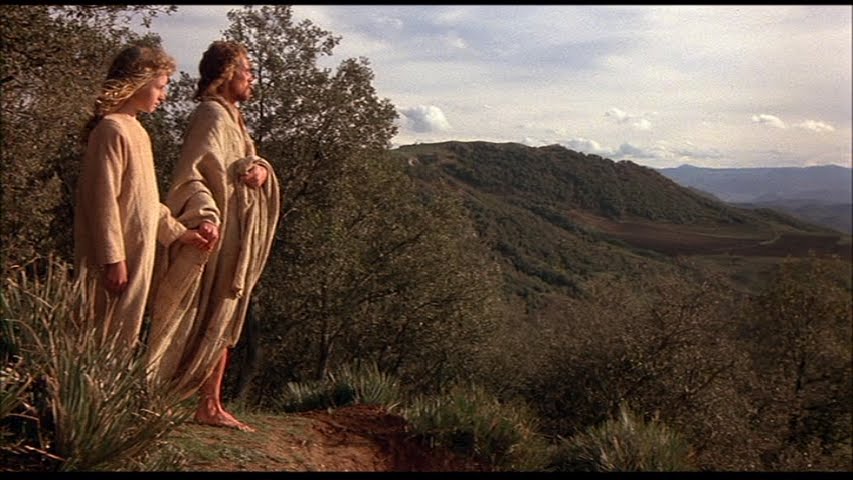 In this earthly paradise of the Satanic temptation, Jesus becomes estranged from the suffering demanded by a deep spiritual understanding of the eternal. The angel tells him, "This is the way the Savior comes. Gradually, from embrace to embrace, from sun to sun. This is the road." In other words, God, the Savior, the eternal, is brought down to earth in a Hegelian way: A linear path of cause-and-effect that is accented in its temporality. "I understand," Jesus responds, ashamed of the "wrong" (and, in this aesthetic light, "embarrassing") ways that he's followed God. In the temptation, God is a gradual coming. But we should note the aimlessness of this earthbound Jesus. He appears lethargic, living from day-to-day, void of the spiritedness and passion that makes him a troubling and attractive figure. Compare this Jesus to the dancing Jesus at the wedding, or the rousing rebel ("The saint of blasphemy!") protesting at the temple. He appears similar to the resurrected Lazarus, who notes, zombie-like, that he doesn't see "much difference" between life and death. He marries Mary, Lazarus' sister, but also has children with Martha, the other sister (reminded by the angel, in a way that recalls Kierkegaard's aesthete Seducer, "there's only one woman in the world.") The reality of existential questions is quashed by living day-to-day. If there is no inwardness regarding the question of the eternal, there is no remark on it. Life is easier, possibly "happier," but episodically going by without spirit and meaning. The reality of death, which connects with key problems of existentialism such as concerned Kierkegaard and the philosophers whom he influenced, is not an issue.
 This is the issue of Christianity. And even if Jesus believes he is free from God, the outside world reminds him that he is not free. One of the film's most interesting scenes involves Paul (Harry Dean Stanton), whom we have seen earlier in the film as Saul of Tarsus, a zealot much like Judas committed to revolution (with disdain for the Nazarene "magician"). He kills Lazarus, proof of Jesus' greatest miracle. Now, Jesus hears himself being preached about by Paul, who claims to have been spiritually changed by Jesus of Nazareth and is now offering the "good news" to all who will listen. "He was not the son of Mary, he was the son of God!" Paul passionately says to those listening. "His mother was a virgin! And the Angel Gabriel came down and put God's seed in her womb – that's how he was born. He was condemned and crucified! But three days later, he rose up from the grave and went up to heaven. Do you understand what that means? Death was conquered. Amen. He conquered death! All of our sins were forgiven, and now the kingdom of God is open to everyone of us, to everybody!" The conquest of death, such as part of the sacrifice of Jesus, brings "death" back into the picture of Jesus' normal life, as it also brings his own identity and life's meaning back to him. This annoys him. He pulls Paul aside and berates the preacher. "I'm a man like everybody else! I live like a man now. I work, eat, have children. I enjoy my life. For the first time, I'm enjoying it!"
 This does not deter Paul. On an objective plane, it doesn't matter who this man says he is, because "the resurrected Jesus will save the world, and that's what matters…Jesus Christ. Jesus of Nazareth. The Son of God. The Messiah. Not you." He then adds, "I'm glad I met you, because now I can forget all about you. My Jesus is much more important and much more powerful. Thank you." Paul emerges as a contradiction. He may have "created" the "Truth," but he is not a manipulator, and seems to honestly believe. Subjective faith becomes much more important, much like in Kierkegaard's universe, than any objective sense with basic knowledge and hard science. Paul resembles the button-molder in Ibsen's Peer Gynt, telling the aesthete Gynt that he's not even significant enough to go to hell, much less heaven. Jesus, meanwhile, crawls back into the arms of his family, pleading, "Don't ever leave me. I'm happy."
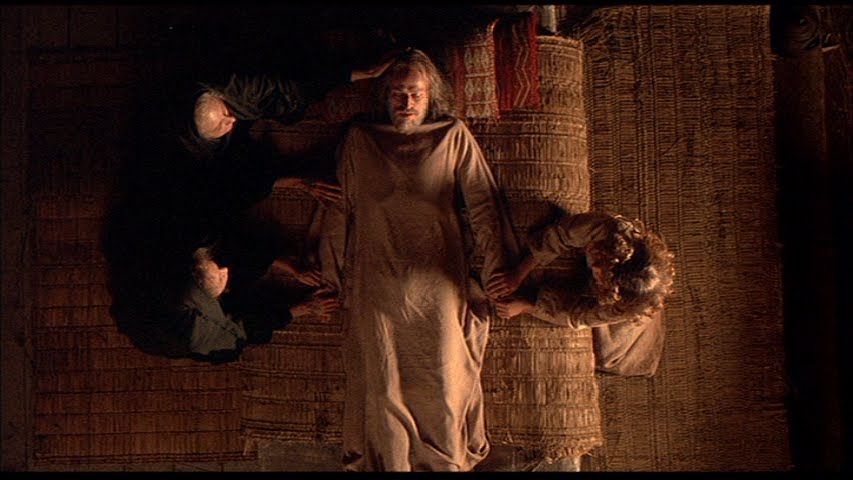 Temporality catches up with Jesus. He is an old man, surrounded by vines that are dying. The angel tells him, "We have to move on. You've grown old. You've done well. We've both done well." Jesus is alone in his old age, insignificant and in a despair. It is not until he is on his deathbed that he must confront the truth of accepting this normal life. It is Judas, who has gone through with his sacrifice (appropriately, blood is on his elderly hands), that comes to Jesus' home and loudly yells, "Traitor!" He revisits the Kierkegaardian theme of how the world of men and the world of God cannot be bridged. "Your place was on the cross. That's where God put you. When death got too close, you got scared and ran away, and hid yourself in the life of some man...What are you doing here? With women? With children? What's good for men isn't good for God! Why weren't you crucified? You die this way, you die like a man."
 Jesus actively chooses to go back on the cross, sacrificing himself. As he struggles up the stairs to the outside world (as Jerusalem burns, indicating that it is probably 70 C.E.), Satan mocks him, "Die. Die like a man." Yet now, Jesus wants to die on the cross and fulfill the will of God, unrestrained in his faith. Back on the cross, in pain, instead of doubt he is full of faith regarding the fulfillment of God's command. "It is accomplished!" he triumphantly exclaims with a smile before dying. The film ends as if it is a celebration of faith in God. Unlike Travis Bickle, Jesus has grown and given himself over to God, suspending himself and his own desires, and doing it with an affirmative smile. He has, unlike the ethical man, shut his eyes and plunged confidently "into the absurd" of Kierkegaard’s Fear and Trembling.