A young married couple is having a difficult time. Some absentmindedness has resulted in an accident, which accelerates long running tensions and unease. It's further exasperated by how the woman runs into an ex-boyfriend on the way over to a getaway romantic hotel. They've dropped their six-year-old daughter off with grandpa. The woman doesn't want to do this; she's an on-call nurse. But the man is insistent. This hotel has fantastically themed rooms – Atlantis, Cupid's Cove, etc – for the guests, in which to revamp their nubile passions and persist in feeling young. They've landed in "The Future Room," a science fiction environment with futurist designs, no windows, and a revolving bed underneath a picture showing an outer space-eye view. The teasing, showering, and foreplay derail into little fights, and ultimately the sex is cut off and denied fulfillment. The woman walks away from the man, now drunk. She locks herself in the other room, or rather, maybe locks him out. He stumbles to the door, and repeats, again and again, "Open the door! Open up!" She won't.

 There is no connection, no discussion, no empathy, and no calm. This is a dead relationship, or if not dead, then mechanical as the designs and references within this, the "Future Room," which the man, after all, described as "a robot's vagina" when they first entered.
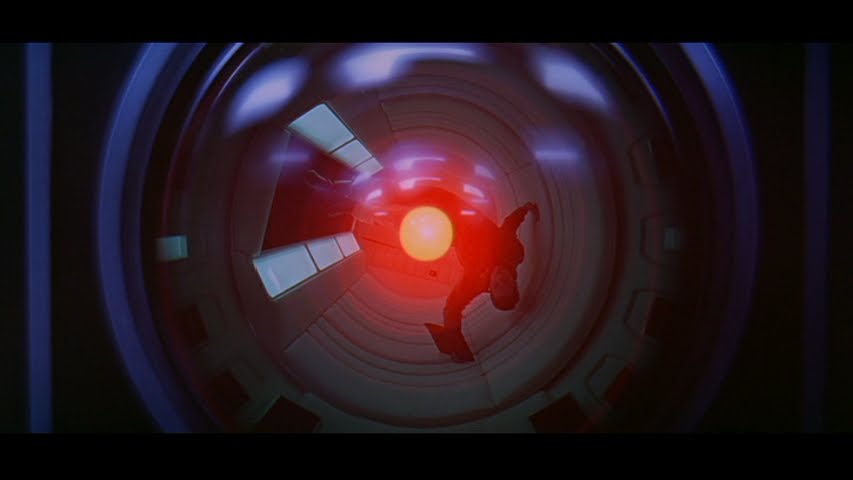
 Derek Cianfrance's Blue Valentine cannot help but to evoke in the watchful viewer's collectively cinematic mind Stanley Kubrick. Certainly Eyes Wide Shut comes to mind, the great dream odyssey into a young married couple's unconscious, not only because of the story of a marriage, but in the beautiful mix of colors with diffuse lighting, particularly blue and red. But the scene of the Future Room evokes 2001: A Space Odyssey. In the guise of a spacecraft, Dean Hiller's (Ryan Gosling) pounding on the door, demanding that his wife Cindy (Michelle Williams) open up, calls to mind poor David Bowman in 2001, repeating to the HAL-9000 computer, "Open the pod-bay doors, HAL," a request that the governing machine will not at all comply with. But beyond that incidental allusion, it also drives into a larger issue when we think about Kubrick's picture, and the context of the Future Room in Blue Valentine. The Future Room is supposedly the Future, not quite different from the Future imagined by Kubrick and Arthur C. Clarke in 2001; they made their prediction in 1968, and as we watch 2001 in the year 2011, we will note how far different the dreams of Kubrick’s Future are from Reality. We see Dean and Cindy's relationship from the moment their eyes first meet until the end, more than six years later, when Dean walks away in a haze of fireworks down a cruddy block. The hope, expectations, ideals, and monuments to the marriage have all shrunk to disappointment. Perhaps the final reflection we would have in comparing Blue Valentine and 2001 is how the lack of empathetic communication and discourse between Dean and Cindy is a microcosm of the disconnect from nature we see in Kubrick's human beings, so distant from their ape-like ancestors in the film's "Dawn on Man" prologue: "robot vaginas" and men asking, out of fear, "What's it mean to be a man?" Blue Valentine goes further, I suspect, in being just the story about a specific couple, however. There is a running motif throughout the picture indicating that Cianfrance sees their romantic decline as being symptomatic of an entire national mindset: America after 2001.
 The places that Blue Valentine takes us are, like with Kubrick, uncomfortable ones. This is not a date movie any more than Eyes Wide Shut was, and it can give a rocky marriage with its unspoken discontents the same sort of awkward ride home that a 19th century couple may have had after viewing a stage production of Ibsen or Chekov, with their portrayals of normal and respectable households weeded with decay. It's even a little horribly unnerving to think that the couple's rotten core and unbalanced foundation is seen so lushly in the film's opening image, their daughter walking through the tall grass. The girl is so beautiful and seemingly innocent, and yet the viewer comes to learn how she came about, and how this pregnancy of dubious origins put two unprepared adults in a place for which they weren't prepared. The circumstances of this marriage's malfunction should give us a bit of hope – Dean and Cindy are not "everymarriage" or "everycouple," and so we have no obligation to identify. But this does not make Blue Valentine any less excruciating to watch. Both the big picture and the small details contain fragments that many will find relatable, and it does not help that Cianfrance is very frank with his sexual politics, which in my experience have never been agreeable to either traditionalists or countercultural radicals: men, who work hard and keep a cool posture, are in fact more needy and romantic; woman, who read romance novels for escape, are often more cold and distant – the sexual quandary of dogs (men) and cats (women), and the sad love that such a see-saw slices into mercilessly.
When we first meet Dean and Cindy, it's on the eve of that Future Room experience, as the child wakes up her daddy to tell him that Megan, the dog, has gone missing. Together they wake up Cindy, desperate for any sleep before beginning her hospital shift. The dynamics of the disproportionate relationship are plain to see: Dean is a man-child, more of a friend to his daughter than a father, eating cereal on the table like an animal with her, playing with a toy horse to which they've added a unicorn's horn. Cindy, on the other hand, administrates, preparing breakfast, driving their daughter to school, and presumably being responsible for a good deal of the income; Dean's job is house painting, which affords him to have a beer or two before going to work, and then having some more when he finishes. But we should also notice that Cindy, though bearing the mantle of responsibility, is not interested in the details. She sees the big picture very clearly, and is geared towards accomplishing that. But she is also careless with the little things: she forgot to lock in the dog; she barely stirs her daughter's instant oatmeal; and she needs to be reminded by Dean to make sure that their daughter's seatbelt is fastened. Her sloppiness incurs Dean's chiding. Fights and hostility ensue.
 Many of the responses to Blue Valentine will have much to say about "who is to blame?" It's a problem in a lot of busted relationships, where one party bears more guilt than the other in taking the blame for the detritus, and I think most perspectives will be taking Cindy's side over Dean's (I was while watching the film). But thinking of the details, and Cindy's carelessness in some matters, to say nothing of a kind of gross selfishness we will see later on, it's difficult to see this in terms of black and white. Both individuals go through their flaws as if against their better natures, unable to prevent their instincts from overwhelming their egos, which is the negative flip side of all love stories. I think that ultimately we may have to bypass our ingrained sense of having to assess blame onto people in watching this movie, which may be one of the lessons of this piteous explosion.
 We flash back to these two people before they knew each other, much younger, more hair on Dean, less weight on Cindy, when they were first wondering about Love. They're drifting through their young lives in expectation for it, whenever it comes. Cindy's not sure if she's had it yet. She's dating a good looking and virile wrestler at college, but still asks her grandmother for counsel. The old woman is candid about the truth; she admits that she probably never loved Cindy's grandfather. Cindy's torn, because she imagines about Love, and cannot think that the virtues of such an emotion would have anything to do with how her own parents treat each other, as we flash to a moment when her father throws his plate on the table to criticize the "shit cooking" of Cindy's desperate-to-please mother. "You just have a feeling," the grandmother says about Love to the granddaughter. "But how do you trust your feelings when they just disappear?" Cindy has to ask.
 Young Dean comes from a different background. He has no education, is a high school drop-out, and has very limited knowledge of his parents, particularly a mother that left his musician father when Dean was a boy. Working for a moving company, he asks his coworkers about Love, and states that he feels men might be more romantic than women. He has his own elderly counterpart in Walter, a war vet he helps move into a nursing home. With care (again, notice his attention to the details at the detriment of doing his job, as we notice his coworkers constantly telling him to stop and get in the truck), Dean has taken all of Walter's photographs and accoutrement from the military and designed a homey environment for the old man, also paying particular close attention to a wedding picture. He asks Walter about this relic, and the now passed-on woman within it. Walter can't really answer coherently, but Dean has scripted his own romantic interpretation in his mind: a sort of peace in love.

 The volatile combination in these two principal characters is simmering. Cindy is looking for a kind of security in love, a knowledge that whomever she's with will be kind to her in a way that differs from her aggressive father and pitiful mother. Dean, meanwhile, is motherless and so then is needy in his pursuit for that maternal figure to take care of him intimately.

 Their eyes finally meet when Dean leaves Walter's room. Cindy, in the room across the hall, had been reading her grandmother a romance novel. Dean sees her, and then we cut to her vantage of Dean, an American flag figuring predominately behind him. His failed flirtation does not deter him from talking about the girl to his coworkers. "I felt like I knew her. It's a feeling," he says. The coworker tells him, "But actually you really don't know her," and says that some "pussy" would cure that longing. It does not matter to Dean, because upon seeing Cindy, he's written her in his mind, which is not unusual for anyone considering their lovers. Dean admits that maybe he's "seen too many movies," but he's too eager to live out his own love story that he sees (or interprets) in Walter's photographs, and his Jungian anima has projected his "Eternal Mother" archetype onto this unknown girl. He knows her as much as he will need to know her. The projection is all that is needed. As Carl Jung himself had said about such a grappling pull, it is useless to resist the anima, because wrestling against it is to wrestle a god. Or, as Dean tells his coworker, "The song comes on, and you gotta dance."
 Love here is about self gratification, driven by basic instincts that demand to be fed, plunging the needy child into a state of infantile helplessness. And luckily for Dean, he's got Cindy in a vulnerable spot. A promising med student who dreams of being a doctor, she is having problems with her wrestler boyfriend, Bobby. As Bobby has unprotected sex with her, he irresponsibly ejaculates inside, which sets her off angrily to the bathroom to clean up. He insists that he didn't mean to; it just "happened." This is one of the pitfalls of a very libidinous male carried away with desire (Bobby makes it clear that he wants all the sex he can get from Cindy), and we have this kind of sociobiological subtext opening up in Blue Valentine, where instincts trump reason. We also notice how passive Cindy is as a sex partner, seeming to carry minimal amorous interest as she's taken from behind here, and later on by Dean in the Future Room, her body lying in a kind of corpse-like submission. Bobby is certainly responsible for his act, but Cindy should not be so passive in her position as a girlfriend and simply allow it to happen (details again). She closes herself off from Bobby, first in the bathroom (as will be repeated with Dean in the Future Room), and then entirely as a girlfriend. He is rendered a needy puppy at her doorstep, bearing flowers and pleading, and finally to jealous rage (the cycle repeats during the entropic stages of her relationship with Dean).
Bobby, for all of his faults, is part of the real world. He's a very tangible person, seemingly down-to-earth, though one can see him being not too unlike Cindy's father someday – a man's man who wants to be pleased. Dean is another sort of creature. Again, maybe he's "seen too many movies," and he's more romantic than most Danielle Steele-reading women, with his artistic temperament and rebel's heart. He finds a leftover locket that belonged to Walter, and goes to the nursing home to return it. But Walter has died. He stops by Cindy's grandmother's room and asks for information about "the girl that was here last week." We next see him on the same bus as Cindy and, seeing how the song comes on, he dances.
 He flirts with her in a brutally honest fashion, knowing that the best way to flirt with a girl is to compliment her in a back-handed way that puts her on the defensive. "The prettier a girl is, the more nuts she is," he tells her, "and you must be completely insane." This assertion, by the way, is not necessarily untrue and we'll discover that Cindy probably has as many issues as National Geographic. She plays along with his flirtation though, and we also gain insight into Dean's character. When the issue of Walter the vet is brought up, Dean is disappointed. "He's dumb for dying. Death and getting old is for suckers." Dean says he's not getting older, and when we think of the man-child six years later, he's right – to a tragic extent. This philosophy of Dean, so idealistic and built up from the world of the Romantic and Filmdom, to say nothing of countless romantic comedies (Say Anything being a definitive example: Lloyd Dobler and Diane Court find their possible outcome in Dean and Cindy Hiller), would be alluring to a young woman struggling with Bobby’s harshness. They're an even match: in Dean, Cindy sees someone who wants to please her. In Cindy, Dean sees a maternal figure from who he will be seeking constant approval. For better or for worse, indeed.
Their first date revels in the unfortunate though playful operation of the subsequent relationship. Dean directs Cindy where to stand, and how to dance as he plays a song on his ukulele, singing "You always hurt the ones you love" in a goofy voice. He even tells her how to place herself, "there, under the heart" hanging on a store window. "Now slow dance to this part."
 I've been in such a place. I imagine many young people have. Love has a kind of established architecture courtesy of movies and books, from the troubadours and Tristan through Dante through Shakespeare, and so forth up to Say Anything and finally Twilight. But the imposition of a script upon reality is tough to carry out, requiring a lot of strenuous work, and usually amounting to nothing. The magic moment here in Blue Valentine is, while not a manufactured magic moment, an aesthetically drawn one. Shakespeare, obsessed with performance, was mindful of Love’s ironies. The Hopeless Romantic sometimes takes a little longer to get in on the rouse. The question is whether one wants the Moment or the Relationship, and we will see that Dean is a man dedicated to a string of moments instead of a deep relationship, when his remedy for domestic unrest is to simply book the Future Room at a romantic getaway.
 Cindy's flaw is in passively going along with it. The early sex scenes between Cindy and Dean are notable for how Dean does not penetrate, but instead performs oral sex on her, a striking contrast to how Bobby aggressively fucks her earlier on. Dean is too focused on pleasing Cindy, who seems to make no movement towards gratifying him. This is a sexual problem that Dean can't stand in the Future Room. He wants sex when she doesn’t, and we could interpret what happens as being a form of rape. While he has sex with her and she lies placidly underneath, he stops and says, "No, stop it. I don't want your body, I want you." But she can't do that for him, even to the extent that she almost masochistically insists that he hit her (something she doesn't want for sexual pleasure, but rather to probably further infuriate and frustrate him).
 The sexual politics of Blue Valentine are much like the dialogical politics. The woman submits both discourse and sexuality to the man, whether it's Dean or Bobby. Dean understands one half of the problem, but his problem is that whenever Cindy tries to engage in a conversation with him, he has to turn it around on her and begin an interrogation ("Shut your beautiful mouth," he tells her during foreplay). However, as with the sex, Cindy's passivity may be seen as an almost unconscious maneuver to belittle Dean: dialogue brings up his lack of fulfilling his potential, which is injurious to him as a sensitive man confused about gender labels ("Be a man? What does that mean?!") An earlier scene has a similar quandary, when Cindy tells Dean that she ran into Bobby at a liquor store. At this point, the audience does not know Bobby's historical relationship to either Cindy or Dean, but in time we will know that whereas Dean is the kind of sensitive, intelligent (however undereducated) man of a post-feminist era, Bobby has no qualms about embracing the stereotypes of his gender, a rollicking and potent man's man – or ladies' man – who only knows how to fuck or beat the hell out of other men. By introducing Bobby into any kind of conversation, Dean has to deal with his own male identity and responds defensively.
 We see how the Hillers' daughter was conceived. Soon after Dean starts seeing Cindy, she discovers that she's pregnant. What more, we can almost be sure that the father is not Dean, but Bobby. When Dean asks if it's his, the audience's kneejerk reaction is to dismiss his question, being that we've only seen Dean go down on Cindy, whereas we've seen actual penetration – and ejaculation – with Bobby (we can also count on the detail-oriented Dean being more responsible with his sperm). Dean will stand by Cindy, though, and goes with her to an abortion clinic. This is one of the film's most difficult scenes to view. The nurses and doctor counsel Cindy, who is often seen in close-up when the procedure begins. We also learn more about her previous intimate life; she lost her virginity at the age of 13, and has since had about 25 sexual partners.
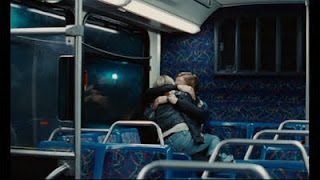 At the last moment, she declines the procedure and the doctor stops. She leaves the office in tears, and Dean is there to hold her. "It's okay," he tells her. "We'll be a family." They tell each other "I love you," and their new life begins. Dean has so given himself in totality to this other person that he will be a parent to someone else's child. This Romantic who never before felt he would be a husband or father takes on both roles with steady dedication, even though this may not be what his partner wants. The circle's ends meet in the Future Room, where a drunken Dean says to Cindy that he wants to make another child, something we at first can only feel as being stupid, until the truth about their daughter's origins comes to light. Dean has been waiting to pass on his own genes – a primal longing that could only have been reinforced after receiving the news that Cindy saw Bobby at a liquor store. Even though Cindy told Dean that Bobby was "old and fat" (which he wasn't) and that he was far from desirable (though I don't think Cindy would trust herself to be alone with him), Dean has to be troubled. Bobby's genes have passed on into Dean's house, and even if Dean loves the child with more compassion than Bobby could ever provide (and probably Cindy), it doesn't change the cold truth. We learn that a vengeful and jealous Bobby kicked Dean's ass in a fit of rage, an attack that Cindy couldn't prevent. This is why Dean is hurt when he is told to "be a man."
 That masculine rage backfires with Dean after the Future Room experience. In a drunken stupor, he wakes up to find Cindy missing. She's gone to the hospital. Though she left a note, Dean is too enraged and selfish to be empathetic to it. He goes to find her, hounding her at her clinic with a few interruptions from a fellow nurse ("Don't let him brainwash you!") When the doctor, Cindy's boss, arrives to break up the argument, Dean transfers his frustrations onto him. The doctor is the calm administrator who threatens to take Cindy away from him (indeed, the doctor has his own selfish and sexually driven motives). He punches the doctor in the face, an act of unchecked aggression that perversely doubles for Bobby's more sustained and practiced assault on Dean years earlier. Whereas Bobby can get away with his aggression, Dean – like Shakespeare's sexually inadequate and gender-confused Macbeth, the definitive poor performer who over-analyzes what is happening around him – cannot. The moment his rage is emptied, he understands what he's done. Cindy is fired because of it, on the spot.
 After the demands of his ego are fulfilled and Cindy makes it clear that everything's over, he pleads for her, saying that he's "fighting for his family," asking her to tell him "how I should be." Such pathetic neediness will never be answered with gratification, and we're left with the blankness of two people, who have devotedly given themselves up to time in a way so as to sacrifice their dreams. Having the baby, marrying Dean, and starting a family, Cindy's hopes of being a doctor have dwindled. She devotes herself restlessly to her nursing practice, compartmentalizing her work life in a fashion separate from her family life (the offer for an out-of-town promotion is never brought up at home). Dean has given all sense of his individuality to his role as husband and father, being a minimal provider with talents. What's left between them were the promises of their marriage vows – for better or worse – the kinds of things that jilted and dumped partners always bring up as the world collapses around them. That's only the script, the words, the assignment of roles. She's similarly devoted to the assignment of roles, in terms of social markers and success. He's picked their song, "You and Me" by Penny and the Quarters, and while she dances and smiles along with the melody, it's Dean who assumes the female chorus in the tune. At the end, he leaves the script, leaves the movie, walking into the fireworks on the Fourth of July.
 The Movies are Heaven, after all. When the Hillers discover that Megan the dog has been hit by a car and killed, Dean consoles the daughter by saying, "Megan's gone to Hollywood to be a movie dog." The real world may not be big enough for the ideals of film. This goes back to the brutal sense of scripting love affairs, when someone may address the Wuthering Heights problem. Women dream of Heathcliff, but they typically end up with Edgar. Kate Winslet can have ecstasy with Leonardo DiCaprio in Titanic, but he’s at least polite enough to die, so that she can marry rich and have several children, living happily with her memories tucked away and waiting for her in death.

 Maybe that strikes some people as sounding bitter, but maybe it's also calm and humored restraint, in perceiving the spidery relations between women and men. In Eyes Wide Shut, it's Dr. Bill (Tom Cruise) who is insistent at the end that their now-conscious enlightenment leads to a "forever." Alice (Nicole Kidman) is the one who shakes her head. "No. Don't say that word. It frightens me." The Harfords in Kubrick's Eyes Wide Shut may be awake from the unconscious dreamworld at the conclusion, but the knowledge they have courtesy of hidden carnal desires does not necessarily reflect an enlightened growth, or ensure security in the future. In fact, it seems to promise a thinner wire of stability, hanging above a cesspool of volcanic lava and uncertainty: Love has no Fail-Safe.
 Bringing up Kubrick before directly launching into my thoughts on Blue Valentine is appropriate, not only because Eyes Wide Shut is one of the definitive pictures about relationships, but because Kubrick was always interested in the problem of the future, of planning, of expectations and ultimately the problem of contingency, something of which a chess master like Kubrick was very conscious, whether in a perfect heist (The Killing), nuclear war (Dr. Strangelove), or a good marriage. This is the haunting resonance of the Future Room hanging over every Valentine's dinner. The arms of Love are not as secure as we would hope.
 The theme is universal, though Kubrick is admittedly from another time. His marriage to Christiane Harlan was apparently a very happy one of nearly 40 years. However, it was also his third marriage, her second, and he first had the inclination to make a movie about the problems of marriage – Arthur Schnitzler's Dream Story – at around their seven-year-itch period in the mid 1960s. The material was familiar to both of them, and hit an intimate nerve, as Christiane has said that she did not want him to enter Schnitzler's world (reading Frederic Raphael's Eyes Wide Open, a memoir about Kubrick, one gets the sense that Kubrick's imposed isolation outside of London and far from Hollywood, was to continue having a successful marriage away from the orgiastic and debaucherous temptations in the entertainment world, just as much as it was to create his own production facilities far from the studios).

 Derek Cianfrance, Michelle Williams, and Ryan Gosling are from another generation, one perhaps even more confused. These are the children of the first divorced generation (when the percentages hit well above 40%, I think), who simultaneously were no less nourished on ideals of romance and love, perhaps even more so. The expectations have not been lowered by history, but there is a sense that history, the flaws of our parents, may be corrected, just as history may be corrected on a sociocultural level by nations. There is another subtext in Blue Valentine, the American one, perfect for reflections on the “future” in that hallmark year of 2001, which gave us 9/11. The color scheme seems to be predominantly blue with some red and white thrown in, and there are several American flags decorating the background at important instances. In the present day, Dean is wearing a bald-eagle shirt. Their song we hear at their daughter's recital is "Yankee Doodle Dandee" along with “America the Beautiful.” On their first date, we see them walk past a US flag, and Cindy sings a song that showcases her memorization of all the American presidents. And then there are those fireworks into which Dean walks at the conclusion.
 Cianfrance makes nothing declarative about this subtext, though it is unavoidable and we should probably take particular note of it when thinking about these characters. They represent the last ten years, an American youth that is bold, believing it will never die, headstrong and idealistic to a fault. Dean's sensibility of "never getting old" is not unlike any number of prosperity preachers, while Cindy's devotion to work at an almost apathetic expense to her family seems to reference a kind of popular economic sensibility. These are lost children to a post-revolutionary period, struggling to swim on the promises of freedom and life, liberty, and the pursuit of happiness. Instead of freedom, there is hostility, blame, coldness, apathy, nitpicking, resentment, confusion, neediness, and a kind of emotional imprisonment that is irresistible, so invested are our emotions and ideals. Both performers, Gosling and Williams, have already made two of the greatest portraits of this hopeless generation in a world becoming more mechanical and estranged from its dialogical ideals (Gosling in Half Nelson; Williams in Wendy and Lucy). In Blue Valentine they are the marriage of that brave new world of reckless abandonment, blurred love, and selfish melancholy. Maybe this is a kind of sad love that the world shouldn't see, and it certainly doesn't want to see, particularly when that sadness goes beyond the intimate microcosm, and extends to the social sphere of American flags and the intergalactic Future Room. Our own movie-love leads us to the Cupid's Cove of countless other kitschy romantic comedies starring Jennifer Aniston and Matthew McConahey, year after year. Perhaps that kind of easy-way-out, Cianfrance is indicating, mirrors the actions and mentality leading to the social and political entropy in our nation, and the technological informatics of this global age. We're looking for escape in the future room, which is ultimately nothing but a simulation of our love dreams, "a robot's vagina": to once more recall 2001: A Space Odyssey, Life Functions Terminated.