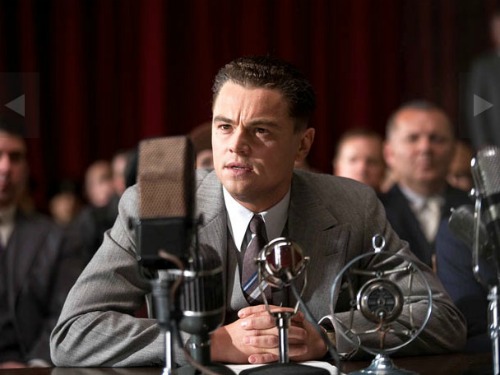
J. Edgar is an incomplete film, appropriate considering that its subject is an incomplete human being. J. Edgar Hoover (Leonardo DiCaprio), America’s face of crime fighting for nearly 50 years, was the definitive bureaucrat, married to his job and desk, and to the official documents which, for him, defined reality and recorded history in lieu of private motives and nuanced interests. Hoover had perhaps strategically arranged the breadcrumbs of his life so that the key to his enigma never could be found. We only have speculation, some of which is drawn from unreliable rumors peppered with giggling innuendo. Clint Eastwood’s film of Dustin Lance Black’s screenplay treats Hoover’s lack of essence as a self-imposed erasure. His life was not one to be lived but to be filed – and shredded. The outward official self that espouses the document-as-reality, is essence for Hoover, who sought to secure the gears of a running mechanical device, his notion of a country and world where individuals fulfilled their functions without a private life invading the public. Among his rules at the Bureau of Investigation -- in addition to strict punctuality, having no facial hair, being well-dressed, and possessing a college degree -- was the stipulation of no personal photographs at the agents' neatly arranged desks. A job at the Bureau did not involve the fulfillment of individual goals, but lifelong dedication to the institution. The feeling of J. Edgar is not, as Andrew O’Hehir accuses, that Hoover was a human worthy of some pathos, but rather how his tragedy is that he wasn’t, or couldn’t allow himself to be, human. Instead of acknowledging very basic desires, namely his homosexuality, J. Edgar Hoover hides behind a mask, from a speech pattern used to cover up a stutter, sequences of names (John, Edgar, J. Edgar) to clear his credit, to authoring a memoir strewn with fabrications. As a character, J. Edgar Hoover joins a list of filmic forebears with a link between repressed sexuality and fascism. His forceful will to dominate others stems from his own inner unease.
 Moving back and forth between several decades, with particular focus paid to the first twenty years of Hoover's career and the final ten, the Bureau administrator tries to verbally justify his existence. In 1919, an anarchist bombs the home of Attorney General A. Mitchell Palmer, part of a coordinated attack on various civic leaders during a tenuous moment in history. Hoover is explaining the nation's very real state of fear, during a time when radical thinkers like Emma Goldman and Luigi Galleani were intellectually justifying the "propaganda of the deed." At the same time there were union and race uprisings, with several voices on the left believing that now was the time to grab the momentum which had just taken hold of Russia, the largest nation state in the world. By May Day, 1920, Palmer nurtured an anxiety that America, as most comfortable citizens and statesmen had known it, was coming to an end. The threat was so great, that thousands of people had to be arrested not for their deeds, but for their ideas.
 The same apocalyptic trembling irritates Hoover decades later. For him, Martin Luther King Jr. is conjoined with a Soviet threat that will eat America up from the inside out. Hoover insists to the present Attorney General, Bobby Kennedy, that communism must be snuffed out by any means necessary. Ignoring the threat, Hoover warns, can put Kennedy's brother, the President of the United States, in the same danger that A. Mitchell Palmer found himself in 1919. Bobby has a longview not possessed by Hoover, who will never acknowledge the unethical broach of civil liberties that 1920's subsequent Palmer Raids were. "Communism in 1919 is different from communism today," Kennedy says. Communism is, after all, an idea, and if one possesses radical thoughts, how can they be interrogated for them in a free country? King is an influential voice in a time of proliferating information and media images. The television, as King's Nobel acceptance speech will show, has surpassed Hoover's monomaniacal possession of information.
 In his Salon.com piece, O'Hehir accuses Eastwood of sanitizing Hoover. The film "implies that, on the one hand, he wasn't a very nice man but, on the other, he was an actual human being who suffered pain." For O'Hehir, a key flaw is that the film fails to take a clear position on its subject. In another Salon piece, Mark Feldstein complains, "Eastwood distorts the historical record, [omits] facts about Hoover’s ruthless abuse of power, and even [sanitizes] the infamous cross-dressing rumors involving America’s top cop." There's no mention of the FBI's smear of Jean Seberg, the second Red Scare, or Hoover's infamous list of citizens who would be interred in camps if the Cold War became Hot. The film underplays the warranted idea that J. Edgar Hoover was a pinch away from being a dictator, or a villainous Iago twisting the minds of several presidents and an entire nation, who substitute for the naive Othello. It's distasteful to some that J. Edgar is capable of being empathetic to this figure, with so many deliberate omissions to the whole history, which is perhaps evidence of Hollywood's sterile handling of troubling material, or maybe even a byproduct of Eastwood's light political conservativism. This was the man who, as Dirty Harry, bypassed due process and civil liberties to keep people safe from the bad guys, after all.
  But it's transparent to me that J. Edgar's omissions are deliberate, and maybe even make the film increasingly alarming when we apply Hoover's methods and beliefs to the way modern day pundits continue to spin things, for example linking Occupy Wall Street protesters to Al Qaeda sympathies, as the blog of comic book artist Frank Miller grotesquely did last week, his words seeming to mimic J. Edgar Hoover's thoughts. The protesters are the same, but the Soviet Union is replaced by Islamic terrorists. J. Edgar Hoover, obsessed with Form the same way Gustave von Aschenbach is in Death in Venice, constructs the narrative of American history, which is to say his own history. Eastwood and Black set out to frustrate us by declaring through Hoover's number two man and suspected lover, Clyde Tolson (Armie Hammer), that many of the flashbacks we've been seeing are fabricated. Personal memory and Hollywood narrative are similarly delusional. At the beginning of the picture, Hoover’s ghostwriter, the first of many anonymous faces in identical suits, asks about specific details. “Let’s leave that to the reader’s imagination,” Hoover answers. “The important thing is drawing the line between the protagonist and the antagonist." Hoover authors the clarity distinguishing hero from villain, penciling incidents and details that never happened. He commands images and the stage to shape public opinion, being able to draw James Cagney, star of The Public Enemy, a new mask after Alvin Karpis' arrest in 1936, as the face of The G-Men. He exploits the Lindbergh kidnapping for the solidification of his power and scientific techniques, and at last, in the film J. Edgar, he convinces you that there was a white horse at the Karpis arrest when there wasn't.
 J. Edgar Hoover's structural ideals, in terms of public policy and personal appearance, reflected each other. The prevalent motif of mirrors suggests how the country’s policies are Hoover’s reflection, his aesthetic posing and checking itself in a mirror. Recklessness had to stamped out, be it Pretty Boy Floyd or a suit in the office that was “too colorful.” He fastened himself in a clean, well-fitted blanket of womblike security, from living with his mother (played by Judi Dench) until her death, burrowing into perfectly tailored suits, or having clockwork lunches and dinners with Clyde Tolson. But machines, their processes stuck to maintaining a non-stop present, get old. They malfunction. They change, die, and are replaced. Eastwood and Black’s conception of Hoover, nicknamed “Speedy” because of his staccato speech patterns, refuses to obey Time. When his mother dies, his pathological need for her to remain materializes in a dramatic moment of putting on her dress and necklace, then staring at a mirror before collapsing in grief. After Tolson suffers a stroke and is beset by motor skill ailments, the perky Hoover cruelly demands his best friend enunciate properly and be "back to work tomorrow.” And when an aging Hoover finds himself vulnerable to exhaustion, he becomes addicted to administered shots for pep.
 The resistance to aging, something pertinent to director Eastwood (an 81-year-old averaging a film every 1.5 years with few signs of slowing down), first struck me when young Hoover strides up his house-steps and is accosted by a shaky old man on his porch. We can barely make out the plea, “Help me, Edgar!” Hoover walks away from the unkempt figure, whose crazed eyes belong to a man torn apart by impulses. The old man, we learn, is his father, who was also a lifelong public servant, but succumbed to "Nature" and ended his days in an asylum. The father’s absence of control is something the son, in his drive to not be his father (look at him when his mother says, “You don’t want to become your father, do you?”), will tame. Formal perfection is a denial of Nature, just as Oscar Wilde saw Art as a rebuke to Nature (and there's certainly an affinity between Wilde's Dorian Gray and J. Edgar Hoover). When the helpless old man goes to his room, Mrs. Hoover asks if Edgar would put him to bed. Edgar walks away, and the old man’s existence is erased from the rest of the picture. The omissions in the film lurk like ghosts, be it the meaning of Hoover Sr.’s madness, the identity of Hoover’s older brother (referenced, but never shown or explained), or the dinner table presence of Hoover’s niece, whose flowery place in the scene craves an explanation, origin, or destination – but is given none. J. Edgar Hoover represents a refutation to organic unity in favor of a machine's dressed-up defiant will.
 Hoover displays his Machine-Man goals on a date with a new secretary, Helen Gandy (Naomi Watts), describing for her a coded book indexing system at the Library of Congress. Gandy asks Hoover to find a book on "indiscretion," and he finds one in a little over a minute. She then asks how he knew that she wanted a book on "political indiscretion." This is subtly interesting moment, because all indiscretions are processed as political for J. Edgar Hoover. The constraints of his mind will not let the privately human modality of being, particularly regarding indiscretion, to be acknowledged. His mechanical efficiency compensates for his ineptness as person. He awkwardly tries to plant a kiss on Gandy, and after that fails, nearly proposes marriage. He lacks all natural ease, but Helen Gandy still becomes a perfect mate. She tells him that she is not interested in a husband and considers herself devoted to work. This is splendid for Hoover, considering that his courtship had less to do with erotic attachment than with socially appropriate convenience. Gandy becomes his loyal personal secretary. The ring on Hoover’s finger was given to him the night of his promotion, wedding him to his beloved Bureau – not another person. One of the attorney generals for whom he works notices this, pointing out, “You have no social life. No wife, no girlfriend, no pals.” Hoover is not offended by the observation, and agrees in a way that suggests his modality is the most correct form of living for a working man. Hoover performs a part he has scripted, masking his tempestuous longings the same way his affected speech covers up a stutter. As he says to a mirror, using a mantra he used to cure himself, “I’m a proficient, remarkable lad capable of noble feats.”
 The private, or "natural" instinctive self, is something corrupted that has to be stamped out, be it a sexual neurosis or a stutter. His work as a fact-finding investigator, using machines to plug and steal away the private mysteries and sins of others, is his distraction. Hoover tells Gandy to imagine a card or print index that’s not for books, but people. And with every citizen entered into this centralized reference system, flesh and blood reduced to numbers and dashes, nature reformatted to a mechanical template, crime fighting will become vastly more efficient. What’s significant here has less to do with the skeletal plans for a social security number or Hoover’s vision of finger-printing, but how Hoover’s notion of identification, or “identity,” immediately associates with guilt. Hoover is unable to be sexual, and so he obsesses over the intimate lives of others, his excuse being that these private moments may affect public policy. We see him deliver a transcript to Bobby Kennedy, which details President having sex with an East German communist. Personal indiscretions are political indiscretions, a theme that, along with Tom Stern's murky Gordon Willis-like cinematography, evokes the dichotomy of "It's not personal, it's strictly business" from The Godfather. Hoover's political monstrosities are tidily buffered with the officiated cover-letter of impersonal documentation, but they are thorns stemming from personal drives.
 Among the film's omissions that have upset some critics is Hoover's racism, but I don't know if making it more overt would trivialize Hoover's delusions, being that the film is mainly told through his jaundiced eye. Hoover assuages notions of prejudice by bringing up, to an African American ghostwriter (who opens the blinds in Hoover’s office, a significant action), how he arrested a Ku Klux Klan leader -- for a very trivial reason, but the “best” reason that Hoover had at his disposal, so he claims. His latent racism is stirred into him from childhood, as his mother talks about dismissing a house maid, adding that “the whole black race is in an uprising." The "trouble" with black servants follows Hoover into old age, when he complains about how his own maid is unable to make his food correctly. The blacks are fine, as long as they know their place, shut up, and boil eggs correctly. This form of racism is conveyed in Eastwood's film, and its latency stings precisely because it is still rampant.
  For Hoover, Civil Rights were inextricably tied to radical political movements. Alongside the anarchist bombings of 1919 were race riots throughout the country, started by white men, but largely blamed on blacks. During the Cold War, a sign of having communist sympathies was being friendly with Negroes. Hoover's hatred for Dr. King relates to how King was an antagonist that swayed the emotions of whites in Middle America. He couldn’t be slandered, even with Hoover’s most nefarious methods. J. Edgar looks at the obsessed surveillance of King, and we see Hoover listening with concentrated and morbid intensity to recordings of King's sexual trysts. He has an unhealthy fetish for his prey, evidenced by the tapes of King, the transcripts of Eleanor Roosevelt, Robert Kennedy's fireplace, and the hat and eyeglasses of John Dillinger, which open the film.
 I am reminded of a moment in Nicolas Roeg's Bad Timing, where the research psychoanalyst played by Art Garfunkel lectures a class about voyeurism. Addressing the "secrecy of spying" we see two a pair of "political voyeurs" projected behind him: Joseph Stalin and J. Edgar Hoover. He points out, "The guilt-ridden voyeur is usually a political conservative." Hoover’s identity is his guilt – the sexual longings of what his mother derides as being a “daffodil.” Trapped in his suits and eccentrically affected speech, he is not free, and so neither should be anyone else. He wears masks in his conformity and flight from sexuality, a trait we can see in other political films about fascism, where the oppressor stomps out the ideological – and sometimes sexual – freedom of others: Bertolucci’s The Conformist and 1900, Costa-Gavras’ Z, Visconti’s The Damned, Pasolini’s Salo or the 120 Days of Sodom, Paul Schrader's Mishima, Sam Mendes' American Beauty, and even Oliver Stone’s JFK. In Nixon, Stone’s sequel-of-sorts to JFK, Hoover (played by Bob Hoskins) appears as a predatory gazer and controlling homosexual, unnerving the similarly unnatural Nixon (Anthony Hopkins) just as he controls him. In Stone's political mythology, JFK represents a global vision, a liberation from the stifling congestion of Cold War isolation. Characters like Nixon, Hoover, Clay Shaw/Bertrand, and Richard Helms are sealed off and secretive. When Pat Nixon makes a sexual advance to her husband, he declines, saying "I'm not Jack Kennedy." The same frustrated humidity is in Dan White (Josh Brolin) from Dustin Lance Black's previous screenplay, Milk, another man never at ease in his skin, certainly when compared to openly gay Harvey Milk (Sean Penn), the political leader he will eventually assassinate.
 Eastwood’s film is reticent about the nature of Hoover’s sexuality. As Stone seems to indicate that Hoover is, much like Clay Shaw (Tommy Lee Jones) in JFK, publicly closeted but privately sexually active, Eastwood’s Hoover, though definitely gay, is unable to come to terms with his sexuality, a kind which he would detect and label as deviant in others, Eleanor Roosevelt being the most ridiculed example. His first sight of Clyde Tolson is enthralled attraction, and Hoover seems at war with his mechanical determinism in the process of interviewing and hiring a dashing man who is similarly willful. Tolson charmingly calls Hoover out on the push-ups he does before their primary interview, inquiring about the Bureau's decree on exercise, then silently handing Hoover, whose chair is stooped up with books to make him appear bigger, a handkerchief. During a vacation getaway as the two are rooming together, Tolson discloses his love, but Hoover pulls away and asks for advice on a Hollywood actress that he would make his wife, a scenario better than fiction considering how the marriage would indeed be a performance. Tolson is greatly angered, but Hoover explains that he doesn’t want to be incomplete. “Is that what I am to you? Incompletion?” Tolson yells, calling Hoover “a miserable little man.” The truth hurts enough to get a violent reaction from Hoover, who fights back physically with a feeble punch. Soon the two of them are wrestling on the ground. Tolson plants a kiss on Hoover, who scowls, “Don’t ever do that again.” This is a loving relationship, but the implication is that it's unconsummated, even if the desire was acknowledged.
 Hoover's job as Administrator carries out any sexual drive. In the one moment when Hoover expresses doubts (“Do I destroy everything that I love?”), Ms. Gandy assures him that “his child” – the Bureau – is good. But it isn’t, by virtue of its steel-headed DNA granted personhood by an unnatural person. Hoover's progeny is out of touch, and its framed virtues are reactionary measures that impede any progress or development. At the end of J. Edgar, we hear some Hoover voiceover that would appear to be taken from his dictation. He talks about the value of love in our nature, and how much more important it is than those feelings which divide us. But it’s an utterance of trickery, contradicting everything we know and have seen about the character. If we are moved and convinced, we are susceptible to the Machine, like we were fooled by the white horse. Eastwood and Black’s point is to show just how self-righteous and deluded Hoover was. In his darkest hours – and Hoover was the blanketing darkness of 20th century America – Hoover steadfastly believed he was acting in the right with the best interest of others. In fact, he was feeding the emptiness of his murky shadow, plugging his libido into an impersonal electricity.
 The sentiment towards the end of the film, scored to Eastwood’s own middling music, is a marked flaw, evidencing that a more formally ambitious director should have made Hoover's story. Indeed, Eastwood's reputation as a passive director not concerned with details is a marked difference from Hoover, and J. Edgar would maybe be a more artistically successful venture (if not as easily digestible one) had the borderline OCD temperaments of Martin Scorsese, David Fincher, and Michael Mann been at the helm, or maybe the kaleidoscopic chaos of Oliver Stone and Paul Greengrass. Eastwood's easy-going style doesn't necessarily “humanize” Hoover, but it feels too simplistic for a man so dizzying and complex. J. Edgar falls onto tragic biopic tropes of self doubt and the ghost of fulfilled love between the two main characters, and it fails to convince. The film's ultimate detriment reminds one of a similar DiCaprio protagonist, damned to isolation and obsessed with control, the Howard Hughes of The Aviator. That remarkable film’s form, particularly in editing and music, exuded from Hughes’ maladjusted chromosomes. One could feel Hughes become unhinged in his fatalistic malfunction.
 But DiCaprio’s absorbing characterization is still enough to make J. Edgar an uneasy affair. Rarely has such an unattractive character been a hero (or feature-length villain) for 135 minutes. Only towards the end do we ever see this character exposed, as a shirtless corpse that tumbled off his bed. Tolson stumbles through Hoover’s room of brawny Hellenistic statues, photographs, and ornaments that express an inner life stowed away in a cocoon, far from the light. The first thing to which Tolson takes notice is the closet, and then the sumptuous room dividers to hide a man dressing and undressing. Tolson then takes the bed blanket and covers his companion, guarding him from exposure the same way Ms. Gandy is doing in her secret office, shredding Hoover’s files into oblivion. The sadness of J. Edgar Hoover is not tied into the mystery of the man, as we have with Charles Foster Kane and his “Rosebud.” Rather, the sadness is that a man must keep such mysteries in the closet, for fear of being a “daffodil.” This repression leads to a plethora of masks while casting the accusing light on the secret lives of others. The homophobe hates what he sees freely expressed and growing in others. Tolson weeps for Hoover while reading the the forbidden sentiments of two of their victims, Lorena Hickock and Eleanor Roosevelt. Hickock's words -- "I remember your eyes with a kind of teasing smile in them, and the feeling of that soft spot just northeast of the corner of your mouth against my lips" -- are appropriated by these two villains. The lasting insight is that the tyrannical perpetrator fears his victim because in his prey he sees a mirror revealing the forbidden self, and in that reflection lay the missing particles that would make such as J. Edgar Hoover a complete person. Instead, like his official biopic, he’s stuck on a script that he’s substituted for reality, which is arguably the destiny for the country he created. The denial of love for a devotion to the machine is an absurdity, displayed the moment when Gandy is called by Hoover's maid with news of his death. The illogical functionality of Hoover's system plays out as she logs, for a man now dead, that the housekeeper has called. For many, Hoover is hatred, intolerance, and paranoia. J. Edgar shows that Hoover also represents Nothingness.